
call_end

  • rss_feed
    add Follow

    Torrent Freak

    people 382 subscribers • TorrentFreak is a publication dedicated to bringing the latest news about copyright, privacy, and everything related to filesharing.

    • chevron_right

      Google Invokes First Amendment to Shield Gmail Users from Piracy Subpoena

      news.movim.eu / TorrentFreak • 12:13 • 4 minutes
    google Flava Works is an Illinois-based adult entertainment company specializing in content featuring Black and Latino men.

    The company has pursued copyright infringers aggressively for years, including a $1.5 million damages award against a defendant who shared its films on BitTorrent and a high-profile clash with an unnamed television executive that was eventually settled.

    Last March, Flava, together with Blatino Media, filed a new lawsuit targeting an alleged Canadian leaker of its videos alongside 47 John Doe defendants. The rightsholders claim the maximum of $150,000 in statutory damages from each defendant, bringing the total damages claim to over $8 million.

    This case stands out from the typical torrent lawsuits as the defendants were identified by their usernames on the private torrent tracker GayTorrent.ru, where they allegedly shared the pirated videos.

    Today, nearly a year has passed since the case was started, and most of those Doe defendants still haven’t been formally named. According to Flava, that’s largely due to one company: Google.

    Google Rejects Broad Subpoena

    In a status report filed this week, Flava informs the Illinois federal court of the progress thus far. The company reports that it signed a confidential settlement with one defendant, while several others were named and formally served. However, most defendants are still “John Does.”

    According to an affidavit filed by Flava’s president, Phillip Bleicher, they can’t properly name the defendants because Google raised objections and refused to fully comply with the subpoena. This, despite complying with an earlier subpoena in a similar case.

    Initially, Google incorrectly claimed the subpoena was issued by a pro se party. After Flava provided documentation that a licensed Illinois attorney had signed it, Google requested a copy of the complaint. That was provided in early December.

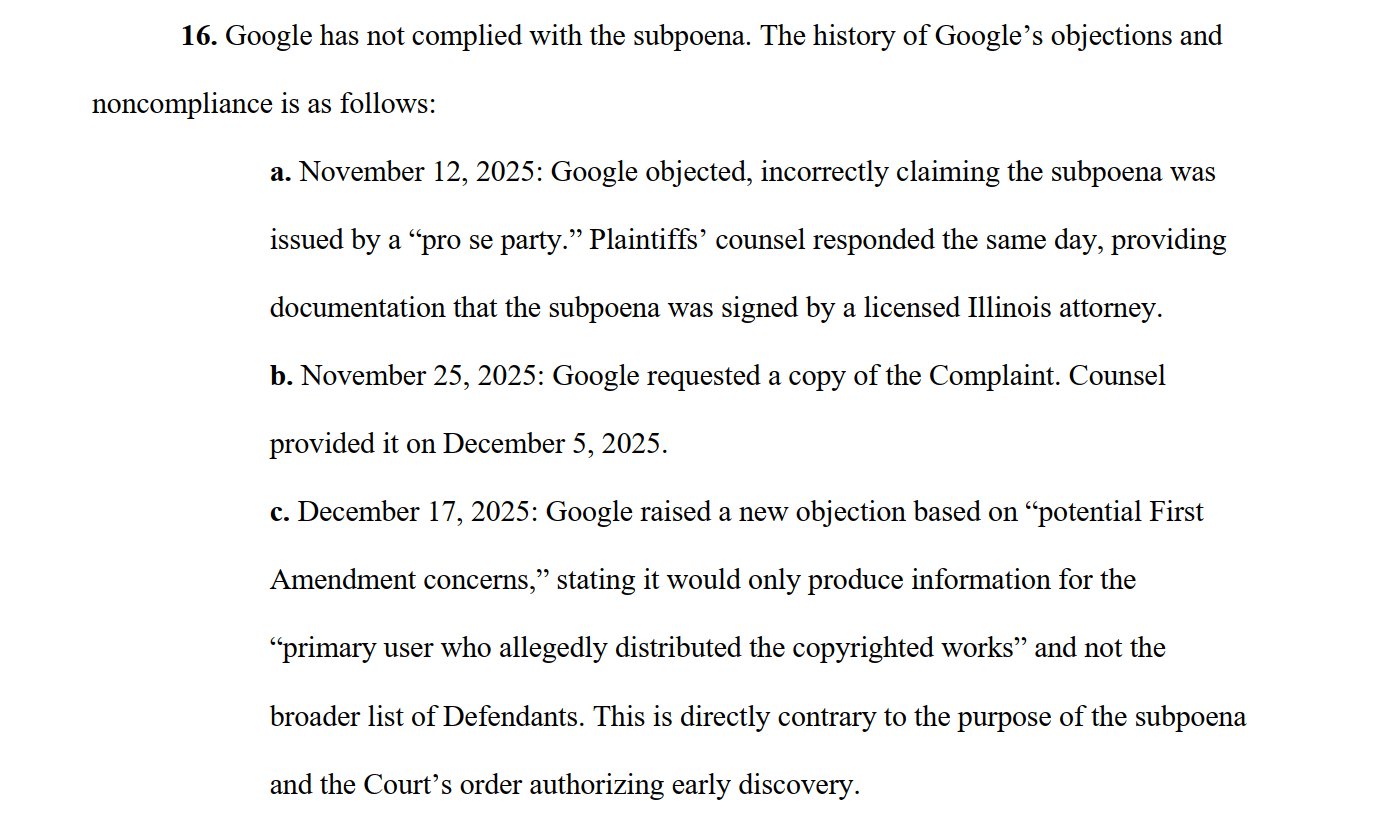
    Shortly after, Google formally objected, raising “potential First Amendment concerns,” while stating it would only provide data for the “primary user who allegedly distributed the copyrighted works,” not the broader list of “John Doe” defendants.
    Google objects

    googleobject

    Google’s objection affects 28 defendants whose primary or sole email addresses are Gmail accounts. Without Google’s subscriber data, Flava says it cannot confirm their identities with sufficient certainty to name them in the lawsuit.

    How Flava Identifies Its Targets

    It is unclear what Google means exactly by raising First Amendment concerns. The company may believe the John Doe defendants are not necessarily direct infringers, a question that touches on how they were identified in the first place.

    The complaint does not explain this. Typically, rightsholders identify torrent pirates by joining a swarm, collecting IP addresses, and subpoenaing ISPs to match those IPs to account holders. In this case, however, Flava already had usernames and email addresses before any court-ordered discovery.

    One possible explanation is that some of these defendants were also paid subscribers on Flava’s own platforms. Membership sites log IP addresses at login. So, if the same IP that appeared in the GayTorrent.ru swarm also appeared in Flava’s own server logs, the company could have linked a torrent username to a registered account and its associated email address entirely from its own internal records.

    Wrongly Accused Pirates

    Critics of BitTorrent lawsuits have long argued that IP addresses do not reliably identify individuals. In this case, Flava makes that same argument in its own favor, using the risk of misidentification as a reason for Google to hand over subscriber data.

    The affidavit acknowledges that an email address alone is not sufficient to confirm an identity either. In at least one instance in a related case, a subpoena response pointed to someone who turned out not to be the infringer. The email address had been used by someone else, and the identified individual contacted prior counsel to clarify the error.

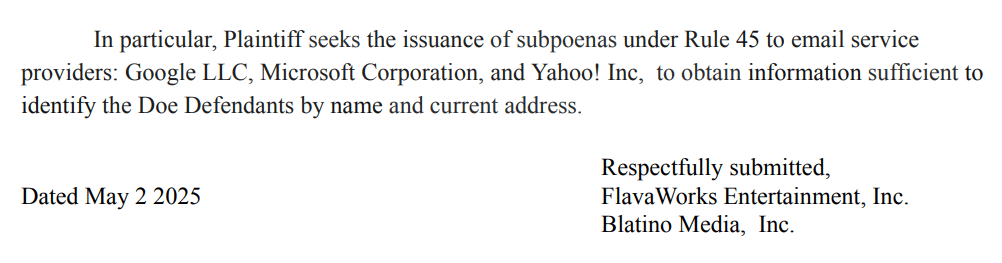
    To avoid naming the wrong people, Flava needs both Google and Microsoft to comply with their subpoenas, which seek information sufficient to identify the defendants by name and current address.
    From the discovery motion

    disco motion

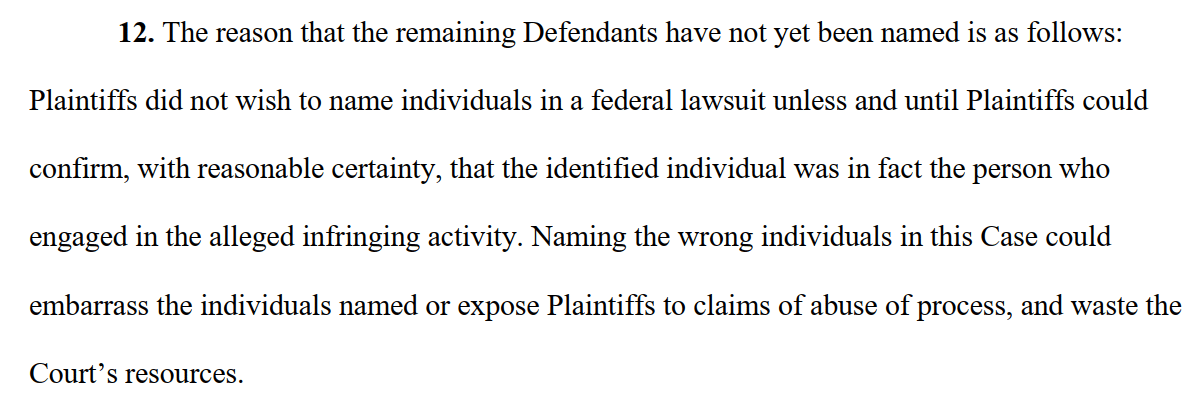
    “Naming the wrong individuals in this Case could embarrass the individuals named or expose Plaintiffs to claims of abuse of process, and waste the Court’s resources,” the affidavit cautions, using the fear of wrongful accusations squarely in its own favor.
    Naming the wrong person

    justified

    What’s Next

    The legal paperwork notes that Microsoft, which also holds data for some of the remaining defendants, indicated it is willing to comply with its subpoena if there is an agreement on fees. Flava’s counsel is working to finalize those terms.

    For the moment, however, the case for the 28 Gmail-linked defendants is effectively on hold pending Google’s cooperation. Flava says it is prepared to file a motion to compel if Google does not respond, but that hasn’t been filed yet.

    If a motion to compel is filed, Google is expected to explain its stated First Amendment rationale in more detail. Then, it will be up to the federal judge to weigh the arguments from both sides.

    A copy of the status report, filed at the United States District Court for the Northern District of Illinois, is available here (pdf) . The supporting affidavit of Phillip Bleicher can be found here (pdf) .

    From: TF , for the latest news on copyright battles, piracy and more.

    • chevron_right

      WordPress.com Flags Concerning Spike in AI-Generated DMCA Takedowns

      news.movim.eu / TorrentFreak • 1 day ago • 4 minutes

    wordpress spam Automattic, the company behind the popular blogging platforms WordPress.com and Tumblr, has been documenting DMCA takedown abuse for well over a decade .
    Over the years, the company has highlighted how automated systems flood platforms with inaccurate or incomplete notices. These errors and mistakes are par for the course now, and Automattic even launched its own Hall of Shame to ‘honor’ the worst offenders.

    In recent years, it appeared that takedown issues had stabilized somewhat. However, the latest transparency report, covering July through December 2025, shows that challenges remain.

    2,431 Notices, 86% Rejected

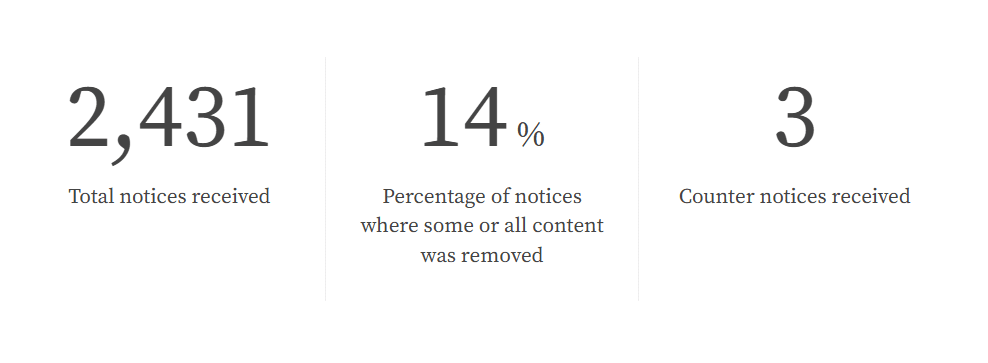
    This week, the company published its latest WordPress.com transparency report , revealing that it processed 2,431 takedown notices during the second half of last year. That is a 20% increase compared to the same period a year earlier.

    This data only applies to the number of DMCA notices that are directed at WordPress.com services. It is also worth noting that these notices can contain multiple URLs, making the number of flagged URLs much higher.

    2025: Jul 1 – Dec 31

    totals

    While the takedown volume is substantial, that’s not necessarily indicative of a copyright infringement problem. According to Automattic, 86% of all takedown notices were rejected entirely due to various shortcomings.

    The rejection rate for WordPress.com takedowns has always been high. Since Automattic began counting in 2014, the platform has processed a total of 123,211 DMCA takedown notices. Of these, only 27% have ever resulted in any removal.

    AI-generated DMCA Notices

    Over the past half year, however, Automattic saw the rejection rate tick up further due to a new phenomenon: AI-generated DMCA notices.

    “We are seeing continued exploitation of the DMCA notice-and-takedown system by third-party monitoring services—in some instances, through the use of AI-generated mass reporting methods,” Automattic’s Trust & Safety team notes.

    According to the blogging platform, copyright infringement reporters use AI en masse , presumably to lower costs and maximize revenue.

    Automattic specifically calls out the company Enforcity, which was by far the top takedown sender with 838 ‘inactionable’ notices in the second half of last year, which represents 34% of all notices sent in that period.

    AI-Driven DMCA content protection

    enforcity

    Speaking with TorrentFreak, Automattic’s Head of Policy and Process, Steve Blythe, says that the first notices from Enforcity started coming in around August of 2025. These claimed to protect OnlyFans creators, but none of the reported links were associated with infringing material.

    “The targets included both static pages with no content, and dynamic search query URLs with keywords pre-filled by the complainants that returned no results. This caused a significant amount of work, as our team manually reviews such notices to screen for abuse,” Blythe says.

    “As of September 2025, we contacted Enforcity directly a number of times to make them aware of the issue, but despite assurances that the problems would be addressed, the notices continued.”

    Automattic believes that this automated activity is largely driven by payment structures that value volume over accuracy. In January 2026, Enforcity was still sending hundreds of notices, but after repeated outreach, no new DMCA notices came in over the past weeks.

    Example of an “Inactionable” AI Notice

    The “infringing” URL is simply a dynamic search query. It contains no hosted content and returns a “No results found” page on the WordPress platform.

    Reported Copyrighted Work:
    https://onlyfans.com/jane_redacted

    Claimed Infringing URL:
    https://[wordpress-site].com/search/jane_redacted

    $29 / Month

    Explicitly naming a sender isn’t a step that’s taken lightly, but Automattic says that it is important to call out abusive behavior, especially when it takes up valuable resources.

    TorrentFreak reached out to Enforcity for a comment, but at the time of publication, the company has yet to reply. If a response comes in, we will update our article accordingly.

    For now, public information confirms that the company offers AI-Driven DMCA content protection starting at $29 per month . The service indeed targets creators, specifically those on OnlyFans, for which it created a dedicated success hub .

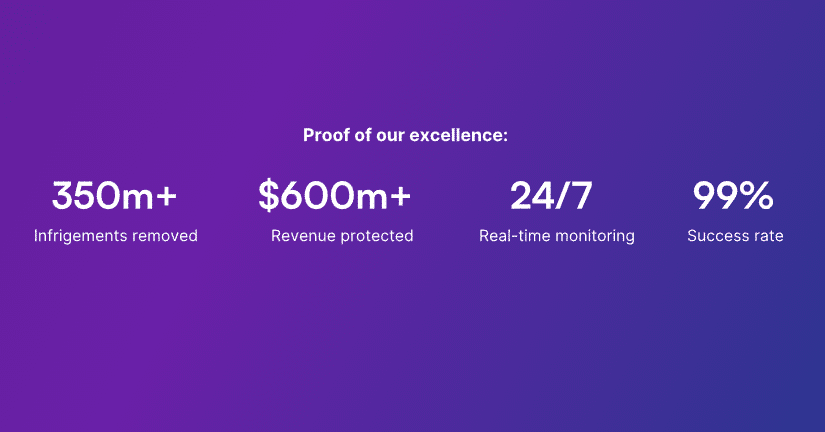
    According to Enforcity’s own website, the takedown service helped customers to remove over 350 million ‘infringements,’ with an impressive 99% success rate, while protecting $600 million in revenue in the process.

    TorrentFreak was unable to verify any of these numbers independently.

    proof

    Regardless, Automattic says it will continue to call out abusive or error-prone reporters, including those who use AI tools.

    “The DMCA notification and takedown process is a powerful tool that enables creators to have control over the use and dissemination of their work. However, it is also frequently abused,” Blythe tells us.

    “We routinely see invalid and inappropriate submissions from third-party agents that charge creators to scour the web and fire off automated notices, seemingly indiscriminately. With the rapid development of AI technology, the flaws in the DMCA are at risk of increasingly resulting in a chilling effect on freedom of expression,” he adds.

    For now, it appears that Automattic’s repeated outreach has had some effect, but whether Enforcity and similar services will change their practices in the long run remains to be seen.

    From: TF , for the latest news on copyright battles, piracy and more.

    • chevron_right

      Meta Employee Deleted 9TB of Torrented Files, Adult Film Producers Claim

      news.movim.eu / TorrentFreak • 3 days ago • 3 minutes

    moviegen In July 2025, adult content producers Strike 3 Holdings and Counterlife Media filed a copyright infringement lawsuit against Meta.
    The complaint accused the tech company of using adult films to assist its AI model training. Similar claims have been made by other rightsholders, including many book authors .

    This latest case, with over 350 million dollars in potential damages, specifically focuses on Meta’s BitTorrent activity that was recorded in detail through proprietary torrent tracking software. That’s no surprise, as plaintiff Strike 3 is the most active copyright litigant in the United States, known for targeting thousands of alleged BitTorrent pirates based on similar evidence.

    Meta responded in October by filing a motion to dismiss , arguing the sporadic downloads were consistent with ordinary ‘personal use’ by employees and visitors on the corporate network. It was certainly not a coordinated AI training effort, Meta countered.

    ‘Meta Employee Deleted 9TB of Torrented Files’

    The motion to dismiss remains pending and, meanwhile, the case is heating up in other areas. Last week, the parties filed their joint discovery plan, which Strike 3 used to raise a rather eye-popping allegation.

    Meta said that it prefers to delay written evidence discovery requests in this case until the court ruled on its motion to dismiss. However, Strike 3 would like to start gathering evidence right away, fearing that key data may otherwise disappear.

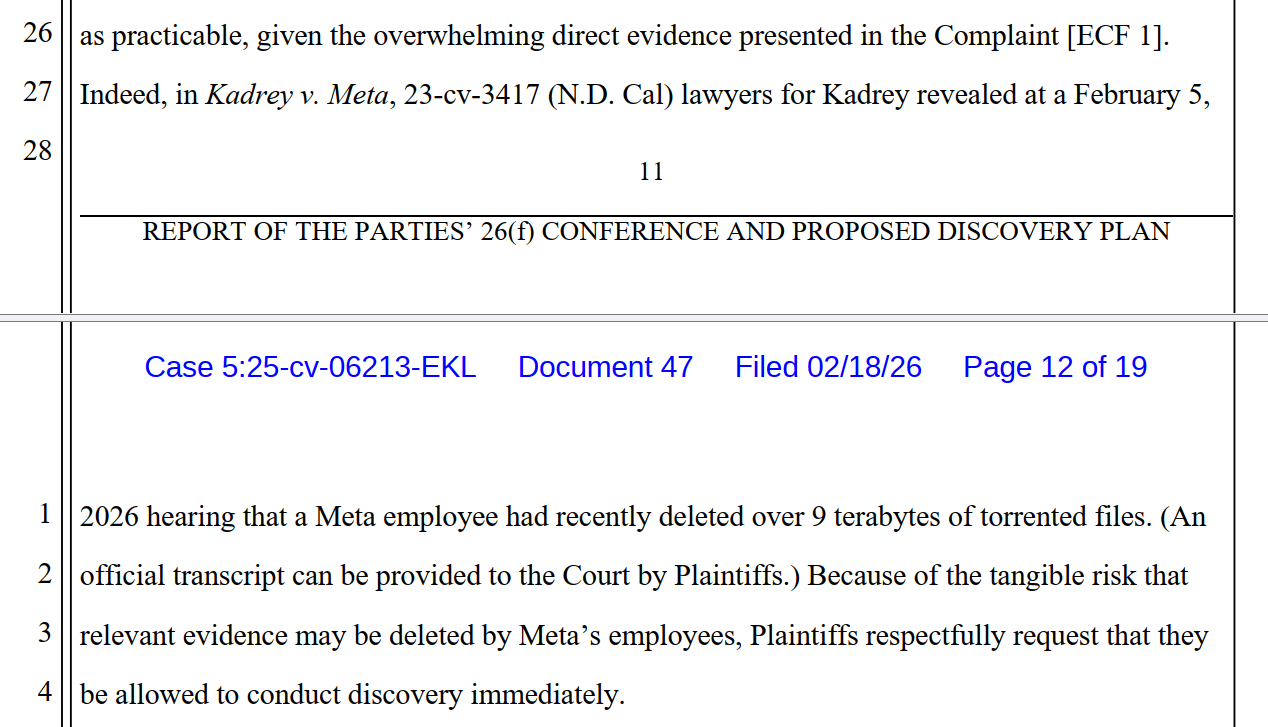
    Strike 3’s legal team points out that, at a February 5 hearing in the unrelated Kadrey v. Meta book-authors case, lawyers revealed that a Meta employee had recently deleted over nine terabytes of torrented files. Fearing more deletions, Strike 3 asks the court to allow discovery in the present case to begin immediately.

    “Because of the tangible risk that relevant evidence may be deleted by Meta’s employees, Plaintiffs respectfully request that they be allowed to conduct discovery immediately,” the plaintiffs write.

    Deleted?

    kadrey delete

    In the same filing, Meta’s legal team immediately tried to defuse the deletion claim. Meta says that no data was spoiled and clarified that it will preserve all evidence as it is legally obliged to do.

    “Plaintiffs mischaracterize the Kadrey record. There was no spoliation in Kadrey, which is an unrelated case, and in any event Meta has an appropriate hold in place and is abiding by its preservation obligations,” Meta writes.

    Torrent Evidence

    The discovery plan also provides the clearest picture yet of what Strike 3 actually wants to find. Among the targets is Meta’s Machine Learning Hub “ML Hub,” including downloaded digital media files, torrenting-related metadata, and labeling data for content acquired from BitTorrent.

    Strike 3 also wants logs of Meta servers communicating over “PySpark or Fairspark protocols,” suggesting it believes these tools were used to coordinate downloads across Meta’s infrastructure. Separately, the company is seeking records tying Meta’s alleged hidden “off-infra” IP addresses to Amazon Web Services instances.

    The discovery list is broad by design, and the above are just a few examples. In essence, Strike 3 wants all policies, directives, and algorithms related to torrenting. They hope that this information will help to back up their copyright infringement claims.

    Meta’s Defense & Trial Date

    While Strike 3 references thousands of downloads, Meta stresses that the complaint only mentions 157 downloads from Meta’s corporate IP addresses over seven years. They note that this is illustrative of personal use, rather than an organized data collection effort.

    Meta also explains that the alleged downloads began years before it started researching generative video AI, making a coordinated training effort even more implausible. In addition, Meta says that Strike 3 has “no facts whatsoever” linking it to the thousands of additional third-party IP addresses that are named in the complaint.

    While Meta’s motion to dismiss is still unresolved, both parties are also looking ahead. While they differ on the exact timing of various deadlines, both believe that an eventual trial can take place in the first half of 2028, if it gets to that.

    A copy of the parties’ 26(f) discovery plan, filed at the U.S. District Court for the Northern District of California, is available here (pdf) . We will add a copy of the transcript as soon as we notice that it is publicly posted.

    From: TF , for the latest news on copyright battles, piracy and more.

    • chevron_right

      Belgian Pirate Site Blocking Order Targets Cloudflare and Google, But Not Their DNS

      news.movim.eu / TorrentFreak • 4 days ago • 4 minutes

    cloudgoogle Belgium has become one of Europe’s most active testing grounds when it comes to pirate site-blocking enforcement.

    The country’s two-step system , where a court issues an injunction and a government department ( BAPO ) then determines how it is implemented, has resulted in a series of diverse site-blocking orders since the framework launched in 2025.

    An Eclectic Site Blocking Push

    The first order, obtained by sports broadcaster DAZN in April 2025, started quite aggressively. It required ISPs and third-party DNS resolvers, including Cloudflare, Google, and Cisco’s OpenDNS , to stop resolving over 100 pirate domains. If not, they would risk a fine of €100,000 per day.

    Cisco refused to comply with the order and instead pulled OpenDNS out of Belgium entirely. Cloudflare and Google remained in Belgium and cooperated, though each did so in its own way.

    A second blocking order followed in July last year, requiring various intermediaries, including ISPs, hosting companies, and payment services, to block shadow libraries . Initially, Internet Archive’s Open Library was also targeted, but this decision was eventually reversed after the U.S. non-profit agreed to geo-block certain content on its service.

    Meanwhile, Cisco reportedly appealed the initial site-blocking order and returned to Belgium. While this appeal remains ongoing, the Belgian site-blocking machine didn’t stop.

    Last November, an order obtained by Disney, Netflix, Sony, Apple, and others , targeted popular movie piracy sites, including 1337x and Soap2day. Notably, this order only applied to Belgium’s five major ISPs. DNS resolvers were nowhere on the list , likely due to Cisco’s appeal.

    First IPTV Blocking Order

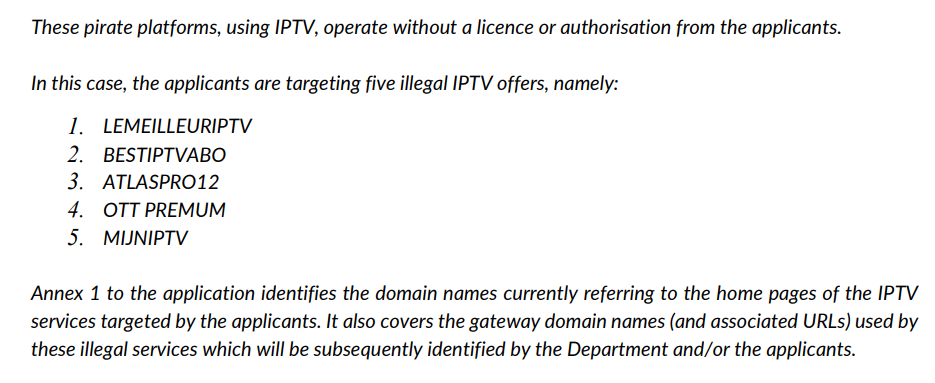
    A new order, issued by the Court of Brussels, targets five illegal IPTV services: LEMEILLEURIPTV, BESTIPTVABO, ATLASPRO12, OTT PREMIUM, and MIJNIPTV. The order was obtained by Belgian broadcasters RTL Belgium and RTBF, whose broadcasts were distributed by these services without permission.

    IPTV targets
    iptv block

    The implementation decision, published by Belgium’s Department for Combating Infringements of Copyright and Related Rights Committed Online (BAPO), described the IPTV services as “structurally dedicated to the mass infringement of audiovisual content”.

    #2e7d32;padding:15px;margin:20px 0;font-style:italic;color:#444;"> Note: While the BAPO implementation order does not explicitly name the rightsholders, it lists specific content from RTL Belgium and RTBF . Both broadcasters confirmed obtaining an IPTV blocking order against Belgian ISPs at the Brussels court earlier this month.

    According to information shared by the rightsholders, the services used cryptocurrency, which they see as a sign of illegality. In addition, the IPTV services showed users how to circumvent blocking measures.

    All in all, the implementation order requires Belgium’s five major ISPs, Proximus, Telenet, Orange Belgium, Mobile Vikings, and DIGI Communications, to block domain names associated with these IPTV services. This also applies to mirror sites and redirect domains that can be added to the blocklist in future updates.

    Cloudflare and Google Are Back, But Not for DNS

    The ISPs will have to use DNS-based blocking measures, as is standard procedure in most countries. However, DNS blocking measures are not requested from Cloudflare and Google, which are also covered by the injunction.

    The order names the American tech companies as intermediaries and requires them to help stop the IPTV services through other routes.

    Specifically, if Cloudflare acts as a CDN or hosting provider, it must take measures to prevent Belgian users from accessing the named IPTV services. Crucially, Cloudflare’s DNS resolver and WARP service are not covered.

    Google is not required to block the domains on its DNS resolver either. Instead, Google must de-index the relevant domains from its search results, deactivate associated Google Ads, and block access through Google Sites and Google Cloud services where applicable.

    This omission of any third-party DNS restrictions is almost certainly not accidental. Cisco’s appeal of the April 2025 order resulted in a Brussels court suspending enforcement of the DNS blocking requirement, allowing OpenDNS to resume operations in Belgium pending a final ruling.

    With that legal challenge still unresolved, rightsholders appear to have opted for a more defensible scope, targeting Cloudflare and Google in their roles as infrastructure providers rather than as DNS operators.

    Exploring the Blocking Limits

    The latest blocking order shows how Belgium’s blocking regime continues to calibrate itself in real time. Each new order is seemingly shaped by the legal and practical fallout from the last.

    #e0e0e0;padding-left:20px;margin:25px 0 25px 10px;font-size:0.95em;line-height:1.5;font-family:sans-serif;">

    April 2025: Initial DAZN order aggressively targets ISPs and third-party DNS resolvers. Cisco pulls OpenDNS from Belgium.

    July 2025: Second order requires various intermediaries to block shadow libraries.

    Summer 2025: Cisco appeals; court suspends DNS blocking requirement, allowing OpenDNS to return.

    Nov 2025: Broad order against movie piracy sites applies strictly to ISPs. DNS resolvers are omitted.

    Current: Broadcasters RTL & RTBF obtain IPTV blocking order. Cloudflare and Google are targeted, but are not required to block DNS.

    Whether the broader DNS blocking orders will return depends in part on how Cisco’s appeal resolves. A ruling against DNS blocking obligations could permanently reshape the scope of future Belgian orders, and there may be even broader repercussions.

    Increasingly, European countries are granting ever more far-reaching pirate site blocking orders, covering a broad range of intermediaries, including DNS resolvers, but also VPN providers.

    While these orders have been given the green light in France, Spain, and elsewhere, they are not uncontested. Given what’s at stake, the European Court of Justice will likely be asked to weigh in eventually to lay out the ground rules.

    A copy of the latest blocking implementation order, published by the Department for Combating Infringements of Copyright and Related Rights Committed Online, is available here (pdf) .

    From: TF , for the latest news on copyright battles, piracy and more.

    • chevron_right

      ProtonVPN Fights French Pirate Site Blockades, But Court Rejects Overblocking Fears

      news.movim.eu / TorrentFreak • 5 days ago • 4 minutes

    protonvpn Earlier this week, a Spanish court ordered ProtonVPN and NordVPN to block pirate LaLiga streams on their networks.

    The VPN providers were not involved in the legal proceedings, and the orders were granted without a defense. In fact, ProtonVPN learned about it from news reports and questioned its legal validity.

    While the Spanish order made headlines due to its novelty, France has seen several of these orders already. This includes two new decisions issued in late January, where ProtonVPN fought back tooth and nail but still lost.

    ProtonVPN Faces Two New Blocking Orders in France

    The Paris Judicial Court issued two separate orders on January 28 and 29, both targeting Proton AG individually as the sole defendant. Both cases involved various rightsholders, including Canal+ companies, who sought to protect their interest in sports broadcasts.

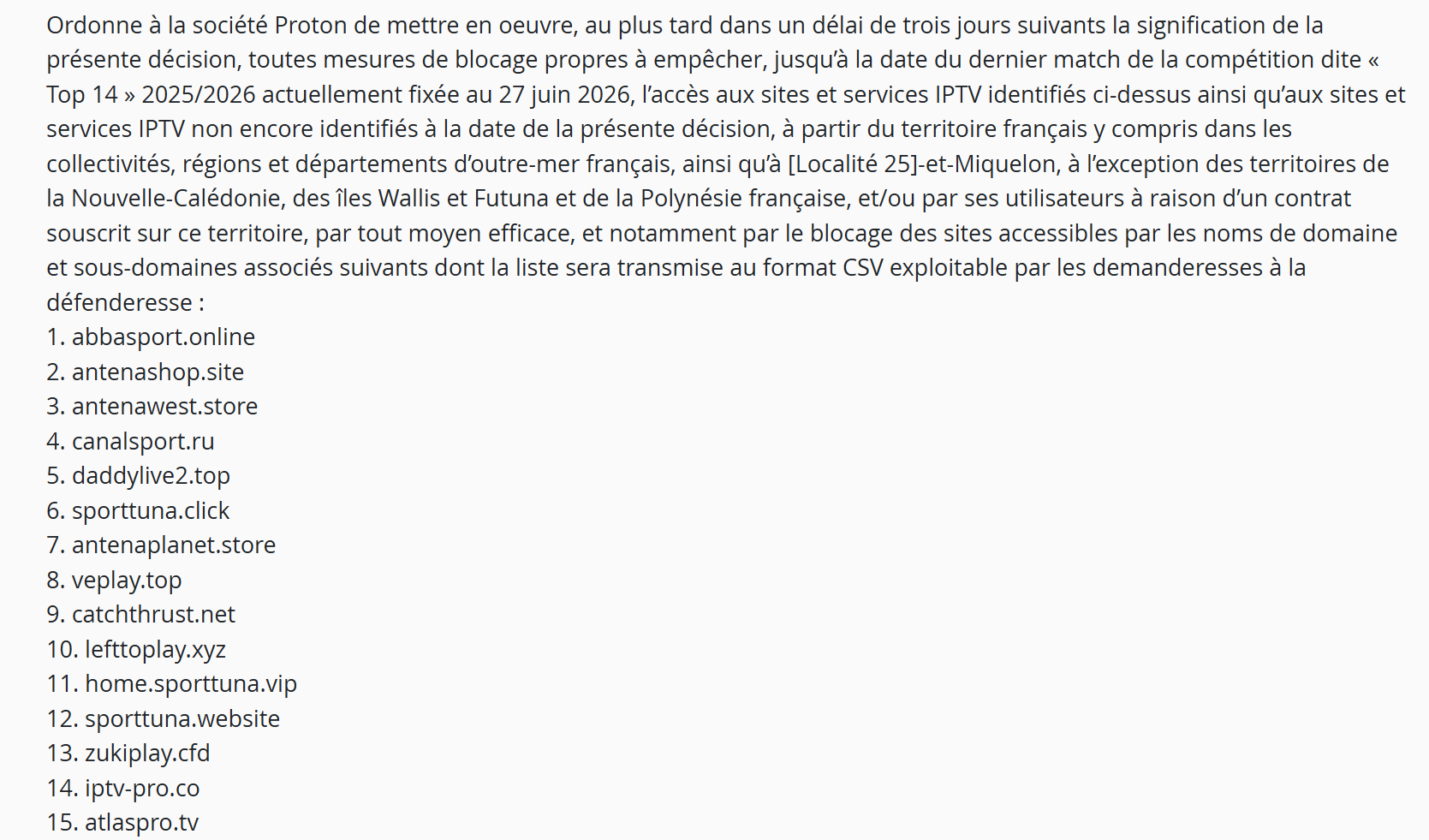
    In one case, they want ProtonVPN to block 16 pirate sites ( full list here ) that streamed Premier League matches, and the other case targets the same number of domain names, focusing on sites that stream the Top 14 Rugby competition.

    From the Rugby case

    The Paris Judicial Court ultimately granted both orders, which is in line with previous blocking injunctions. In the Rugby case, one domain was excluded from the blocklist due to an oversight; the court noted that the URL tested during the investigation didn’t match the domain name Canal+ actually requested to be blocked.

    Feature Premier League Case Top 14 Rugby Case
    Case Number RG nº 25/12499 RG nº 25/10983
    Plaintiffs Canal+ entities Canal+ entities and the Ligue Nationale de Rugby (LNR) as intervener
    Targeted Content Premier League (2025/2026 season) Top 14 Rugby (2025/2026 season)
    Domains Targeted 16 pirate domains 16 domains initially listed (one rejected)
    Duration of Block Until May 24, 2026 (end of season) Until June 27, 2026 (end of season)

    ProtonVPN Fought Back Hard

    While Proton was excluded from the legal process in Spain, the Swiss company was allowed to defend itself before the Paris court. This is precisely what it did, with the VPN provider raising a wide variety of defenses.

    The VPN provider raised jurisdictional questions and also requested to see evidence that Canal+ owned all the rights at play. However, these concerns didn’t convince the court.

    The same applies to Proton’s net neutrality defense, which argued that Article 333-10 of the French sports code, which is at the basis of all blocking orders, violates EU Open Internet Regulation. This defense was too vague, the court concluded, noting that Proton cited the regulation without specifying which provisions were actually breached.

    “Under these circumstances, the argument is unfounded. There is no basis for granting Proton’s subsidiary claim of non-compliance with European law,” the court concluded.

    Additionally, Proton argued that forcing a Swiss company to block content for French users restricts cross-border trade in services under the WTO’s General Agreement on Trade in Services . The court dismissed this argument, as the proposed blocking measures are limited in scope and duration, which should be allowed under the WTO agreement.

    Overblocking Concerns Dismissed

    Proton’s defense didn’t stop there; the company also argued that the blocking measures are technically unrealizable, costly, and unnecessarily complex.

    Crucially, the VPN provider argued that a block cannot be technically restricted to France. Therefore, forcing the company to block these domains in France would effectively force an international, global blockade, which is highly disproportionate to the localized rights Canal+ holds.

    The Paris Court was not swayed by these technical and cost-related concerns, including the fears of a global blockade.

    “It must be noted that no quantifiable and verifiable technical evidence corroborates the technical difficulties of implementation cited by the defense,” the court concluded.

    The Battle Continues

    While ProtonVPN was allowed to defend itself, unlike in Spain, the end result is similar. The VPN provider has to block access to the 31 domain names.

    That said, the court didn’t grant Canal+ everything it asked for. The broadcaster wanted ProtonVPN to publish the ruling on its website for three months, but the court concluded that this would unfairly put the VPN provider in a bad light, disproportionately associating it with the pirate sites. Canal+’s €30,000 cost claim didn’t survive either.

    Both orders are dynamic in nature, meaning that rightsholders can report new pirate domains or mirror sites directly to ARCOM, the French media regulator. After ARCOM verifies these new domains, ProtonVPN has to add them to their blocklist.

    The legal battle over VPN blocking is far from over yet. Proton previously said it would take VPN blocking to Europe’s highest court.

    Meanwhile, however, French rightsholders show no sign of slowing down. These two Proton orders came alongside a parallel Google DNS blocking order for the same Premier League domains, as well a massive ISP blocking order covering 150+ IPTV domains.

    At this point, the question isn’t whether French courts will keep ordering VPN blocks. They will. The question is whether Europe’s highest court will eventually set any limits or not.

    Copies of the court orders (in French) are linked below, alongside all targeted domain names.

    Premier League Case (16 Domains):

    – abbasport.online
    – antenaplanet.store
    – antenawest.store
    – daddylive.dad
    – foot22.ru
    – miztv.top
    – tous-sports.ru
    – andrenalynrushplay.cfd
    – vidembed.re
    – bleedfilter.net
    – alldownplay.xyz
    – catchthrust.net
    – 4kultramedia.fr
    – smart.stella.cx
    – franceiptvabonnement.fr
    – slayvision.xyz

    Top 14 Rugby Case (15 Domains):

    – abbasport.online
    – antenashop.site
    – antenawest.store
    – canalsport.ru
    – daddylive2.top
    – sporttuna.click
    – antenaplanet.store
    – veplay.top
    – catchthrust.net
    – lefttoplay.xyz
    – home.sporttuna.vip
    – sporttuna.website
    – zukiplay.cfd
    – iptv-pro.co
    – atlaspro.tv

    (Additionally, here is the simultaneous Google DNS order that targets the same 16 Premier League domains, and the massive ISP order targets roughly 150+ domains tied to seven major IPTV operations).

    From: TF , for the latest news on copyright battles, piracy and more.

    • chevron_right

      Ukraine Paves the Way for Pirate Site Blocking, Despite Ongoing War

      news.movim.eu / TorrentFreak • 20 February 2026 • 3 minutes

    ukraine Every year, the Office of the U.S. Trade Representative ( USTR ) invites governments and copyright holders to share input for its Special 301 Report , which identifies countries that fail to protect copyrights.
    For many years, Ukraine was a regular entry on this list, seen as a safe haven for pirate sites by rightsholders. The IIPA, for one, called for sanctions and the suspension of trade benefits , while the MPAA and RIAA routinely flagged Ukraine-hosted sites in their annual filings.

    In previous years, Ukraine has made progress on the anti-piracy front, but, since Russia’s full-scale invasion in February 2022, the USTR has suspended its annual review of Ukraine . The country had other, more existential priorities, after all.

    However, that hasn’t stopped Ukraine from taking steps forward. In a 25-page submission ahead of the 2026 Special 301 Report, the Ukrainian government details a broad range of IP reforms it has pursued despite the ongoing war.

    Paving the Way for Site Blocking

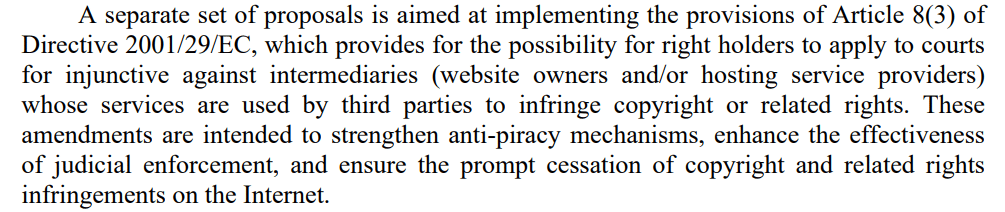
    Among the most notable items in Ukraine’s submission is a set of proposed copyright amendments that would implement Article 8(3) of the EU’s Copyright Directive (2001/29/EC). The provision allows rightsholders to seek injunctions against intermediaries whose services are used by third parties to infringe copyright. This essentially is the framework for Europe’s ISP site-blocking efforts .

    While Ukraine is not part of the European Union, it informed the U.S. that it will use this EU framework for the planned amendments, which are “intended to strengthen anti-piracy mechanisms, enhance the effectiveness of judicial enforcement, and ensure the prompt cessation of copyright and related rights infringements on the Internet.”

    Notably, Ukraine’s submission doesn’t explicitly mention ISP blocking, but cites website owners and/or hosting service providers instead.

    From Ukraine’s Submission

    ukraine

    The proposals are part of a broader package of copyright amendments, which bring Ukraine’s policies in line with EU directives. Other changes address additional compensation for authors and performers, and an extension of the term of protection for performances and phonograms to 70 years.

    A Decade of Broken Promises?

    Ukraine has proposed site blocking legislation before. In October 2015, the Cabinet of Ministers approved a draft law that explicitly included provisions for “restriction of access” to infringing content, along with heavy fines for non-compliant services. At the time, officials said that the bill was designed to avoid U.S. economic sanctions and bring Ukraine’s legislation “into line with EU countries.”

    That law never made it through parliament. However, the current proposals arrive in a different context. Ukraine is now an EU candidate country, actively preparing to bring their legislation in line with the EU. Meanwhile, the U.S. interests are also kept in mind. The submission notes that a representative of the American Chamber of Commerce in Ukraine is involved in the process too.

    WIPO ALERT and the Ad-Revenue Approach

    While ISP blocking is no reality yet, Ukraine already operates an active anti-piracy mechanism by taking part in WIPO ALERT , a program that targets the advertising revenue of pirate sites. In 2025, UANIPIO received 17 applications from rightsholders and included 15 websites in the national advertising blocklist, which is shared with the WIPO database.

    Ukraine’s Clear Sky initiative , run by a coalition of local media companies, has been a driving force behind these efforts. The group has also pushed for the blocking of hundreds of pirate and pro-Russian streaming sites under Ukraine’s Media Law, which prohibits the distribution of “aggressor state” media services.

    According to recent reports, more than 570 websites have been blocked by Ukrainian ISPs under this framework. That mechanism is rooted in national security and media regulation, not copyright law. The proposed EU Directive-based amendments would create a separate, copyright-specific site-blocking tool.

    The American Irony

    Ukraine and other countries are gladly reporting their pirate site blocking progress to the USTR, signaling the progress that they make when it comes to copyright protections. Interestingly, however, the United States itself still lacks a pirate site blocking regime.

    Over the past year, several site-blocking bills have been proposed by U.S. lawmakers, Rep. Zoe Lofgren’s FADPA bill that was first announced in January 2025. However, these have yet to move forward.

    We expect that the American proposals will move forward this year, as lawmakers previously indicated that they would like to see site-blocking legislation implemented during the current Congress session, which ends in a few months.

    Meanwhile, Ukraine will continue to fight battles on multiple fronts. The 25-page USTR submission addresses a wide variety of IP enforcement efforts to show that, despite facing existential threats, Ukraine continues to pay attention to its place in the international IP system.

    A copy of Ukraine’s USTR submission is available here (pdf).

    From: TF , for the latest news on copyright battles, piracy and more.

    • chevron_right

      DISH Sues ‘DMTN IPTV’ in $21m Piracy Lawsuit; Operator Posed as Breaking Bad Creator

      news.movim.eu / TorrentFreak • 18 February 2026 • 3 minutes

    elkas With the continued growth of pirate IPTV services in recent years, TV broadcasters and distributors have been ramping up their anti-piracy efforts.

    The International Broadcaster Coalition Against Piracy ( IBCAP ) has been particularly active. It’s also the main driver behind a new lawsuit filed yesterday by DISH Network at a New York federal court.

    Dish Sues Pirate IPTV Operation

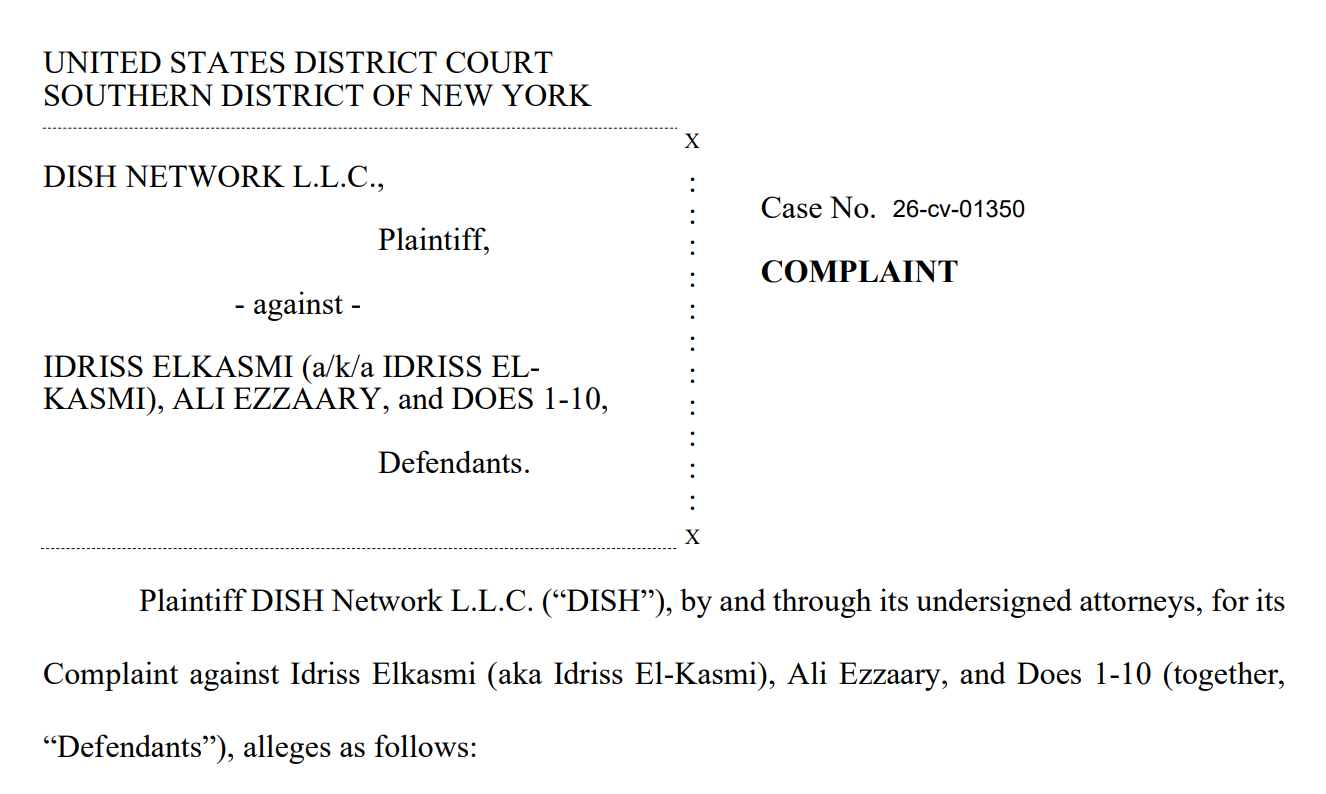
    The American pay-TV provider accuses Moroccan resident Idriss Elkasmi and various unnamed defendants of running the IPTV operation, using various brands, including DMTN IPTV, Idriss Premium TV and Manx TV.

    These services allegedly offered access to thousands of live channels and up to 100,000 movies and series on demand.

    100,000+ movies and series

    100k

    In addition, the complaint names Ali Ezzaary and various John Does as co-defendants. They allegedly promoted and enabled access to the pirate IPTV services as secondary infringers by collecting payments, among other things.

    The complaint

    maroc complaint

    Dish has been aware of the IPTV services for years already and repeatedly issued takedown notices, hoping to stop the infringing activity. However, that didn’t yield the desired result, after which Dish decided to take legal action.

    “Even after receiving 68 cease-and-desist notices from DISH between 2021 and 2026, Elkasmi and the other Defendants have defiantly continued to operate the Infringing Service, willfully infringing DISH’s copyrights on a massive scale with actual knowledge that their activities are unlawful,” the complaint reads.

    Leather Backpack & Breaking Bad

    According to the International Broadcaster Coalition Against Piracy (IBCAP), which coordinates the legal action on behalf of Dish, the operators also used various deceptive tactics to hide the nature of their operation.

    When an undercover Dish investigator purchased an IPTV subscription, Elkasmi’s WhatsApp account sent instructions to send the payment to another business called “Genuine Leather”.

    When finalized, the investigator received a receipt falsely stating the purchase was for a “Philos Brown Leather BackPack.” Soon after, the same investigator received working credentials to access the pirate IPTV service.

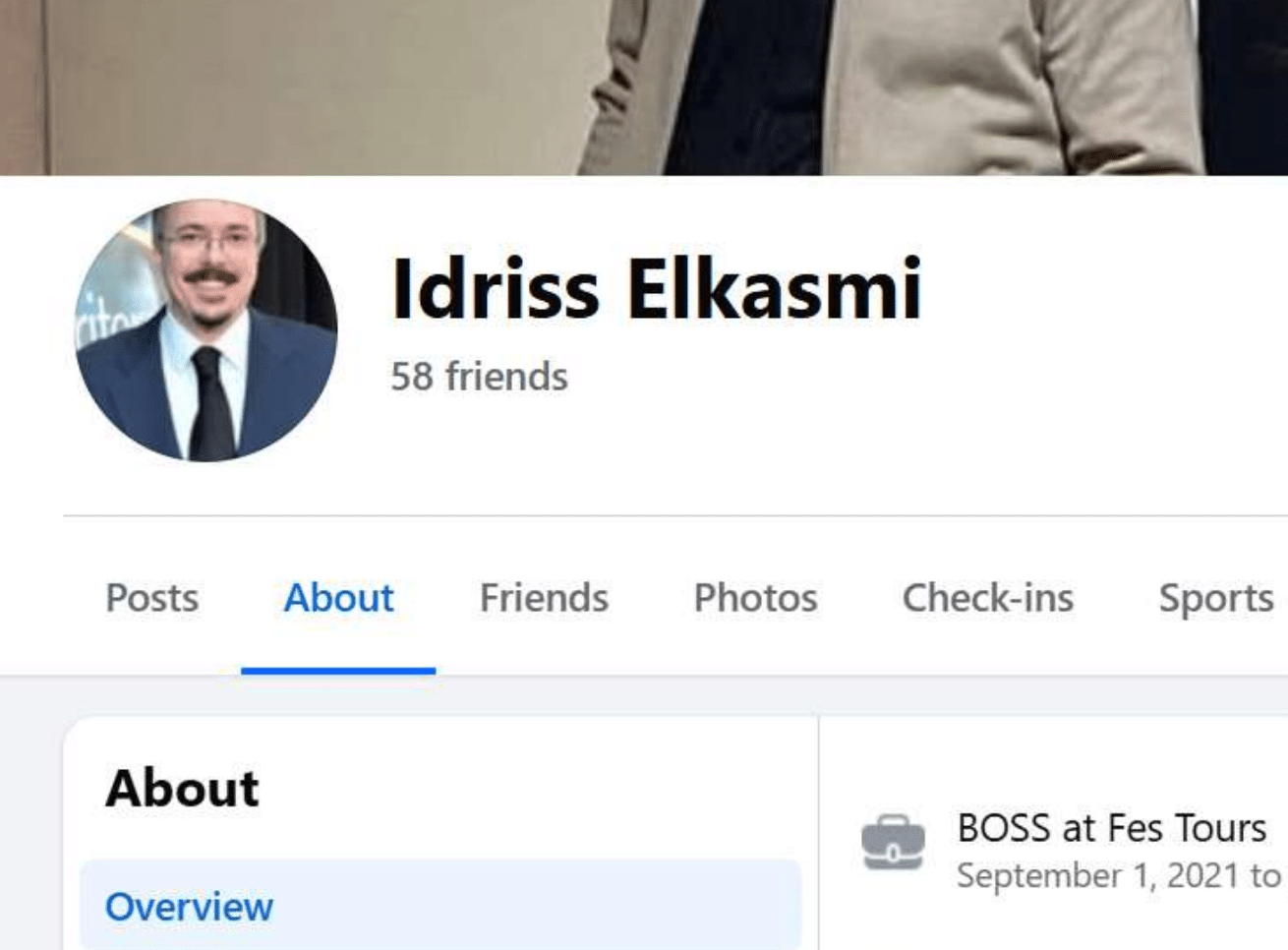
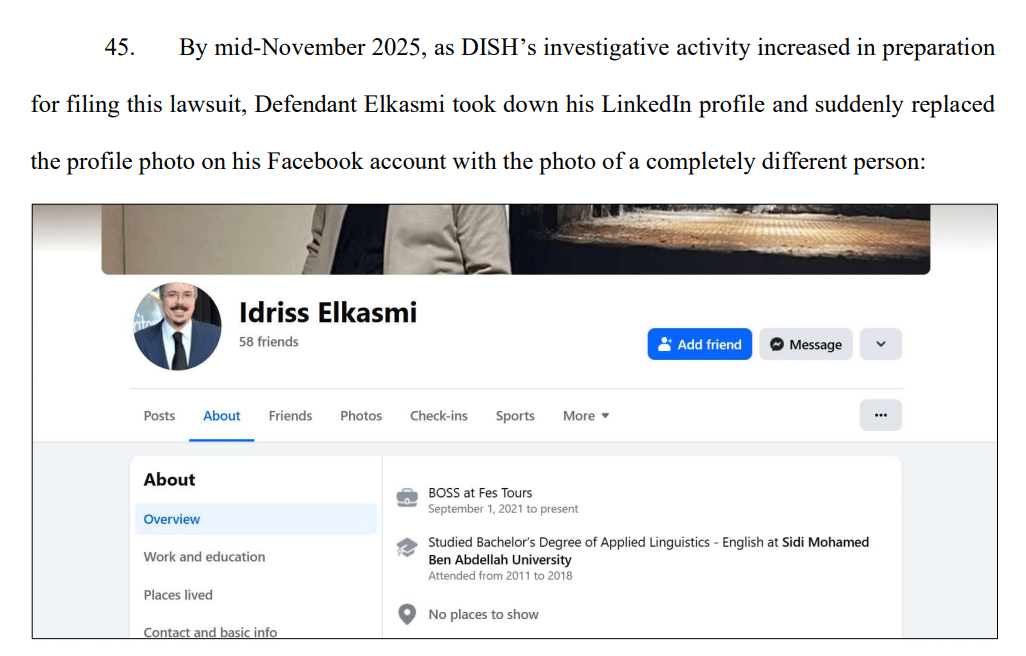
    As DISH’s investigative activity intensified ahead of filing, Elkasmi allegedly took additional steps to obscure his identity. He took down his LinkedIn profile and replaced his Facebook profile photo with an image of someone else entirely.

    “The new photo used by Defendant Elkasmi is in fact an image of a famous Hollywood director named Vince Gilligan, who gained notoriety as the creator of a popular television show called ‘Breaking Bad,’ as well as its spinoff, ‘Better Call Saul.’ The same image appears on Mr. Gilligan’s IMDB page,” the complaint reads.

    “There is no indication that Mr. Gilligan has any connection whatsoever to Defendant Elkasmi or the Infringing Service,” the complaint adds.

    Fakebook profile

    $21 Million & a Broad Injunction

    The lawsuit mentions that at least 145 registered copyrighted works were infringed, and DISH seeks the maximum of $150,000 in statutory copyright infringement damages for each, totaling over $21 million.

    Beyond the multi-million damages figure, DISH requests a permanent injunction and the transfer of domains including dmtn4k.com, dmtn-tv.net, and dmtn8k.com. In addition, it would like the injunction to cover third parties enabling the service. That includes hosting providers, CDNs, ISPs, and payment processors.

    One of the IPTV portals

    iptv

    IBCAP executive director Chris Kuelling said the organization expects the case to follow the pattern of previous successful actions. In addition to a victory in court, he hopes that intermediaries, ranging from payment providers to CDNs, will help to keep the IPTV services offline.

    “In line with past lawsuit wins, we expect a similar outcome in this case, including a broad injunction that can be enforced against third parties, such as hosting providers, CDNs, ISPs, and payment processors, to stop this infringement,” Kuelling said.

    The involvement of third-party intermediaries could be key, as the Moroccan defendants have not been very responsive thus far. They allegedly ignored previous takedown requests from rightsholders in the past, so there’s a realistic chance that they will not appear in court either.

    As of the filing date, dmtn8k.com and dmtniptv.net remain active, and these services continue to operate.


    —-

    A copy of the complaint filed by Dish Network at the Southern District of New York is available here (pdf) .

    From: TF , for the latest news on copyright battles, piracy and more.

    • chevron_right

      Spanish Court Orders ProtonVPN and NordVPN to Block Pirate Football Streams

      news.movim.eu / TorrentFreak • 17 February 2026 • 3 minutes

    laliga VPNs have long been a thorn in the side of LaLiga, as they are used to circumvent the ISP blocking measures it has spent years securing in local courts.

    To address this problem, the Spanish football league has recently gone to court to target the VPNs themselves.

    Today, the Commercial Court No. 1 of Córdoba granted LaLiga and its broadcasting partner Telefónica Audiovisual Digital (TAD) an emergency injunction, targeting NordVPN and ProtonVPN . The VPN companies must block IP addresses linked to illegal streaming of LaLiga matches, making these inaccessible from Spain.

    The orders offer no immediate appeal option, according to El Economista , and there is one significant caveat. Neither VPN company was present in court when the ruling was handed down.

    VPNs Not Heard

    The court orders were issued inaudita parte , which is Latin for “without hearing the other side.” Citing urgency, the Córdoba court did not give NordVPN and ProtonVPN the opportunity to contest the measures before they were granted.

    Without a defense, the court reportedly concluded that both NordVPN and ProtonVPN actively advertise their ability to bypass geo-restrictions, citing match schedules in their marketing materials. The VPNs are therefore seen as active participants in the piracy chain rather than passive conduits, according to local media reports.

    The order is dynamic, which means that LaLiga and Telefónica can update the list of IP addresses the VPNs must block at any time, when new illegal streams are identified. In practice, this would require NordVPN and ProtonVPN to continuously receive and apply new blocklists during live match windows, effectively mirroring the real-time blocking infrastructure already imposed on Spanish ISPs.

    In the past, Spanish blocking measures have been heavily criticized , as they also affected innocent parties that shared IP addresses with pirate services.

    The court acknowledged this risk. It obligated LaLiga and Telefónica to preserve sufficient digital evidence that the IPs they report are genuinely tied to illegal content, a requirement designed to reduce collateral damage. It is not immediately clear how effectively this will prevent overblocking.

    “We Have Not Been Formally Notified”

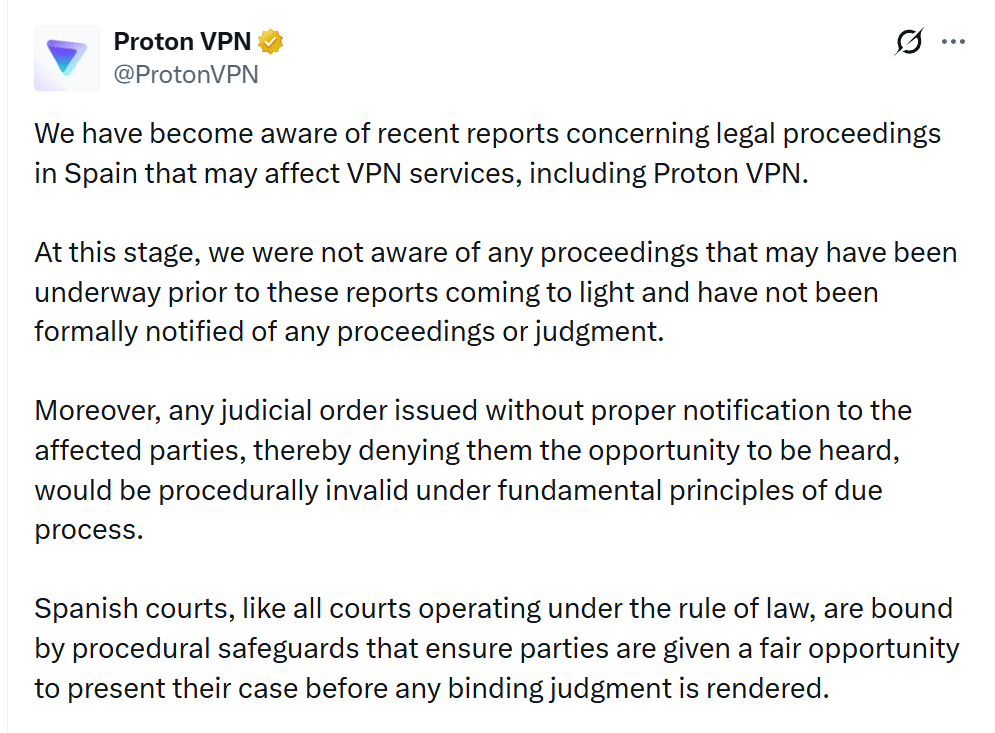
    ProtonVPN apparently learned about the ruling from news reports, the same way everyone else did.

    “We have become aware of recent reports concerning legal proceedings in Spain that may affect VPN services, including Proton VPN,” the company wrote on X . “At this stage, we were not aware of any proceedings that may have been underway prior to these reports coming to light and have not been formally notified of any proceedings or judgment.”

    The company questions whether the order has any legal validity at all.

    “Spanish courts, like all courts operating under the rule of law, are bound by procedural safeguards that ensure parties are given a fair opportunity to present their case before any binding judgment is rendered,” the VPN company noted.

    proton response

    NordVPN, speaking to Spanish tech outlet Bandaancha , called the approach “unacceptable” and also confirmed that it had not been involved in any legal proceedings in Spain.

    Outside EU Jurisdiction

    While the current orders are a first in Spain, we have seen similar blocking injunctions in France already. In May 2025, the Paris Judicial Court ordered five major VPN providers to block access to more than 200 illegal sports streaming sites, and similar orders followed .

    In France, the orders are still under appeal. What options are available in Spain is unclear, however. The providers can comply, but they might also explore indirect options to challenge the injunctions, including jurisdictional concerns.

    Enforcing the order is far from straightforward. ProtonVPN is operated by Proton AG, a Swiss company based in Geneva. NordVPN is operated by Nord Security, incorporated in Panama. Neither country is an EU member state.

    This jurisdiction issue raises significant questions about enforcement. While the court has ordered the rulings to be translated and sent to the companies’ headquarters, it remains unclear what leverage a Spanish commercial court has over entities in Panama or Switzerland.

    For now, the orders are in effect, and the companies are officially on notice. Whether any football match in Spain will actually become harder to pirate as a result remains to be seen, but LaLiga is pleased with the outcome and called it a landmark victory.

    The original court filing from Juzgado Mercantil No. 1 de Córdoba was not immediately available to us.

    From: TF , for the latest news on copyright battles, piracy and more.

    • chevron_right

      ACE Targets Pirate Streaming Site ‘HDFull’ Through Cloudflare and Discord Subpoenas

      news.movim.eu / TorrentFreak • 17 February 2026 • 4 minutes

    hdfull logo HDFull is a pirate streaming portal that has served Spanish-speaking audiences for years, offering a massive library of movies and TV shows.
    Despite being the target of court-ordered ISP blocks in Spain going back to 2018 , the site has proven remarkably resilient, hopping from domain to domain to stay accessible.

    The site also maintained an active Discord community, “HDFull Oficial,” with roughly 33,000 members. However, while the main site remained operating, the Discord server abruptly disappeared last week.

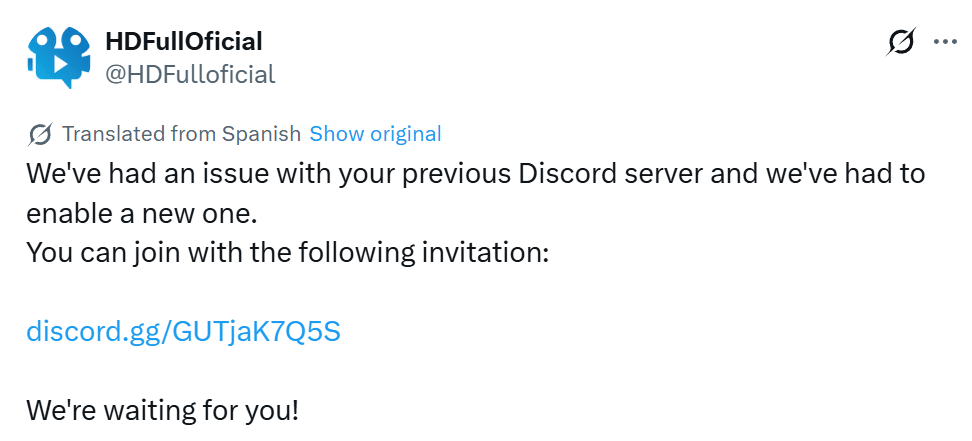
    On February 11, HDFull’s official X account posted a message informing users that there was an ‘issue’ with the original Discord community, directing them to a newly created replacement server.

    HDFull’s message (translated)

    hdfullnew

    The admins and moderators of the site and Discord server didn’t go into detail on this apparent ‘issue,’ but it didn’t take long before the culprit was identified. As it turns out, anti-piracy group ACE requested Discord to take action.

    DMCA Subpoena Targets Discord

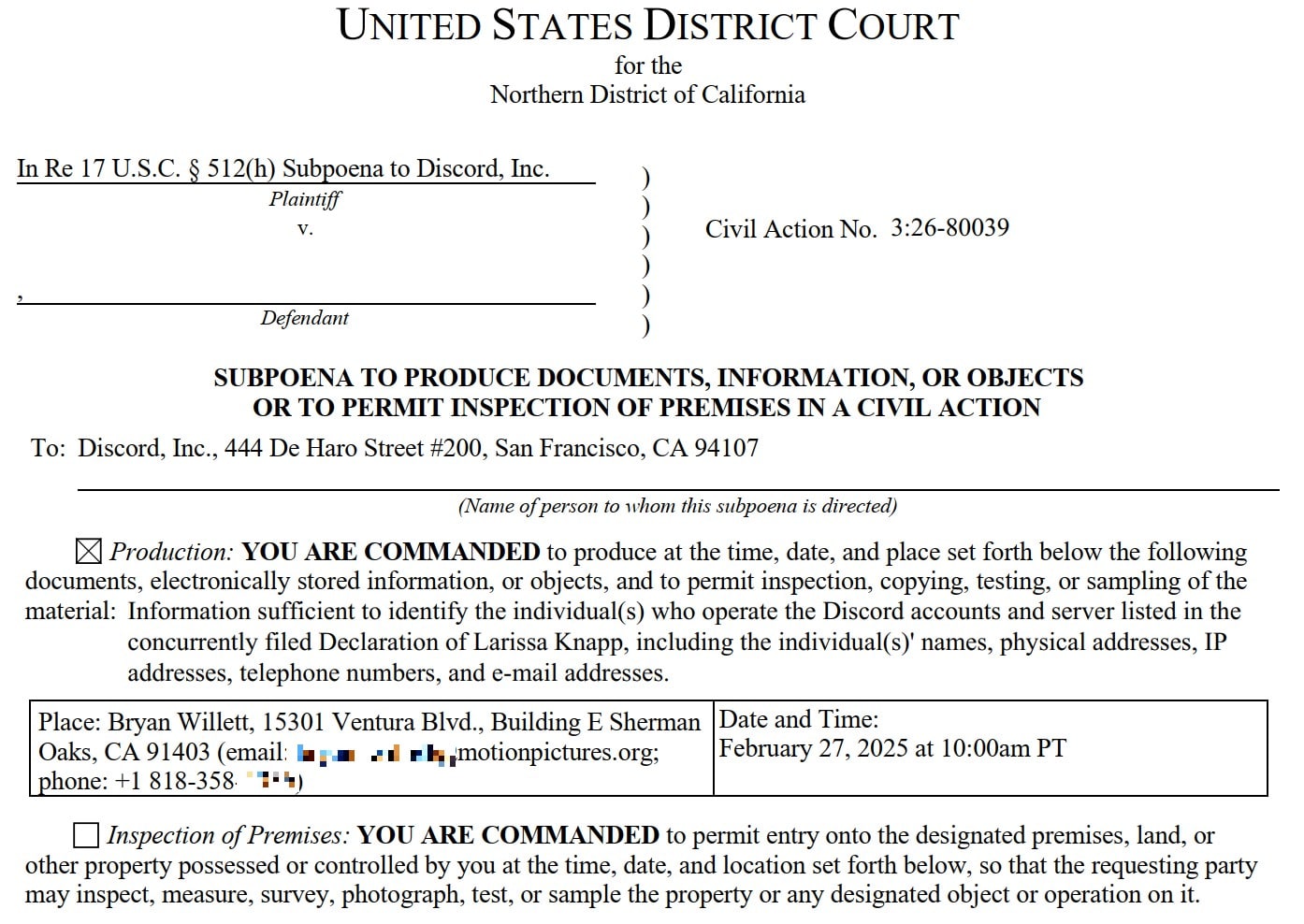
    On February 13, the MPA filed a request for a DMCA subpoena at the U.S. District Court for the Northern District of California, targeting Discord. On behalf of ACE members Warner Bros. and Universal, MPA asked the company to identify two key users who operated the HDFull Oficial server.

    The targeted accounts belong to the Discord user “hdfull”, who appears to be the server owner and primary moderator, and “xenus9999”, a moderator with “Mod” and “Uploaders” roles.

    The filing includes a DMCA notice sent to Discord on February 9, two days before the server went dark. This notice explicitly asks Discord to disable the HDFull server, which is precisely what happened.

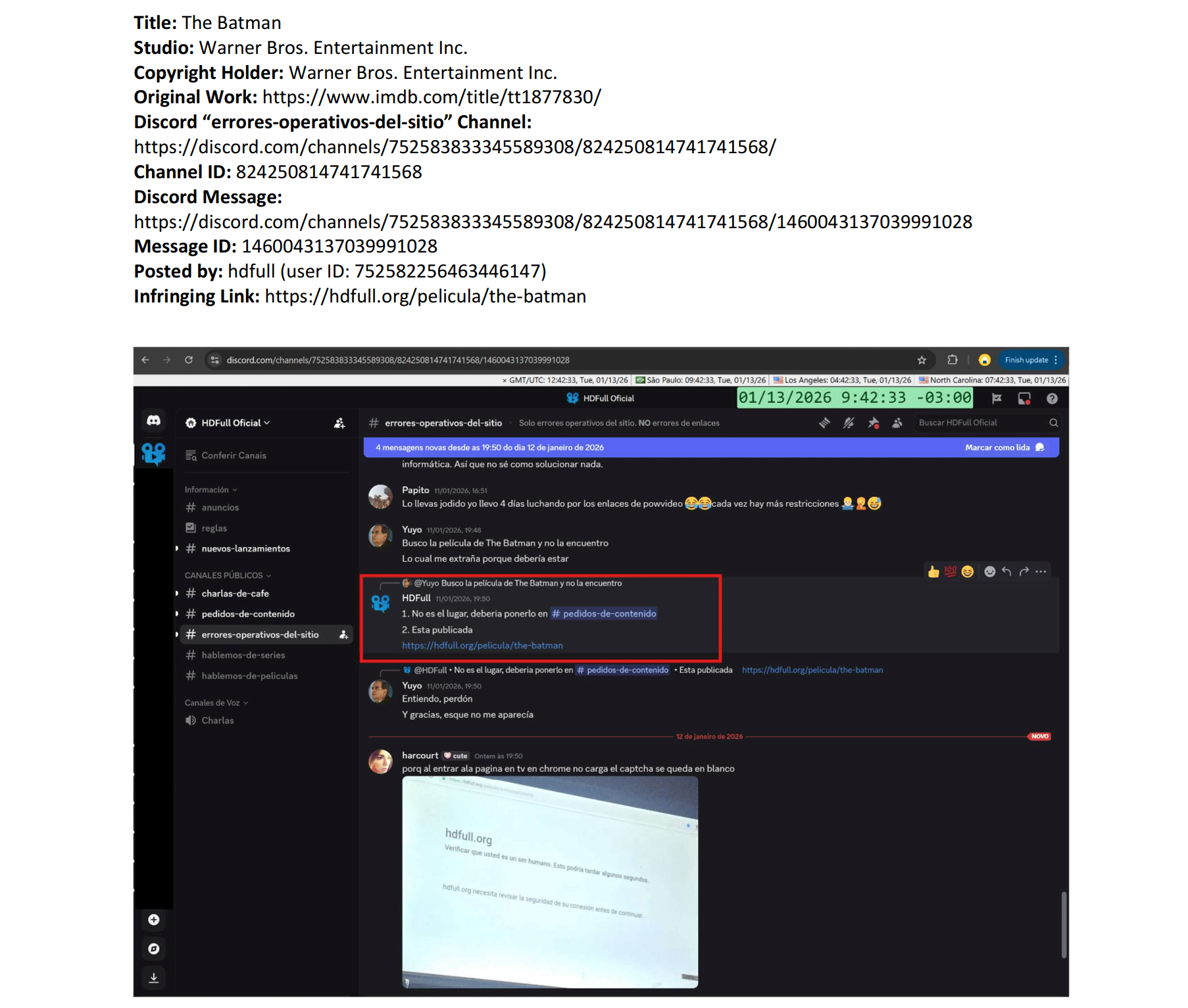
    The notice came with a 23-page exhibit documenting the server’s activities in detail. Screenshots show the “hdfull” account sharing direct links to infringing streams of Warner Bros.’ The Batman and It Chapter Two on the HDFull website. The “xenus9999” account allegedly posted links to The Batman and Universal’s Furious 7.

    Batman link.. (click to enlarge)

    Through the DMCA subpoena, ACE asks Discord to hand over names, physical addresses, IP addresses, telephone numbers, and email addresses for the individuals behind both accounts.

    Cloudflare Subpoena Targets 19 Domains

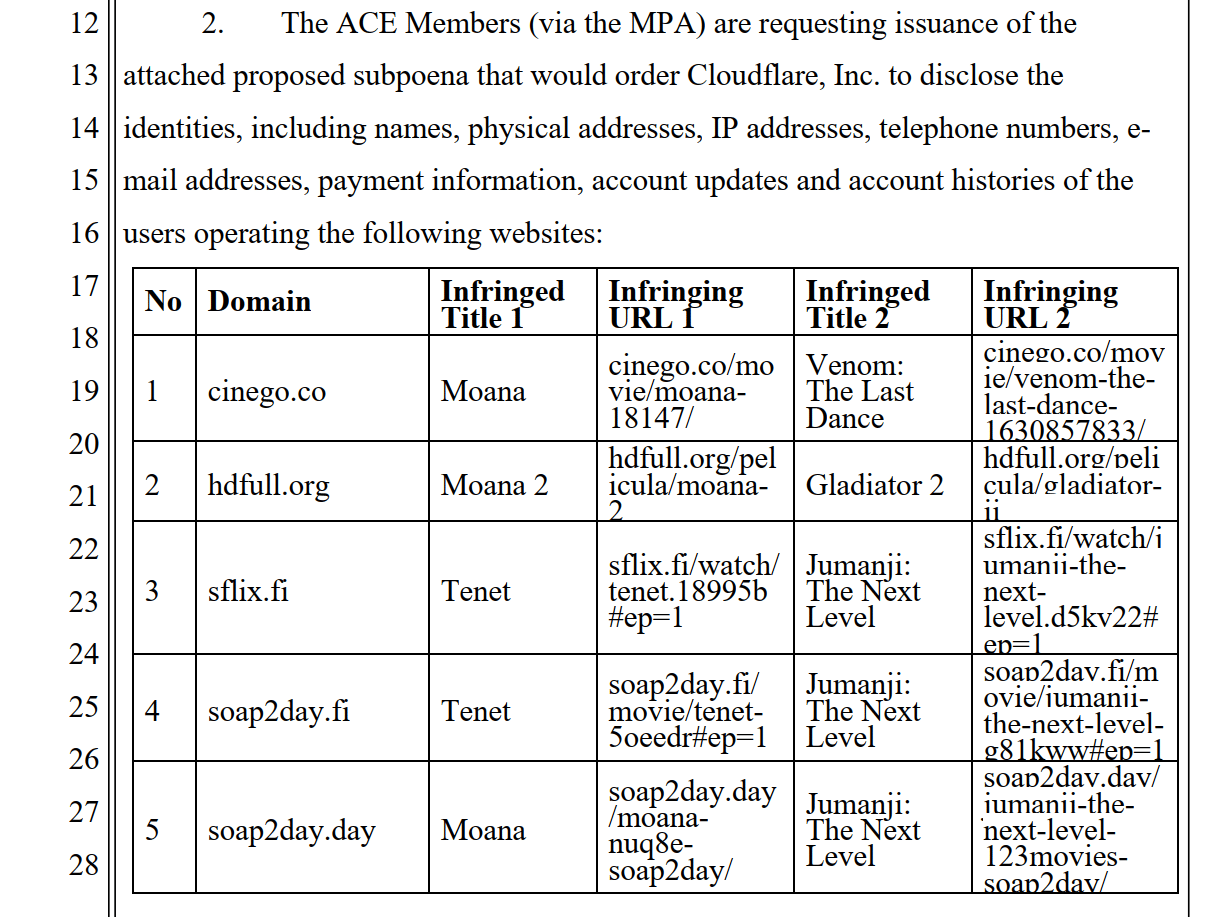
    The Discord subpoena was not the only filing submitted by MPA and ACE last Friday. They filed a separate DMCA subpoena at the Central District of California Court, targeting Cloudflare. This subpoena seeks to unmask the operators of 19 pirate streaming domains, including HDFull.org.

    Cloudflare is asked to identify the customers connected to the pirate site accounts, with the MPA citing various copyright-infringing links that appear on these platforms.

    Cloudflare subpoena

    subpoena

    The 19 targeted domains are noticeably diverse, covering multiple languages and regions. For example, in addition to English portals, they include the German streaming veteran kinox.to , mirrors of Spanish-language site Pelisflix, Turkish streaming sites, and an Arabic anime portal, among others.

    #ddd;padding:10px 14px;margin:10px 0;font-size:16px;line-height:1.6;"> Cloudflare domains targeted: cinego.co, hdfull.org, sflix.fi, soap2day.fi, soap2day.day, kinox.to, pelisflix1.help, pelisflix1.best, pelisflix1.club, anime4up.rest, motchiill.la, motchillk.la, motchillk.ac, 456movie.net, hdfilmcehennemi.nl, vduapk.com, dizigom104.com, pstream.mov, streamingunity.tv

    The pirated titles range from recent blockbusters like Moana 2, Gladiator 2, Nobody 2, and Venom: The Last Dance, to older catalog titles including Tenet, Frozen II, The Lion King, and Tangled.

    For all 19 domains, Cloudflare is asked to provide names, physical addresses, IP addresses, telephone numbers, email addresses, payment information, account updates, and account histories. While many pirate sites are known to share false data, ACE hopes to find sufficient information to expose some of the operations.

    HDFull’s Long and Resilient History

    HDFull has been a thorn in Hollywood’s side for the better part of a decade. In 2018, following complaints from Disney, Fox, Paramount, Sony, Universal, and Warner, a court in Barcelona ordered Spanish ISPs including Telefónica, Vodafone, and Orange to block the site along with fellow pirate portal Repelis.tv.

    The site responded by doing what many pirate sites do: going on a domain hopping spree.

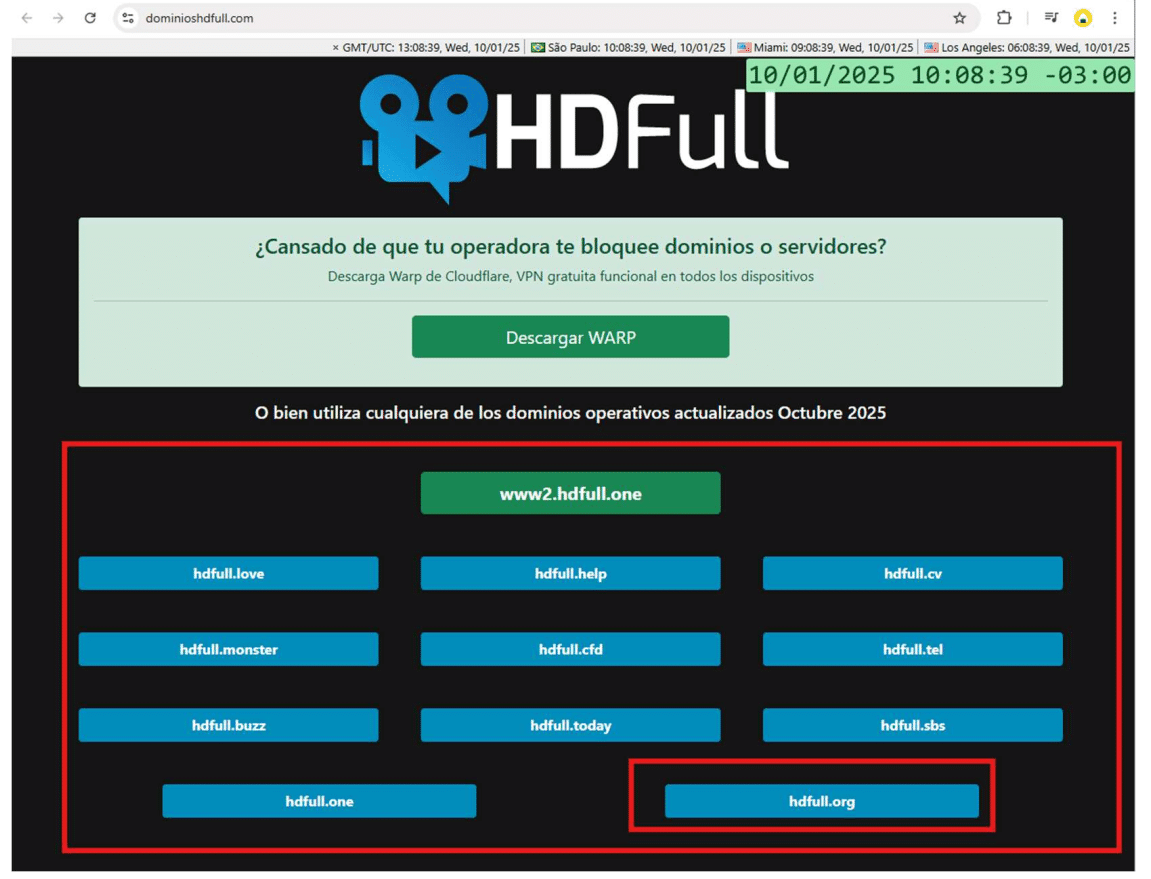
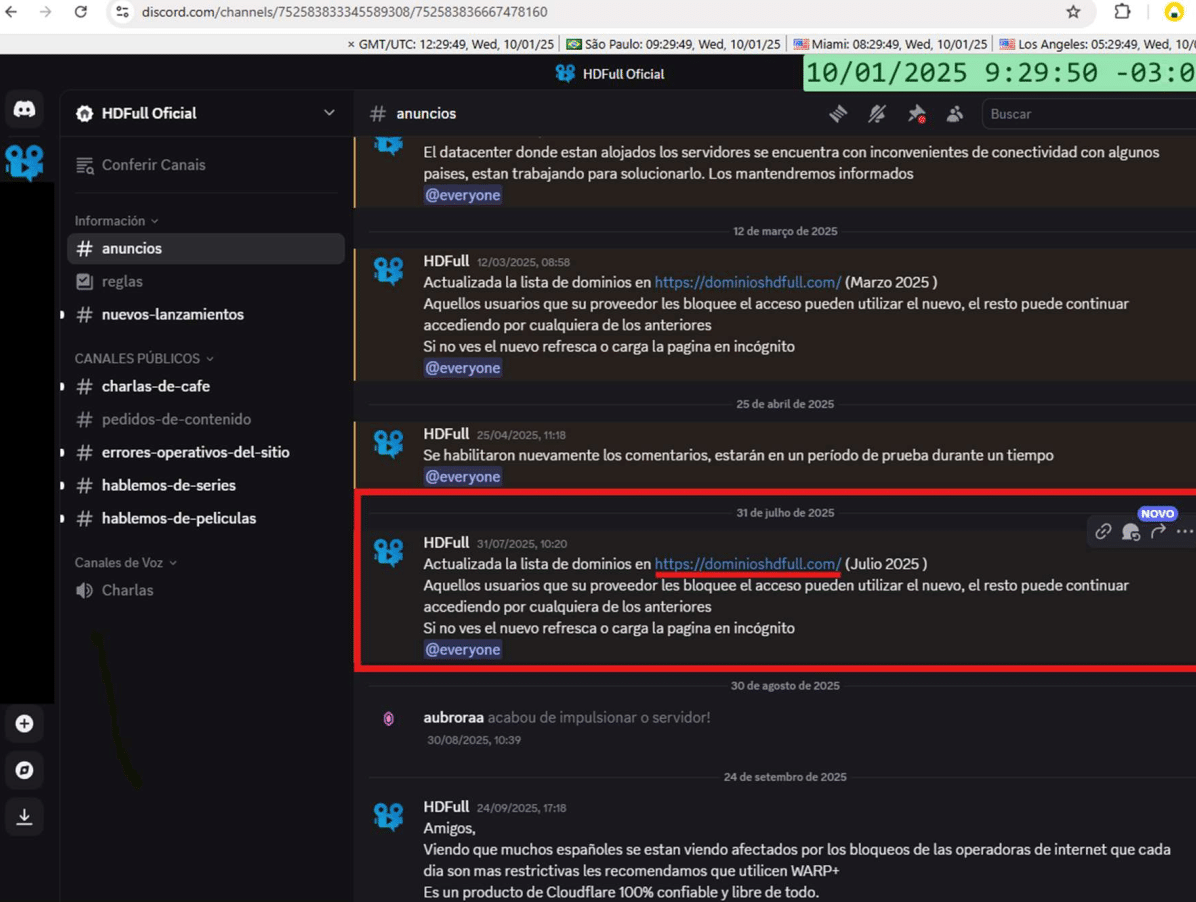
    The court filing’s exhibit documents this in vivid detail. Screenshots from the Discord server show the “hdfull” account periodically posting updated lists of working domains for its users. An October 2025 screenshot shows at least 13 active mirror domains, from hdfull.org and hdfull.one to hdfull.love, hdfull.monster, and hdfull.buzz.

    Presented evidence

    The Discord server, in other words, helped to evade the very ISP blocks that courts had ordered. Other messages also recommend Spanish users install Cloudflare’s WARP VPN to circumvent blocks imposed by their internet providers.
    This dual role, as both a community hub and an anti-blocking tool, likely made the Discord server a key target for ACE.

    What Happens Next?

    Both subpoenas have yet to be signed off on by a court clerk. Interestingly, the Discord subpoena requires a response by February 27, “2025” rather than 2026. The request for subpoena and the declaration were also signed and dated February 13, 2025 , suggesting that the MPA is struggling to adapt to the new year. These errors will have to be corrected.

    Wrong date

    wrong date

    Whether Cloudflare and Discord will comply without resistance remains to be seen, but both companies are usually responsive to valid subpoenas issued by a U.S. court.

    ACE has used this playbook before. Late last year, the MPA filed a similar DMCA subpoena targeting Discord over pirate streaming site OnionPlay, successfully getting the server shut down while seeking to unmask its operator.

    For HDFull’s operators, being targeted from multiple directions at once likely puts them on high alert. For now, however, the site remains online, with over a dozen operational backup domains in place. In addition, the team has set up a new Discord server to replace the one that was taken down.

    A copy of the Discord DMCA subpoena request, filed at the U.S. District Court for the Northern District of California, is available here (pdf) . The Cloudflare DMCA subpoena request, filed at the Central District of California, is available here (pdf) .

    From: TF , for the latest news on copyright battles, piracy and more.