

-
To
chevron_right
Google Invokes First Amendment to Shield Gmail Users from Piracy Subpoena
news.movim.eu / TorrentFreak • 27 February 2026 • 4 minutes
 Flava Works is an Illinois-based adult entertainment company specializing in content featuring Black and Latino men.
The company has pursued copyright infringers aggressively for years, including a $1.5 million damages award against a defendant who shared its films on BitTorrent and a high-profile clash with an unnamed television executive that was eventually settled.
Last March, Flava, together with Blatino Media, filed a new lawsuit targeting an alleged Canadian leaker of its videos alongside 47 John Doe defendants. The rightsholders claim the maximum of $150,000 in statutory damages from each defendant, bringing the total damages claim to over $8 million.
This case stands out from the typical torrent lawsuits as the defendants were identified by their usernames on the private torrent tracker GayTorrent.ru, where they allegedly shared the pirated videos.
Today, nearly a year has passed since the case was started, and most of those Doe defendants still haven’t been formally named. According to Flava, that’s largely due to one company: Google.
Google Rejects Broad Subpoena
In a status report filed this week, Flava informs the Illinois federal court of the progress thus far. The company reports that it signed a confidential settlement with one defendant, while several others were named and formally served. However, most defendants are still “John Does.”
According to an affidavit filed by Flava’s president, Phillip Bleicher, they can’t properly name the defendants because Google raised objections and refused to fully comply with the subpoena. This, despite complying with an earlier subpoena in a similar case.
Initially, Google incorrectly claimed the subpoena was issued by a pro se party. After Flava provided documentation that a licensed Illinois attorney had signed it, Google requested a copy of the complaint. That was provided in early December.
Shortly after, Google formally objected, raising “potential First Amendment concerns,” while stating it would only provide data for the “primary user who allegedly distributed the copyrighted works,” not the broader list of “John Doe” defendants.
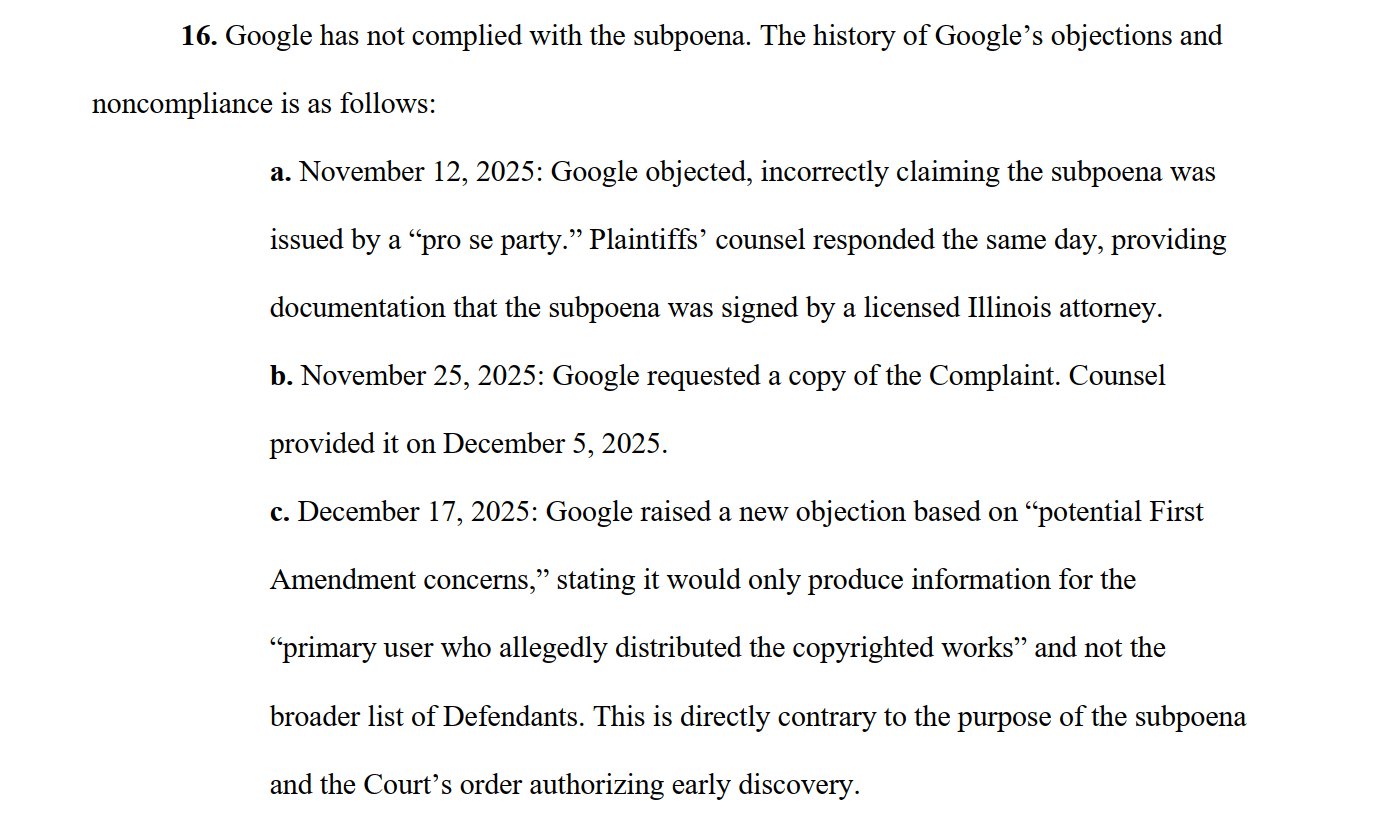
Google’s objection affects 28 defendants whose primary or sole email addresses are Gmail accounts. Without Google’s subscriber data, Flava says it cannot confirm their identities with sufficient certainty to name them in the lawsuit.
How Flava Identifies Its Targets
It is unclear what Google means exactly by raising First Amendment concerns. The company may believe the John Doe defendants are not necessarily direct infringers, a question that touches on how they were identified in the first place.
The complaint does not explain this. Typically, rightsholders identify torrent pirates by joining a swarm, collecting IP addresses, and subpoenaing ISPs to match those IPs to account holders. In this case, however, Flava already had usernames and email addresses before any court-ordered discovery.
One possible explanation is that some of these defendants were also paid subscribers on Flava’s own platforms. Membership sites log IP addresses at login. So, if the same IP that appeared in the GayTorrent.ru swarm also appeared in Flava’s own server logs, the company could have linked a torrent username to a registered account and its associated email address entirely from its own internal records.
Wrongly Accused Pirates
Critics of BitTorrent lawsuits have long argued that IP addresses do not reliably identify individuals. In this case, Flava makes that same argument in its own favor, using the risk of misidentification as a reason for Google to hand over subscriber data.
The affidavit acknowledges that an email address alone is not sufficient to confirm an identity either. In at least one instance in a related case, a subpoena response pointed to someone who turned out not to be the infringer. The email address had been used by someone else, and the identified individual contacted prior counsel to clarify the error.
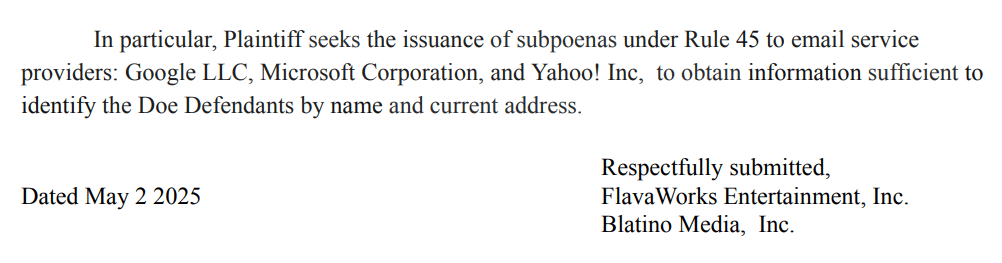
To avoid naming the wrong people, Flava needs both Google and Microsoft to comply with their subpoenas, which seek information sufficient to identify the defendants by name and current address.
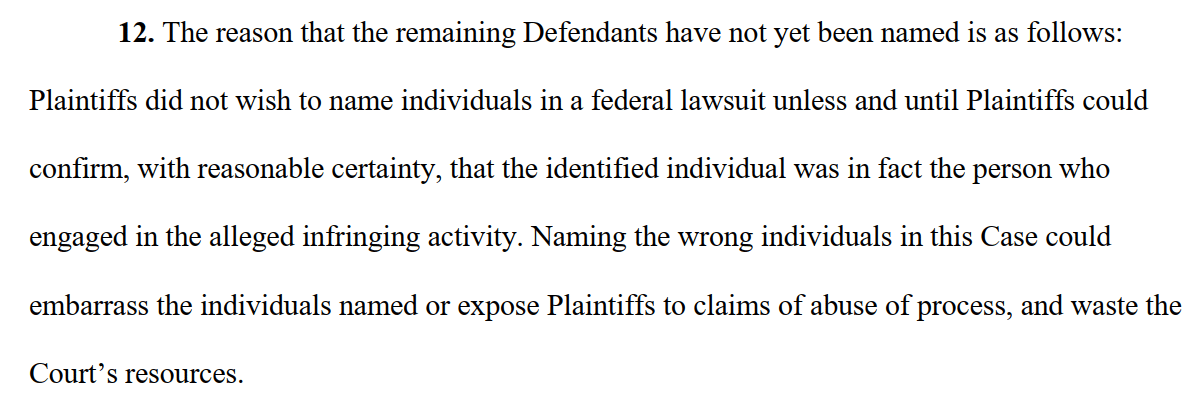
“Naming the wrong individuals in this Case could embarrass the individuals named or expose Plaintiffs to claims of abuse of process, and waste the Court’s resources,” the affidavit cautions, using the fear of wrongful accusations squarely in its own favor.
What’s Next
The legal paperwork notes that Microsoft, which also holds data for some of the remaining defendants, indicated it is willing to comply with its subpoena if there is an agreement on fees. Flava’s counsel is working to finalize those terms.
For the moment, however, the case for the 28 Gmail-linked defendants is effectively on hold pending Google’s cooperation. Flava says it is prepared to file a motion to compel if Google does not respond, but that hasn’t been filed yet.
If a motion to compel is filed, Google is expected to explain its stated First Amendment rationale in more detail. Then, it will be up to the federal judge to weigh the arguments from both sides.
—
A copy of the status report, filed at the United States District Court for the Northern District of Illinois, is available here (pdf) . The supporting affidavit of Phillip Bleicher can be found here (pdf) .
From: TF , for the latest news on copyright battles, piracy and more.