

-
To
chevron_right
Belgian Pirate Site Blocking Order Targets Cloudflare and Google, But Not Their DNS
news.movim.eu / TorrentFreak • 23 February 2026 • 4 minutes
 Belgium has become one of Europe’s most active testing grounds when it comes to pirate site-blocking enforcement.
The country’s two-step system , where a court issues an injunction and a government department ( BAPO ) then determines how it is implemented, has resulted in a series of diverse site-blocking orders since the framework launched in 2025.
An Eclectic Site Blocking Push
The first order, obtained by sports broadcaster DAZN in April 2025, started quite aggressively. It required ISPs and third-party DNS resolvers, including Cloudflare, Google, and Cisco’s OpenDNS , to stop resolving over 100 pirate domains. If not, they would risk a fine of €100,000 per day.
Cisco refused to comply with the order and instead pulled OpenDNS out of Belgium entirely. Cloudflare and Google remained in Belgium and cooperated, though each did so in its own way.
A second blocking order followed in July last year, requiring various intermediaries, including ISPs, hosting companies, and payment services, to block shadow libraries . Initially, Internet Archive’s Open Library was also targeted, but this decision was eventually reversed after the U.S. non-profit agreed to geo-block certain content on its service.
Meanwhile, Cisco reportedly appealed the initial site-blocking order and returned to Belgium. While this appeal remains ongoing, the Belgian site-blocking machine didn’t stop.
Last November, an order obtained by Disney, Netflix, Sony, Apple, and others , targeted popular movie piracy sites, including 1337x and Soap2day. Notably, this order only applied to Belgium’s five major ISPs. DNS resolvers were nowhere on the list , likely due to Cisco’s appeal.
First IPTV Blocking Order
A new order, issued by the Court of Brussels, targets five illegal IPTV services: LEMEILLEURIPTV, BESTIPTVABO, ATLASPRO12, OTT PREMIUM, and MIJNIPTV. The order was obtained by Belgian broadcasters RTL Belgium and RTBF, whose broadcasts were distributed by these services without permission.
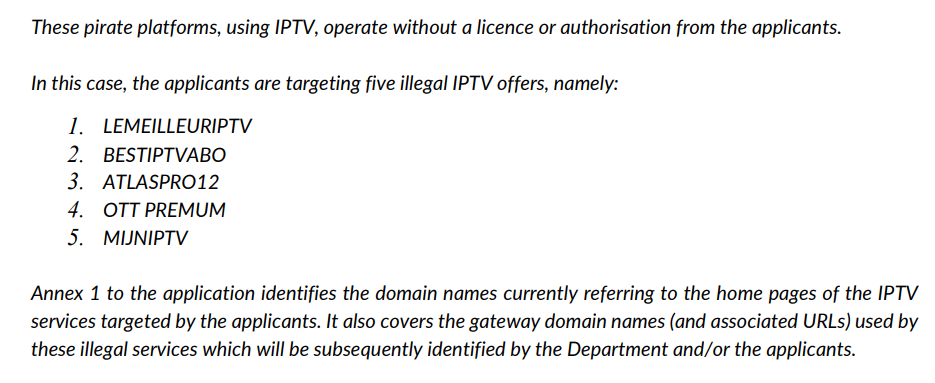
The implementation decision, published by Belgium’s Department for Combating Infringements of Copyright and Related Rights Committed Online (BAPO), described the IPTV services as “structurally dedicated to the mass infringement of audiovisual content”.
According to information shared by the rightsholders, the services used cryptocurrency, which they see as a sign of illegality. In addition, the IPTV services showed users how to circumvent blocking measures.
All in all, the implementation order requires Belgium’s five major ISPs, Proximus, Telenet, Orange Belgium, Mobile Vikings, and DIGI Communications, to block domain names associated with these IPTV services. This also applies to mirror sites and redirect domains that can be added to the blocklist in future updates.
Cloudflare and Google Are Back, But Not for DNS
The ISPs will have to use DNS-based blocking measures, as is standard procedure in most countries. However, DNS blocking measures are not requested from Cloudflare and Google, which are also covered by the injunction.
The order names the American tech companies as intermediaries and requires them to help stop the IPTV services through other routes.
Specifically, if Cloudflare acts as a CDN or hosting provider, it must take measures to prevent Belgian users from accessing the named IPTV services. Crucially, Cloudflare’s DNS resolver and WARP service are not covered.
Google is not required to block the domains on its DNS resolver either. Instead, Google must de-index the relevant domains from its search results, deactivate associated Google Ads, and block access through Google Sites and Google Cloud services where applicable.
This omission of any third-party DNS restrictions is almost certainly not accidental. Cisco’s appeal of the April 2025 order resulted in a Brussels court suspending enforcement of the DNS blocking requirement, allowing OpenDNS to resume operations in Belgium pending a final ruling.
With that legal challenge still unresolved, rightsholders appear to have opted for a more defensible scope, targeting Cloudflare and Google in their roles as infrastructure providers rather than as DNS operators.
Exploring the Blocking Limits
The latest blocking order shows how Belgium’s blocking regime continues to calibrate itself in real time. Each new order is seemingly shaped by the legal and practical fallout from the last.
April 2025: Initial DAZN order aggressively targets ISPs and third-party DNS resolvers. Cisco pulls OpenDNS from Belgium.
July 2025: Second order requires various intermediaries to block shadow libraries.
Summer 2025: Cisco appeals; court suspends DNS blocking requirement, allowing OpenDNS to return.
Nov 2025: Broad order against movie piracy sites applies strictly to ISPs. DNS resolvers are omitted.
Current: Broadcasters RTL & RTBF obtain IPTV blocking order. Cloudflare and Google are targeted, but are not required to block DNS.
Whether the broader DNS blocking orders will return depends in part on how Cisco’s appeal resolves. A ruling against DNS blocking obligations could permanently reshape the scope of future Belgian orders, and there may be even broader repercussions.
Increasingly, European countries are granting ever more far-reaching pirate site blocking orders, covering a broad range of intermediaries, including DNS resolvers, but also VPN providers.
While these orders have been given the green light in France, Spain, and elsewhere, they are not uncontested. Given what’s at stake, the European Court of Justice will likely be asked to weigh in eventually to lay out the ground rules.
—
A copy of the latest blocking implementation order, published by the Department for Combating Infringements of Copyright and Related Rights Committed Online, is available here (pdf) .
From: TF , for the latest news on copyright battles, piracy and more.