• Pl chevron_right

      Lucas Baudin: Being a Mentor for Outreachy

      news.movim.eu / PlanetGnome • 6 February 2026 • 3 minutes

    I first learned about Outreachy reading Planet GNOME 10 (or 15?) years ago. At the time, I did not know much about free software and I was puzzled by this initiative, as it mixed politics and software in a way I was not used to.

    Now I am a mentor for the December 2025 Outreachy cohort for Papers (aka GNOME Document Viewer), so I figured I would write a blog post to explain what Outreachy is and perpetuate the tradition! Furthermore, I thought it might be interesting to describe my experience as a mentor so far.

    Papers and Outreachy logo

    What is Outreachy?

    Quoting the Outreachy website :

    Outreachy provides [paid] internships to anyone from any background who faces underrepresentation, systemic bias, or discrimination in the technical industry where they are living.

    These internships are paid and carried out in open-source projects. By way of anecdote, it was initially organized by the GNOME community around 2006-2009 to encourage women participation in GNOME and was progressively expanded to other projects later on . It was formally renamed Outreachy in 2015 and is now managed independently on GNOME, apart from its participation as an open-source project.

    Compared to the well-funded Summer of Code program by Google, Outreachy has a much more precarious financial situation, especially in recent years . With little surprise, the evolution of politics in the US and elsewhere over the last few years does not help.

    Therefore, most internships are nowadays funded directly by open-source projects (in our case the GNOME Foundation, you can donate and become a Friend of GNOME ), and Outreachy still has to finance (at least) its staff ( donations here ).

    Outreachy as a Mentor

    So, I am glad that the GNOME Foundation was able to fund an Outreachy internship for the December 2025 cohort. As I am one of the Papers maintainers, I decided to volunteer to mentor an intern and came up with a project on document signatures. This was one of the first issues filled when Papers was forked from Evince, and I don't think I need to elaborate on how useful PDF signing is nowadays. Furthermore, Tobias had already made designs for this feature, so I knew that if we actually had an intern, we would precisely know what needed to be implemented 1 .

    Once the GNOME Internship Committee for Outreachy approved the project, the project was submitted on the Outreachy website, and applicants were invited to start making contributions to projects during the month of October so projects could then select interns (and interns could decide whether they wanted to work for three months in this community). Applicants were already selected by Outreachy (303 applications were approved out of 3461 applications received). We had several questions and contributions from around half a dozen applicants, and that was already an enriching experience for me. For instance, it was interesting to see how newcomers to Papers could be puzzled by our documentation.

    At this point, a crucial thing was labeling some issues as "Newcomers". It is much harder than what it looks (because sometimes things that seem simple actually aren't), and it is necessary to make sure that issues are not ambiguous, as applicants typically do not dare to ask questions (even, of course, when it is specified that questions are welcomed!). Communication is definitively one of the hardest things.

    In the end, I had to grade applicants (another hard thing to do), and the Internship Committee selected Malika Asman who accepted to participate as an intern! Malika wrote about her experience so far in several posts in her blog .

    1

    Outreachy internships do not have to be centered around programming; however, that is what I could offer guidance for.

    • Pl chevron_right

      Cassidy James Blaede: ROOST at FOSDEM 2026

      news.movim.eu / PlanetGnome • 6 February 2026 • 5 minutes

    stickers.jpg

    A few months ago I joined ROOST (Robust Open Online Safety Tools) to build our open source community that would be helping to create, distribute, and maintain common tools and building blocks for online trust and safety. One of the first events I wanted to make sure we attended in order to build that community was of course FOSDEM , the massive annual gathering of open source folks in Brussels, Belgium.

    Luckily for us, the timing aligned nicely with the v1 release of our first major online safety tool, Osprey , as well as its adoption by Bluesky and the Matrix.org Foundation. I wrote and submitted a talk for the FOSDEM crowd and the decentralized communications track, which was accepted. Our COO Anne Bertucio and I flew out to Brussels to meet up with folks, make connections, and learn how our open source tools could best serve open protocols and platforms.

    Brunch with the Christchurch Call Foundation

    Saturday, ROOST co-hosted a brunch with the Christchurch Call Foundation where we invited folks to discuss the intersection of open source and online safety. The event was relatively small, but we engaged in meaningful conversations and came away with several recurring themes. Non-exhaustively, some areas attendees were interested in: novel classifiers for unique challenges like audio recordings and pixel art; how to ethically source and train classifiers; ways to work better together across platforms and protocols.

    Personally I enjoyed meeting folks from Mastodon, GitHub, ATproto, IFTAS, and more in person for the first time, and I look forward to continuing several conversations that were started over coffee and fruit.

    Talk

    Our Sunday morning talk “Stop Reinventing in Isolation” (which you can watch on YouTube or at fosdem.org ) filled the room and was really well-received.

    Cassidy Anne

    Cassidy and Anne giving a talk. | Photos from @matrix@mastodon.matrix.org

    In it we tackled three major topics: a crash course on what is “trust and safety”; why the field needs an open source approach; and then a bit about Osprey, our self-hostable automated rules engine and investigation tool that started as an internal tool built at Discord.

    Q&A

    We had a few minutes for Q&A after the talk, and the folks in the room spurred some great discussions. If there’s something you’d like to ask that isn’t covered by the talk or this Q&A, feel free to start a discussion ! Also note that this gets a bit nerdy; if you’re not interested in the specifics of deploying Osprey, feel free to skip ahead to the Stand section.

    Room

    When using Osprey with the decentralized Matrix protocol, would it be a policy server implementation?

    Yes, in the Matrix model that’s the natural place to handle it. Chat servers are designed to check with the policy server before sending room events to clients, so it’s precisely where you’d want to be able to run automated rules. The Matrix.org Foundation is actively investigating how exactly Osprey can be used with this setup, and already have it deployed in their staging environment for testing.

    Does it make sense to use Osprey for smaller platforms with fewer events than something like Matrix, Bluesky, or Discord?

    This one’s a bit harder to answer, because Osprey is often the sort of tool you don’t “need” until you suddenly and urgently do. That said, it is designed as an in-depth investigation tool, and if that’s not something needed on your platform yet due to the types and volume of events you handle, it could be overkill. You might be better off starting with a moderation/review dashboard like Coop, which we expect to be able to release as v0 in the coming weeks. As your platform scales, you could then explore bringing Osprey in as a complementary tool to handle more automation and deeper investigation.

    Does Osprey support account-level fraud detection?

    Osprey itself is pretty agnostic to the types of events and metadata it handles; it’s more like a piece of plumbing that helps you connect a firehose of events to one end, write rules and expose those events for investigation in the middle, and then connect outgoing actions on the other end. So while it’s been designed for trust and safety uses, we’ve heard interest from platforms using it in a fraud prevention context as well.

    What are the hosting requirements of Osprey, and what do deployments look like?

    While you can spin Osprey up on a laptop for testing and development, it can be a bit beefy. Osprey is made up of four main components: worker, UI, database, and Druid as the analytics database. The worker and UI have low resource requirements, your database (e.g. Postgres) could have moderate requirements, but then Druid is what will have the highest requirements. The requirements will also scale with your total throughput of events being processed, as well as the TTLs you keep in Druid. As for deployments, Discord, Bluesky, and the Matrix.org Foundation have each integrated Osprey into their Kubernetes setups as the components are fairly standard Docker images. Osprey also comes with an optional coordinator, an action distribution and load-balancing service that can aid with horizontal scaling.

    Stand

    This year we were unable to secure a stand (there were already nearly 100 stands in just 5 buildings!), but our friends at Matrix graciously hosted us for several hours at their stand near the decentralized communications track room so we could follow up with folks after our talk. We blew through our shiny sticker supply as well as our 3D printed ROOST keychains (which I printed myself at home!) in just one afternoon. We’ll have to bring more to future FOSDEMs!

    Stickers

    When I handed people one of our hexagon stickers the reaction was usually some form of, “ooh, shiny!” but my favorite was when someone essentially said, “Oh, you all actually know open source!” That made me proud, at least. :)

    Interesting Talks

    Lastly, I always like to shout out interesting talks I attended or caught on video later so others can enjoy them on their own time. I recommend checking out:

    • Pl chevron_right

      This Week in GNOME: #235 Integrating Fonts

      news.movim.eu / PlanetGnome • 6 February 2026 • 4 minutes

    Update on what happened across the GNOME project in the week from January 30 to February 06.

    GNOME Core Apps and Libraries

    GTK ↗

    Cross-platform widget toolkit for creating graphical user interfaces.

    Emmanuele Bassi says

    The GTK developers published the report for the 2026 GTK hackfest on their development blog. Lots of work and plans for the next 12 months:

    • session save/restore
    • toolchain requirements
    • accessibility
    • project maintenance

    and more!

    Glycin ↗

    Sandboxed and extendable image loading and editing.

    Sophie (she/her) reports

    Glycin 2.1.beta has been released. Starting with this version, the JPEG 2000 image format is supported by default. This was made possible by a new JPEG 2000 implementation that is completely written in safe Rust.

    While this image format isn’t in widespread use for images directly, many PDFs contain JPEG 2000 images since PDF 1.5 and PDF/A-2 support embedded JPEG 2000 images. Therefore, images extracted from PDFs, frequently have the JPEG 2000 format.

    GNOME Circle Apps and Libraries

    Resources ↗

    Keep an eye on system resources

    nokyan says

    This week marks the release of Resources 1.10 with support for new hardware, software and improvements all around! Here are some highlights:

    • Added support for AMD NPUs using the amdxdna driver
    • Improved accessibility for screen reader users and keyboard users
    • Vastly improved app detection
    • Significantly cut down CPU usage
    • Searching for multiple process names at once is now possible using the “|” operator in the search field

    In-depth release notes can be found on GitHub .

    Resources is available on Flathub .

    gtk-rs ↗

    Safe bindings to the Rust language for fundamental libraries from the GNOME stack.

    Julian 🍃 announces

    I’ve added another chapter for the gtk4-rs book. It describes how to use gettext to make your app available in other languages: https://gtk-rs.org/gtk4-rs/stable/latest/book/i18n.html

    Third Party Projects

    Ronnie Nissan announces

    This week I released Sitra, an app to install and manage fonts from google fonts. It also helps devs integrate fonts into their projects using fontsource npm and CDN.

    The app is a replacement to the Font Downloader app which has been abandoned for a while.

    Sitra can be downloaded from flathub

    sitra-font-preview-page-with-font-installed.UtiR11Xn_2id1Ph.webp

    sitra-use-in-a-project-dialog-npm.CDfZQJgX_Z1X4h4W.webp

    Arnis (kem-a) announces

    AppManager is a GTK/Libadwaita developed desktop utility in Vala that makes installing and uninstalling AppImages on Linux desktop painless. It supports both SquashFS and DwarFS AppImage formats, features a seamless background auto-update process, and leverages zsync delta updates for efficient bandwidth usage. Double-click any .AppImage to open a macOS-style drag-and-drop window, just drag to install and AppManager will move the app, wire up desktop entries, and copy icons.

    And of course, it’s available as AppImage. Get it on Github

    AppManager-v3.0.0-TWIG.Boy3BBoi_Z1xxHDw.webp

    Parabolic ↗

    Download web video and audio.

    Nick reports

    Parabolic V2026.2.0 is here!

    This release contains a complete overhaul of the downloading engine as it was rewritten from C++ to C#. This will provide us with more stable performance and faster iteration of highly requested features (see the long list below!!). The UIs for both Windows and Linux were also ported to C# and got a face lift, providing a smoother and more beautiful downloading experience.

    Besides the rewrite, this release also contains many new features (including quality and subtitle options for playlists - finally!) and plenty of bug fixes with an updated yt-dlp .

    Here’s the full changelog:

    • Parabolic has been rewritten in C# from C++
    • Added arm64 support for Windows
    • Added support for playlist quality options
    • Added support for playlist subtitle options
    • Added support for reversing the download order of a playlist
    • Added support for remembering the previous Download Immediately selection in the add download dialog
    • Added support for showing yt-dlp’s sleeping pauses within download rows
    • Added support for enabling nightly yt-dlp updates within Parabolic
    • Redesigned both platform application designs for a faster and smoother download experience
    • Removed documentation pages as Parabolic shows in-app documentation when needed
    • Fixed an issue where translator-credits were not properly displayed
    • Fixed an issue where Parabolic crashed when adding large amounts of downloads from a playlist
    • Fixed an issue where Parabolic crashed when validating certain URLs
    • Fixed an issue where Parabolic refused to start due to keyring errors
    • Fixed an issue where Parabolic refused to start due to VC errors
    • Fixed an issue where Parabolic refused to start due to version errors
    • Fixed an issue where opening the about dialog would freeze Parabolic for a few seconds
    • Updated bundled yt-dlp

    Parabolic_V2026.2.0.BBxr5_C5_Z1jVJEy.webp

    Shell Extensions

    subz69 reports

    I just released Pigeon Email Notifier , a new GNOME Shell extension for Gmail and Microsoft email notifications using GNOME Online Accounts. Supports priority-only mode, persistent and sound notifications.

    pigeon.CXwjHacz_Z12patp.webp

    Miscellaneous

    Arjan reports

    PyGObject 3.55.3 has been released. It’s the third development release (it’s not available on PyPI) in the current GNOME release cycle.

    The main achievements for this development cycle, leading up to GNOME 50, are:

    • Support for do_dispose and do_constructed methods in Python classes. do_constructed is called after an object has been constructed (as a post-init method), and do_dispose is called when a GObject is disposed.
    • Removal of duplicate marshalling code for fields, properties, constants, and signal closures.
    • Removal of old code, most notable pygtkcompat and wrappers for Glib.OptionContext/OptionGroup .
    • Under the hood toggle references have been replaced by normal references, and PyGObject sinks “floating” objects by default.

    Notable changes include for this release include:

    • Type annotations to Glib and GObject overrides. This makes it easier for pygobject-stubs to generate type hints.
    • Updates to the asyncio support.

    A special thanks to Jamie Gravendeel, Laura Kramolis, and K.G. Hammarlund for test-driving the unstable versions.

    All changes can be found in the Changelog .

    This release can be downloaded from Gitlab and the GNOME download server .If you use PyGObject in your project, please give it a spin and see if everything works as expected.⁦

    That’s all for this week!

    See you next week, and be sure to stop by #thisweek:gnome.org with updates on your own projects!

    • Pl chevron_right

      Cassidy James Blaede: ROOST at FOSDEM 2026

      news.movim.eu / PlanetGnome • 6 February 2026 • 5 minutes

    stickers.jpg

    A few months ago I joined ROOST (Robust Open Online Safety Tools) to build our open source community that would be helping to create, distribute, and maintain common tools and building blocks for online trust and safety. One of the first events I wanted to make sure we attended in order to build that community was of course FOSDEM , the massive annual gathering of open source folks in Brussels, Belgium.

    Luckily for us, the timing aligned nicely with the v1 release of our first major online safety tool, Osprey , as well as its adoption by Bluesky and the Matrix.org Foundation. I wrote and submitted a talk for the FOSDEM crowd and the decentralized communications track, which was accepted. Our COO Anne Bertucio and I flew out to Brussels to meet up with folks, make connections, and learn how our open source tools could best serve open protocols and platforms.

    Brunch with the Christchurch Call Foundation

    Saturday, ROOST co-hosted a brunch with the Christchurch Call Foundation where we invited folks to discuss the intersection of open source and online safety. The event was relatively small, but we engaged in meaningful conversations and came away with several recurring themes. Non-exhaustively, some areas attendees were interested in: novel classifiers for unique challenges like audio recordings and pixel art; how to ethically source and train classifiers; ways to work better together across platforms and protocols.

    Personally I enjoyed meeting folks from Mastodon, GitHub, ATproto, IFTAS, and more in person for the first time, and I look forward to continuing several conversations that were started over coffee and fruit.

    Talk

    Our Sunday morning talk “Stop Reinventing in Isolation” (which you can watch on YouTube or at fosdem.org ) filled the room and was really well-received.

    Cassidy Anne

    Cassidy and Anne giving a talk. | Photos from @matrix@mastodon.matrix.org

    In it we tackled three major topics: a crash course on what is “trust and safety”; why the field needs an open source approach; and then a bit about Osprey, our self-hostable automated rules engine and investigation tool that started as an internal tool built at Discord.

    Q&A

    We had a few minutes for Q&A after the talk, and the folks in the room spurred some great discussions. If there’s something you’d like to ask that isn’t covered by the talk or this Q&A, feel free to start a discussion ! Also note that this gets a bit nerdy; if you’re not interested in the specifics of deploying Osprey, feel free to skip ahead to the Stand section.

    Room

    When using Osprey with the decentralized Matrix protocol, would it be a policy server implementation?

    Yes, in the Matrix model that’s the natural place to handle it. Chat servers are designed to check with the policy server before sending room events to clients, so it’s precisely where you’d want to be able to run automated rules. The Matrix.org Foundation is actively investigating how exactly Osprey can be used with this setup, and already have it deployed in their staging environment for testing.

    Does it make sense to use Osprey for smaller platforms with fewer events than something like Matrix, Bluesky, or Discord?

    This one’s a bit harder to answer, because Osprey is often the sort of tool you don’t “need” until you suddenly and urgently do. That said, it is designed as an in-depth investigation tool, and if that’s not something needed on your platform yet due to the types and volume of events you handle, it could be overkill. You might be better off starting with a moderation/review dashboard like Coop, which we expect to be able to release as v0 in the coming weeks. As your platform scales, you could then explore bringing Osprey in as a complementary tool to handle more automation and deeper investigation.

    Does Osprey support account-level fraud detection?

    Osprey itself is pretty agnostic to the types of events and metadata it handles; it’s more like a piece of plumbing that helps you connect a firehose of events to one end, write rules and expose those events for investigation in the middle, and then connect outgoing actions on the other end. So while it’s been designed for trust and safety uses, we’ve heard interest from platforms using it in a fraud prevention context as well.

    What are the hosting requirements of Osprey, and what do deployments look like?

    While you can spin Osprey up on a laptop for testing and development, it can be a bit beefy. Osprey is made up of four main components: worker, UI, database, and Druid as the analytics database. The worker and UI have low resource requirements, your database (e.g. Postgres) could have moderate requirements, but then Druid is what will have the highest requirements. The requirements will also scale with your total throughput of events being processed, as well as the TTLs you keep in Druid. As for deployments, Discord, Bluesky, and the Matrix.org Foundation have each integrated Osprey into their Kubernetes setups as the components are fairly standard Docker images. Osprey also comes with an optional coordinator, an action distribution and load-balancing service that can aid with horizontal scaling.

    Stand

    This year we were unable to secure a stand (there were already nearly 100 stands in just 5 buildings!), but our friends at Matrix graciously hosted us for several hours at their stand near the decentralized communications track room so we could follow up with folks after our talk. We blew through our shiny sticker supply as well as our 3D printed ROOST keychains (which I printed myself at home!) in just one afternoon. We’ll have to bring more to future FOSDEMs!

    Stickers

    When I handed people one of our hexagon stickers the reaction was usually some form of, “ooh, shiny!” but my favorite was when someone essentially said, “Oh, you all actually know open source!” That made me proud, at least. :)

    Interesting Talks

    Lastly, I always like to shout out interesting talks I attended or caught on video later so others can enjoy them on their own time. I recommend checking out:

    • Pl chevron_right

      Michael Meeks: 2026-01-31 Saturday

      news.movim.eu / PlanetGnome • 31 January 2026

    • Breakfast with some of the team. Taxi to the venue laden with beavers. Distributed these to various hard-working people.
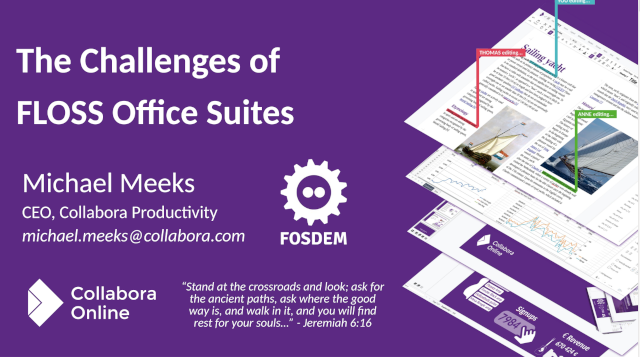
    • Gave a talk scraping the surface of why writing your own office suite from scratch is really foolish, although an increasingly popular folly these days:
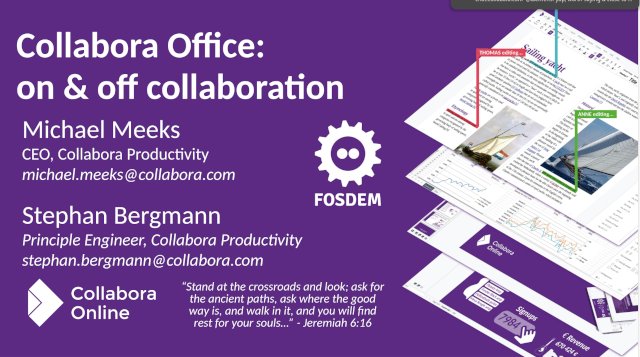
    • More wandering, grabbed some lunch, gave a talk with Stephan on on&off collaborative editing:
    • Out to the XWIKI drinks party & dinner in the evening. /ul>
    • Pl chevron_right

      This Week in GNOME: #234 Annotated Documents

      news.movim.eu / PlanetGnome • 30 January 2026 • 6 minutes

    Update on what happened across the GNOME project in the week from January 23 to January 30.

    GNOME Core Apps and Libraries

    Document Viewer (Papers) ↗

    View, search or annotate documents in many different formats.

    lbaudin announces

    Papers can now be used to draw freehand annotations on PDF documents (ink), as well as add text to them! These features were merged this week and are now available in GNOME nightly, more details in this blog post .

    papers.mQXjQQiK_Z2unixv.webp

    GTK ↗

    Cross-platform widget toolkit for creating graphical user interfaces.

    Emmanuele Bassi reports

    As usual, a few GTK developers are meeting up before FOSDEM for the planning hackfest; we are discussing the current state of the project, and also where do we want to go in the next 6-12 months:

    • the new SVG rendering code
    • accessibility
    • icons and other assets
    • platform support, especially Windows and Android
    • various improvements in the GLib code
    • the state of various dependencies, like gdk-pixbuf and accesskit
    • whether to introduce unstable API as an opt in for experimentation, before finalising it

    You can follow along the agenda, and the notes here: https://pad.gnome.org/gtk-hackfest-2026

    We are also going to be at the GNOME social event on Saturday in Brussels, so make sure to join us!

    Emmanuele Bassi says

    Matthias just released a new GTK 4.21 developers snapshot , in time for GNOME 50’s beta release. This release brings various changes:

    • the state saving and restoring API has been made private; we have received feedback by early adopters, and we are going to need to go back to the drawing board in order to address some issues related to its use
    • GSK shaders are now autogenerated
    • GTK does not depend on librsvg any more, and implements its own SVG renderer, including various filters
    • the Inspector has a heat map generator
    • SVG filters can be used inside CSS data URLs
    • GtkAspectFrame’s measurement has been fixed to properly (and efficiently) support more cases and fractional sizes

    Additionally, we have multiple fixes for Windows, macOS, and Android. Lots of things to look forward for the 4.22 stable release!

    GNOME Circle Apps and Libraries

    gtk-rs ↗

    Safe bindings to the Rust language for fundamental libraries from the GNOME stack.

    Julian 🍃 announces

    After a quite long hiatus, I continued writing on the gtk4-rs book. This time we introduce the build system Meson. This sets the stage for more interesting features like internationalization: https://gtk-rs.org/gtk4-rs/stable/latest/book/meson.html

    Mahjongg ↗

    Match tiles and clear the board

    Mat announces

    Mahjongg 49.1 has been released, and is available on Flathub . This release mainly focuses on usability improvements, and includes the following changes:

    • Implement pause menu with ‘Resume’ and ‘Quit’ buttons
    • Add Escape keyboard shortcut to pause game
    • Pause game when main window is obscured
    • Pause game when dialogs and menus are visible
    • Don’t allow pausing completed games
    • Don’t show confirmation dialog for layout change after completing game
    • Fix text entry not always receiving focus in Scores dialog
    • Translation updates

    mahjongg-paused.g7ScB1vB_ZqiIH2.webp

    Third Party Projects

    Danial reports

    We are announcing an important update to Carburetor , our tool for easily setting up a Tor proxy. This release focuses on crucial improvements for users in Iran, where Tor remains one of the few reliable ways to stay connected.

    Following the massacre of protesters by Iran state which reportedly led to the killing of more than 60,000 individuals in a couple of days (this includes shooting injured people into the head on the hospital beds), the Internet and all other means of communications such as SMS and landlines suffered a total shutdown. After dozen of days, network access is now very fragile and heavily restricted there.

    In response, this update adds support for Snowflake bridges with AMP cache rendezvous, which have proven more reliable under current conditions. To use them, ensure these two bridges are included in your inventory:

    snowflake 192.0.2.5:80 2B280B23E1107BB62ABFC40DDCC8824814F80A72 url=https://snowflake-broker.torproject.net/ ampcache=https://cdn.ampproject.org/ front=www.google.com tls-imitate=hellorandomizedalpn
    snowflake 192.0.2.6:80 8838024498816A039FCBBAB14E6F40A0843051FA url=https://snowflake-broker.torproject.net/ ampcache=https://cdn.ampproject.org/ front=www.google.com tls-imitate=hellorandomizedalpn

    We’ve also removed the previous 90 seconds connection timeout, as establishing a connection now often takes much longer due to extreme throttling and filtering, sometimes more than 10 minutes.

    Additionally, dependencies like Tor and pluggable transports have been updated to ensure better stability and security.

    Stay safe. Keep connected.

    Carburetor.mjXq36N6_1d6hqR.webp

    justinrdonnelly announces

    I’ve just released a new version of Bouncer. Launching Bouncer now opens a dashboard to show the status of required components and configurations. Longtime users may not notice, but this will be especially helpful for new users trying to get Bouncer up and running. You can get Bouncer from Flathub !

    bouncer-dashboard-light.Dqo6rbTf_Zuar6T.webp

    Jeffry Samuel says

    Alpaca 9 is out, now users can now implement character cards to make role-play scenarios with their AI models, this update also brings changes to how Alpaca integrates Ollama instances, simplifying the process of running local AI even more. Check out the release discussion for more information -> https://github.com/Jeffser/Alpaca/discussions/1088

    ollama_manager.CLJ79u5l_Z10qlwX.webp

    Daniel Wood reports

    Design, 2D computer aided design (CAD) for GNOME sees a new release, highlights include:

    • Enable clipboard management (Cut, Copy, Paste, Copy with basepoint, Select All)
    • Add Cutclip Command (CUTCLIP)
    • Add Copyclip Command (COPYCLIP)
    • Add Copybase Command (COPYBASE)
    • Add Pasteclip Command (PASTECLIP)
    • Add Match Properties Command (MA)
    • Add Pan Command (P)
    • Add Zoom Command (Z)
    • Show context menu on right click
    • Enable Undo and Redo
    • Improved Trim (TR) command with Arc, Circle and Line entities
    • Indicate save state on tabs and header bar
    • Plus many fixes!

    Design is available from Flathub:

    https://flathub.org/apps/details/io.github.dubstar_04.design

    Design-2D-CAD-TWIG-234.DLC2YvqK_1GX0yO.webp

    slomo announces

    GStreamer 1.28.0 has been released! This is a major new feature release, with lots of exciting new features and other improvements. Some highlights:

    • GTK4 is now shipped with the GStreamer binaries on macOS and Windows alongside the gtk4paintablesink video sink
    • vulkan plugin now supports AV1, VP9, HEVC-10 decoding and H264 encoding
    • glupload now has a udmabuf uploader to more efficiently share video buffers, leading to better perf when using, say, a software decoder and waylandsink or gtk4paintablesink
    • waylandsink has improved handling for HDR10 metadata
    • New AMD HIP plugin and integration library
    • Analytics (AI/ML) plugin suite has gained numerous new features
    • New plugins for transcription, translation and speech synthesis, etc
    • Enhanced RTMP/FLV support with HEVC support and multi-track audio
    • New vmaf element for perceptual video quality assessment using Netflix’s VMAF framework
    • New source element to render a Qt6 QML scene
    • New GIF decoder element with looping support
    • Improved support for iOS and Android
    • And many, many more new features alongside the usual bug fixes

    Check the extensive release notes for more details.

    rat reports

    Echo 3 is released! Echo is a GUI ping utlity.

    Version 3 brings along two notable features: instant cancelling of pings and a “Trips” tab showing details about each trip made in the ping.

    As well as smaller changes to the layout: removed the ping options expander and moved error messages below the address bar.

    Get it on Flathub: https://flathub.org/en/apps/io.github.lo2dev.Echo

    Echo-version-3.CXAL5K5X_Z2xiX3.webp

    Pipeline ↗

    Follow your favorite video creators.

    schmiddi reports

    Pipeline 3.2.0 was released. This release updates the underlying video player, Clapper, to the latest version. This in particular allows specifying options passed to yt-dlp for video playback, including cookies files or extractor arguments. Besides that, it also adds some new keyboard shortcuts for toggling fullscreen and the sidebar, and fixes quite a few bugs.

    One important note: Shortly before the release of this version, YouTube decided to break yt-dlp. We are working on updating the yt-dlp version, but as a temporary workaround, you can add the following string to the yt-dlp extraction arguments configurable in the preferences: youtube:player_client=default,-android_sdkless .

    Shell Extensions

    Just Perfection says

    Just Perfection extension is now ported to GNOME Shell 50 and available on EGO. This update brings bug fixes and new features, including toggles for backlight and DND button visibility.

    Internships

    lbaudin announces

    Malika is now halfway through her Outreachy internship about signatures in Papers and has made great progress! She just published a blog post about her experience so far, you can read it here .

    That’s all for this week!

    See you next week, and be sure to stop by #thisweek:gnome.org with updates on your own projects!

    • Pl chevron_right

      Mathias Bonn: The Hobby Lives On

      news.movim.eu / PlanetGnome • 28 January 2026 • 1 minute

    Maintaining an open source project in your free time is incredibly rewarding. A large project full of interesting challenges, limited only by your time and willingness to learn. Years of work add up to something you’ve grown proud of. Who would’ve thought an old project on its last legs could turn into something beautiful?

    The focus is intense. So many people using the project, always new things to learn and improve. Days fly by when time allows for it. That impossible feature sitting in the backlog for years, finally done. That slow part of the application, much faster now. This flow state is pretty cool, might as well tackle a few more issues while it lasts.

    Then comes the day. The biggest release yet is out the door. More tasks remain on the list, but it’s just too much. That release took so much effort, and the years are adding up. You can’t keep going like this. You wonder, is this the beginning of the end? Will you finally burn out, like so many before you?

    A smaller project catches your eye. Perhaps it would be fun to work on something else again. Maybe it doesn’t have to be as intense? Looks like this project uses a niche programming language. Is it finally time to learn another one? It’s an unfamiliar project, but it’s pretty fun. It tickles the right spots. All the previous knowledge helps.

    You work on the smaller project for a while. It goes well. That larger project you spent years on lingers. So much was accomplished. It’s not done yet, but software is never done. The other day, someone mentioned this interesting feature they really wanted. Maybe it wouldn’t hurt to look into it? It’s been a while since the last feature release. Maybe the next one doesn’t have to be as intense? It’s pretty fun to work on other projects sometimes, too.

    The hobby lives on. It’s what you love doing, after all.

    • Pl chevron_right

      Lucas Baudin: Drawing and Writing on PDFs in Papers (and new blog)

      news.movim.eu / PlanetGnome • 28 January 2026 • 1 minute

    Nearly 10 years ago, I first looked into this for Evince but quickly gave up. One year and a half ago, I tried again, this time in Papers. After several merge requests in poppler and in Papers, ink and free text annotations support just landed in Papers repository!

    Therefore, it is now possible to draw on documents and add text, for instance to fill forms. Here is a screenshot with the different tools:

    Papers with the new drawing tools

    This is the result of the joint work of several people who designed, developed, and tested all the little details. It required adding support for ink and free text annotations in the GLib bindings of poppler, then adding support for highlight ink annotations there. Then several things got in the way adding those in Papers; among other things, it became clear that an undo/redo mechanism was necessary and annotations management was entangled with the main view widget. It was also an opportunity to improve document forms, which are now more accessible.

    This can be tested directly from the GNOME Nightly flatpak repository and new issues are welcomed.

    Also, this is a new blog and I never quite introduced myself: I actually started developing with GTK on GTK 2, at a time when GTK 3 was looming. Then I took a long break and delved again into desktop development two years ago. Features that just got merged were, in fact, my first contributions to Papers. They are also the ones that took the most time to be merged! I became one of Papers maintainers last March, joining Pablo (who welcomed me in this community and stopped maintenance since then), Markus, and Qiu.

    Next time, a post about our participation in Outreachy with Malika's internship !

    • Pl chevron_right

      Asman Malika: Mid-Point Project Progress: What I’ve Learned So Far

      news.movim.eu / PlanetGnome • 26 January 2026 • 2 minutes

    Dark mode: Manual Signature Implementation

    Light mode: When there is no added signature

    Reaching the midpoint of this project feels like a good moment to pause, not because the work is slowing down, but because I finally have enough context to see the bigger picture.

    At the start, everything felt new: the codebase, the community, the workflow, and even the way problems are framed in open source. Now, halfway through, things are starting to connect.

    Where I Started

    When I began working on Papers, my main focus was understanding the codebase and how contributions actually happen in a real open-source project. Reading unfamiliar code, following discussions, and figuring out where my work fit into the larger system was challenging.

    Early on, progress felt slow. Tasks that seemed small took longer than expected, mostly because I was learning how the project works, not just what to code. But that foundation has been critical.

    Photo: Build failure I encountered during development

    What I’ve Accomplished So Far

    At this midpoint, I’m much more comfortable navigating the codebase and understanding the project’s architecture. I’ve worked on the manual signature feature and related fixes, which required carefully reading existing implementations, asking questions, and iterating based on feedback. I’m now working on the digital signature implementation, which is one of the most complext part of the project and builds directly on the foundation laid by the earlier work.

    Beyond the technical work, I’ve learned how collaboration really functions in open source:

    • How to communicate progress clearly
    • How to receive and apply feedback
    • How to break down problems instead of rushing to solutions

    These skills have been just as important as writing code.

    Challenges Along the Way

    One of the biggest challenges has been balancing confidence and humility, knowing when to try things independently and when to ask for help. I’ve also learned that progress in open source isn’t always linear. Some days are spent coding, others reading, debugging, or revisiting decisions.

    Another challenge has been shifting my mindset from “just making it work” to thinking about maintainability, users, and future contributors. That shift takes time, but it’s starting to stick.

    What’s Changed Since the Beginning

    The biggest change is how I approach problems.

    I now think more about who will use the feature, who might read this code later, and how my changes fit into the overall project. Thinking about the audience, both users of Papers and fellow contributors, has influenced how I write code, documentation, and even this blog.

    I’m also more confident participating in discussions and expressing uncertainty when I don’t fully understand something. That confidence comes from realizing that learning in public is part of the process.

    Looking Ahead

    The second half of this project feels more focused. With the groundwork laid, I can move faster and contribute more meaningfully. My goal is to continue improving the quality of my contributions, take on more complex tasks, and deepen my understanding of the project.

    Most importantly, I want to keep learning about open source, about collaboration, and about myself as a developer.

    Final Thoughts

    This midpoint has reminded me that growth isn’t always visible day to day, but it becomes clear when you stop and reflect. I’m grateful for the support, feedback, and patience from GNOME community, especially my mentor Lucas Baudin. And I’m so excited to see how the rest of the project unfolds.