
• chevron_right

      Owners mourn spoiled food after firmware update bricks Samsung smart fridges

      news.movim.eu / ArsTechnica • 23 September 2026

    Some Samsung smart fridges stopped working on Tuesday due to a firmware update.

    Korean outlets were the first to report the problems, which affect Samsung’s Bespoke AI line of fridges. Star News Korea, per a Google-provided translation, said that most of the affected devices were four-door fridges from 2024 or later.

    Affected fridges “suddenly lost power and stopped functioning immediately after” trying to issue a firmware update through SmartThings, Samsung’s smart home platform, per Star News Korea. The SmartThings app then showed the devices as offline. Some users said that their fridge’s internal display was stuck showing the message "Checking SmartThings app during update.”
    Read full article

    Comments

    • chevron_right

      Former NASA chief sounds alarm on China's lunar "exploration" plans

      news.movim.eu / ArsTechnica • 23 September 2026

    In a forthcoming memoir, former US politician and NASA Administrator Bill Nelson offers a blistering assessment of China, saying the United States must do all it can to retain its leadership in space exploration.

    "Beijing's intended strategy is to dominate the high ground of the twenty-first century," writes Nelson in Space Odyssey, a book to be published by Harper Horizon in January 2027.

    A former Congressman and Senator from Florida, Nelson served as a mission specialist on a space shuttle flight in 1986 and later as NASA administrator from May 2021 to January 2025 under President Biden. The book largely focuses on his space policy work in Congress and his tenure as NASA's leader.

    Read full article

    Comments

    • chevron_right

      After multiple deaths and injuries, NHTSA is investigating comma.ai

      news.movim.eu / ArsTechnica • 23 September 2026

    Aftermarket devices that can boost or augment a vehicle’s native advanced driver assistance systems are the target of a new federal investigation this week. The National Highway Traffic Safety Administration’s Office of Defects Investigation says it knows of five crashes in which drivers using devices from comma.ai crashed into stopped or slow-moving cars. Two of the crashes resulted in three deaths, and 11 people were injured in four of the five crashes, some seriously.

    Comma.ai was the brainchild of George Hotz, who rose to prominence at the start of the last decade by jailbreaking iOS and hacking Sony PlayStations. In 2015, Hotz turned his attention to partially automated driver assists, which were gaining attention following Tesla’s exploits with its Autopilot system. Hotz first modified his own Acura to give it a more advanced driver assist that let him take his hands off the wheel, with the goal of selling his system to Tesla and replacing Mobileye as the company’s supplier.

    (Mobileye dropped Tesla as a customer the following year after becoming unhappy with the way the car company was using Mobileye products in unintended ways.)

    Read full article

    Comments

    • chevron_right

      America gave up its rare earth edge. China took full advantage.

      news.movim.eu / ArsTechnica • 23 September 2026

    Look around you, and you’ll see rare earth elements at work. A phone vibrates because a magnet moves a weight. Its screen was polished with cerium powder. Its connection to the rest of the world crosses oceans on cables amplified with erbium. If you drove today, a rare earth magnet helped you steer, and a cerium compound scrubbed the exhaust.

    All of these devices function because of 17 metals collectively known as rare earth elements. The scientists who gave the group that name in 1794 created a misnomer. Cerium alone is about as common in the Earth’s crust as copper.

    However, separating rare earth minerals from one another and from raw ore is intensely difficult. As a result, countries that control the processing of rare earth minerals have a lot of political leverage.

    Read full article

    Comments

    • chevron_right

      Small undersea volcanoes may unleash outsized tsunamis

      news.movim.eu / ArsTechnica • 23 September 2026

    Krakatau, a volcanic island in Indonesia, killed more than 30,000 people when it erupted in 1883. One might assume that volcanic debris posed the major threat, yet many of the victims died from a tsunami caused by the volcanic eruption instead.

    Volcanoes at sea can pose hazards quite different from those on land, as their impact can vary depending on how the volcanic activity interacts with seawater. In the deep ocean, high water pressure can suppress explosive volcanic activity, making eruptions less destructive. But closer to the surface, the lower water pressure and the high temperatures of volcanic material can cause violent explosions. Yet scientists still do not fully understand the conditions under which volcanic activity can cause a tsunami.

    To better understand these risks, an international team of researchers examined the 2022 Hunga eruption in Tonga, focusing on the rapid caldera collapse that may have amplified its powerful tsunami. Calderas form when the ground above a magma reservoir collapses as the magma drains away. Comparisons of seafloor topography before and after the eruption showed that a roughly four-kilometer-wide caldera sank by about a kilometer during the eruption.

    Read full article

    Comments

    • chevron_right

      A new report from Europe raises serious alarms about orbital collisions

      news.movim.eu / ArsTechnica • 23 September 2026

    The 2013 sci-fi blockbuster film Gravity, starring Sandra Bullock and George Clooney, popularized the notion of the Kessler syndrome. In the movie, Russia shoots down a defunct satellite and creates a cloud of debris, leading to serious tension in orbit.

    The movie is fantastic, a true thriller, and while some liberties were taken with the depiction of outer space, the basic premise of a cascading series of collisions rendering orbits too cluttered with debris to be usable is valid. The idea was first proposed by NASA scientists Donald Kessler and Burton Cour-Palais nearly half a century ago.

    Still, the movie was science fiction, right?

    Read full article

    Comments

    • chevron_right

      Woman's brain worm infection confirmed after eggs grow tails in lab test

      news.movim.eu / ArsTechnica • 22 September 2026

    Out of nowhere, a woman's right arm and leg started shaking uncontrollably. In the moments leading up to the experience, she seemed well; she had no headache, confusion, or weakness. But for about a minute, half of her body juddered.

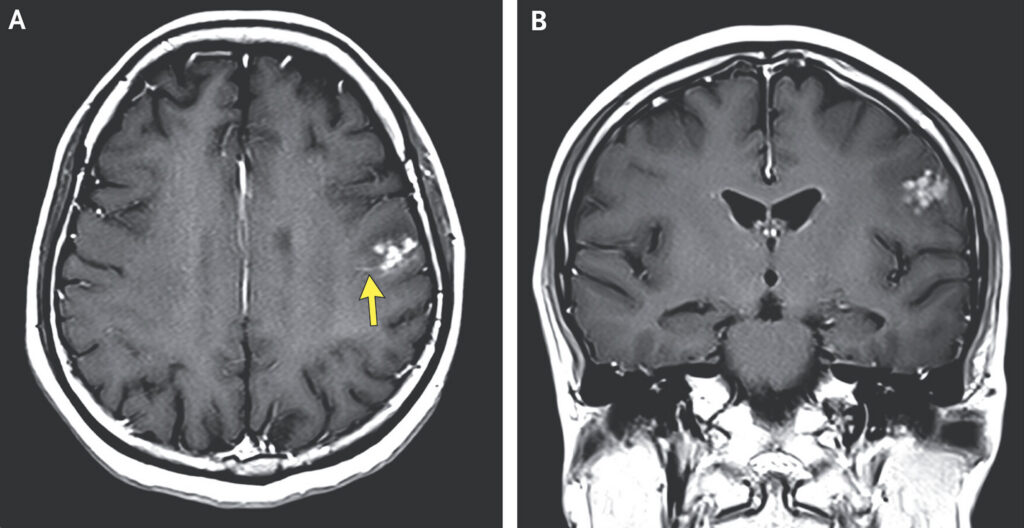
    The woman, a rice farmer in the Philippines, headed to the emergency department. There, doctors gave her a physical exam and found nothing out of the ordinary. Then they took a look at her brain. Magnetic resonance imaging revealed a bright cluster of nodules surrounded by fluid in her left frontal lobe. The doctors had an immediate guess as to what they were: worm eggs.

    An MRI of the woman's brain showing nodules. Credit: NEJM, 2026

    In a case report published in the latest issue of the New England Journal of Medicine, doctors write that they suspected the woman had neuroschistosomiasis, an uncommon complication of an infection with a Schistosoma parasitic worm, aka a blood fluke. In the Philippines, the most common fluke is S. japonicum. It's also found in China and part of Indonesia; despite its name, it has been eliminated from Japan.

    Read full article

    Comments

    • chevron_right

      New Anthropic, OpenAI models make same promise: A little more for a lot less money

      news.movim.eu / ArsTechnica • 22 September 2026

    OpenAI and Anthropic both recently released new models aimed at lowering costs. Anthropic announced Opus 5.5, the latest version of its main mass-market workhorse model, used for tasks like coding and other complex knowledge work.

    And OpenAI announced GPT-6 Sol and Luna, the latest versions of its middle-of-the-road or smaller models focused on efficiency and speed.

    Read full article

    Comments

    • chevron_right

      Cities across US oppose Trump FCC plan to preempt local broadband rules

      news.movim.eu / ArsTechnica • 22 September 2026

    Cities and counties around the US are angry at the Trump administration over a proposal to override local rules that govern the deployment of wired broadband networks.

    The Federal Communications Commission has been taking public comments on a Notice of Proposed Rulemaking that proposes to preempt state and local permitting rules. The FCC argues that too many local governments "excessively delay approvals and seek to extract exorbitant sums from providers, resulting in costs that render some deployments infeasible."

    The FCC plan is supported by broadband providers, but local governments told the FCC that it would override rules that protect public safety. Local governments say the plan is illegal and that the FCC should instead focus on how Internet providers thwart competition with permit-hoarding and other tactics that prevent competitors from deploying networks.

    Read full article

    Comments