

-
To
chevron_right
U.S. Site Blocking Bill Adds VPNs to the List of Blocking Targets
news.movim.eu / TorrentFreak • 21 September 2026 • 4 minutes
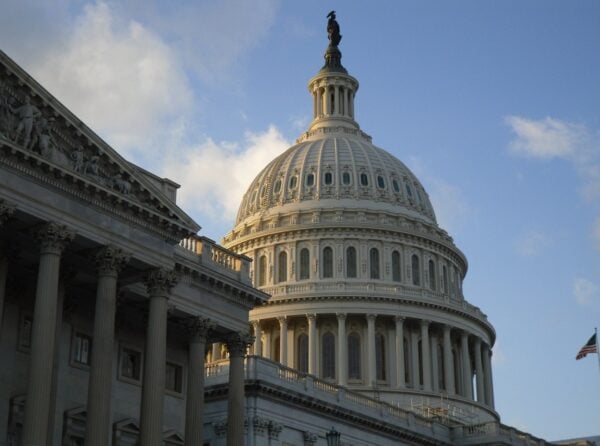 Last week, Rep. Darrell Issa formally introduced his long-awaited site blocking bill: the American Copyright Protection Act.
The text wasn’t public when TorrentFreak first reported on the filing, but an earlier discussion draft suggested that only ISPs and DNS resolvers would be covered. That has changed.
The full text of the bill surfaced online after Public Knowledge shared a copy with Ars Technica. This shows that the final version of the bill goes further than the draft did, explicitly covering ISPs, DNS resolvers, and VPN providers.
VPNs Join the Blocking Parties
The bill allows copyright holders to ask a federal court to determine that a website is a ‘foreign piracy site’. With that declaration in hand, they can then petition for a blocking order that requires specific service providers to prevent people from accessing the site.
These providers exclude domain name registries and root nameservers, but virtual private networks are explicitly covered.
“The term ‘service provider’ includes providers of broadband internet access services, providers of domain name resolution services, and virtual private networks, but excludes root nameserver operators and top level domain registries,” the bill reads.
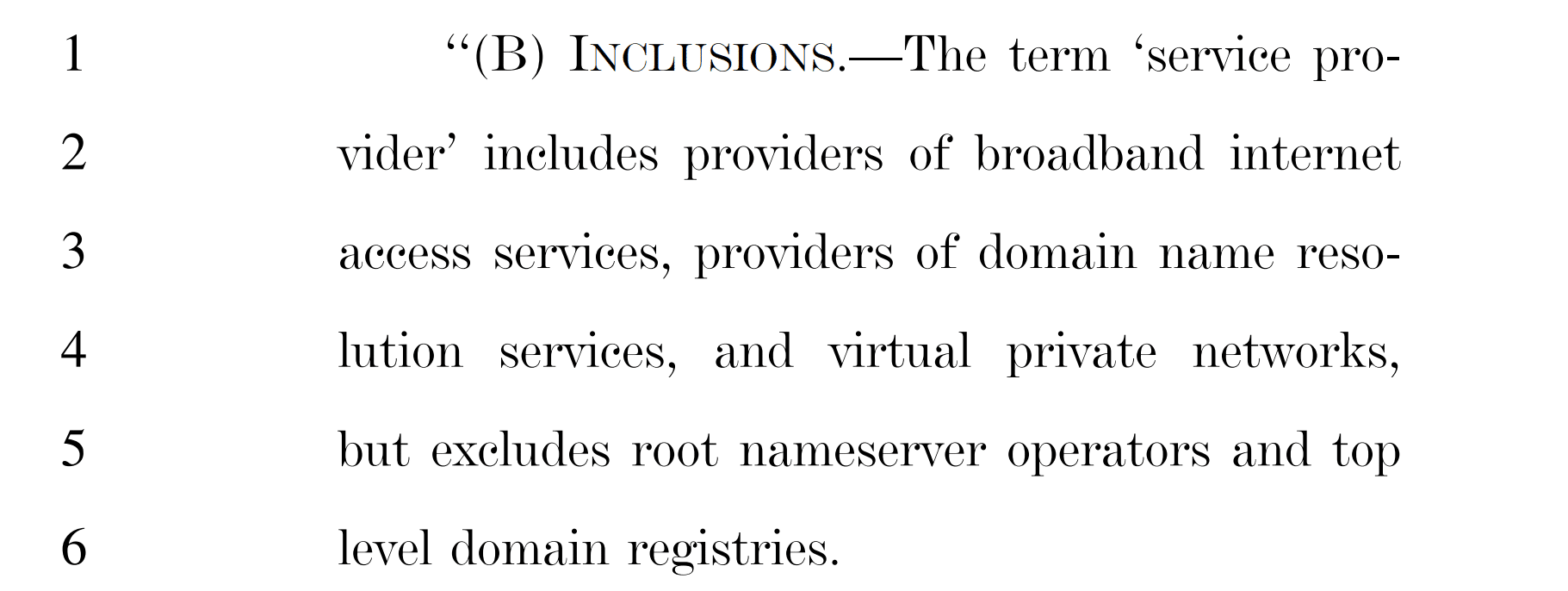
This VPN category is new. The discussion draft TorrentFreak reported on in June last year stated that “both internet service providers (ISPs) and DNS resolvers” would be covered, nothing more.
The bill doesn’t explain why VPNs were added, but it follows a European trend, including orders in France and Spain, where a broader set of intermediaries is required to block pirate sites.
Smaller services are exempt, as the proposed bill excludes “any entity that provides services to fewer than 100,000 monthly users or subscribers in the United States.” That means that it will target the larger providers.
Blocking ‘From the United States’
When an order is issued, providers have 14 to 30 days to “take all commercially reasonable steps to prevent users or subscribers from using its systems or networks to access the foreign piracy site from the United States.”
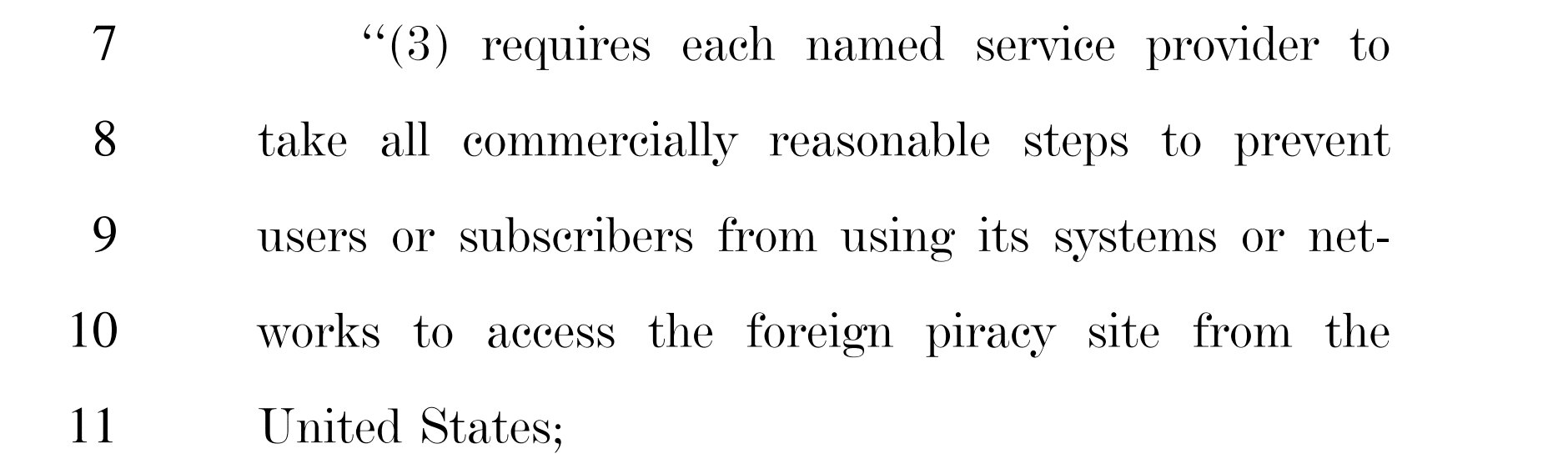
For a regular ISP, that requirement is pretty straightforward. However, for a VPN provider with servers in dozens of countries, it can be interpreted in more than one way, with varying consequences.
A VPN could block the pirate site on its U.S. servers only. That would mean that American subscribers are free to connect through servers in Amsterdam or Toronto, while a Canadian user who connects through New York would be blocked.
Alternatively, a VPN could block the site for everyone who connects from an American IP address, regardless of the server they choose. That should be technically possible without logging a user’s IP address.
The bill doesn’t explain how the technical implementation should work and a judge has no say in it either. The blocking orders can’t prescribe or require any specific blocking techniques, so this choice is left to the providers.
VPN providers can contest their inclusion in a blocking order. Before naming a provider, the court has to weigh several factors, including the “technical feasibility and efficacy” of the blocking.
VPNs raised similar objections in France, with little effect. Among other things, the Paris court concluded that a no-log policy doesn’t prevent VPNs from blocking sites.
Live Sports Fast Track
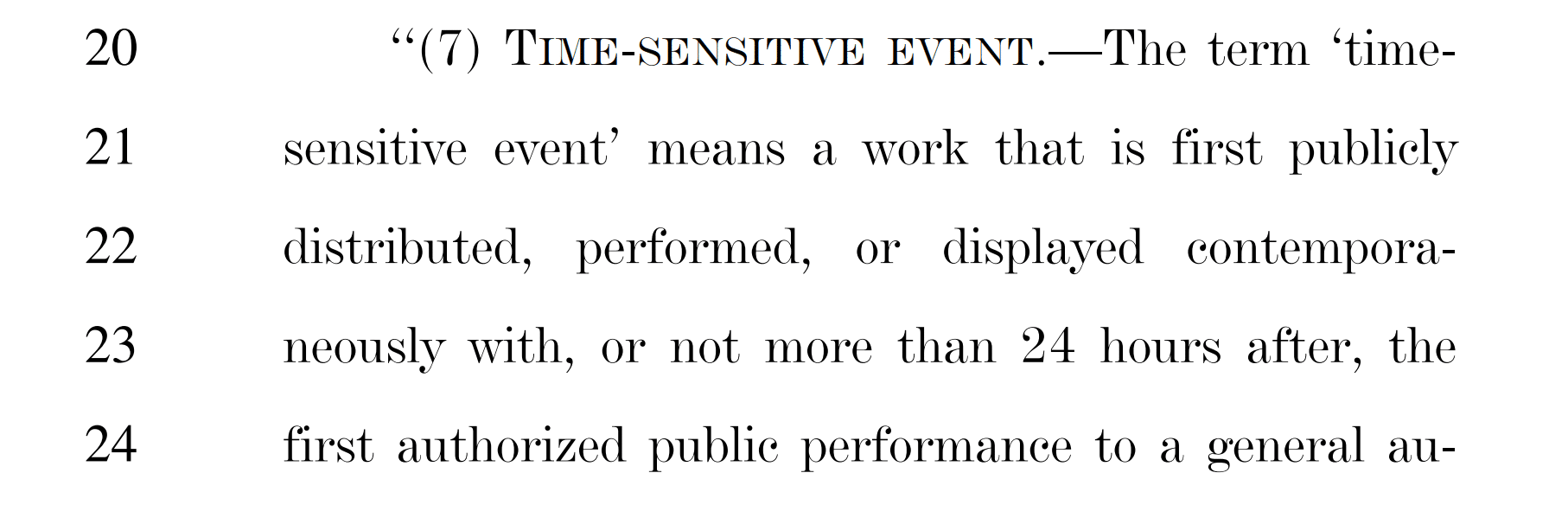
Not all blocking orders have to wait 14 days before being implemented. The court can shorten any deadline in the bill if it finds good cause. This includes blocking measures that target “time-sensitive events.”
Issa previously made it clear who this is for. At a House hearing in June, he said that enforcement has to be fast enough to make a difference during live sports broadcasts, which lose their value quickly.
“[W]hat is the reasonable speed? Can we do it at the speed of sound? Can we do it at the speed of light? More importantly, in a 45 minute or sometimes a fraction of that live sports broadcast, can we do it soon enough to make it no longer profitable for those who pop up and sell their clandestine wares?” he said.
In addition to sports, the “time-sensitive” carveout can also be used to protect movies and TV shows that leak online “not more than 24 hours after” their first authorized release in the United States.
To Be Continued
VPNs are not the only change since the first draft appeared last year. There are other nuances as well, which will be highlighted in future coverage.
For now, most commentary on the bill has come from opponents, including Public Knowledge and Re:Create. Rightsholders have been quiet so far and the MPA informed TorrentFreak that it will share a statement once Issa’s office issues its press release.
Whether Rep. Issa will get the bill across the finish line is uncertain. He retires at the end of this year, so he won’t be around to reintroduce it if it doesn’t pass during the current session.
Notably, this is not the only U.S. site blocking bill that’s being prepared. As previously reported, Senator Thom Tillis and Rep. Zoe Lofgren are working on a bicameral site blocking bill of their own.
This means that, after the SOPA-ghosts were defeated, there’s now some internal site-blocking competition on the Hill.
—
A copy of the American Copyright Protection Act of 2026 (H.R. 10364) is available here (pdf).
From: TF, for the latest news on copyright battles, piracy and more.