

-
To
chevron_right
Adviser of EU’s Highest Court Backs VPN Neutrality in Anne Frank Copyright Battle
news.movim.eu / TorrentFreak • 25 January 2026 • 3 minutes
 The Diary of Anne Frank
, written by a young girl hiding from the Nazis in Amsterdam during World War II, is one of the best-known literary works in history.
The Diary of Anne Frank
, written by a young girl hiding from the Nazis in Amsterdam during World War II, is one of the best-known literary works in history.
While the diary’s importance is widely agreed upon, the accessibility of its digital likeness remains at the center of a modern-day copyright battle.
These copyrights are controlled by the Swiss-based Anne Frank Fonds, which was the sole heir of Anne’s father, Otto Frank. The Fonds states that many print versions of the diary remain protected for decades , and even the manuscripts are not freely available everywhere.
In the Netherlands, for example, certain sections of the manuscripts remain protected by copyright until 2037, even though they have entered the public domain in neighboring countries like Belgium.
Anne Frank ©
To navigate these conflicting laws, the Dutch Anne Frank Stichting published a scholarly edition online using “state-of-the-art” geo-blocking to prevent Dutch residents from accessing the site. Visitors from the Netherlands and other countries where the work is protected are met with a clear message, informing them about these access restrictions.

“The scholarly edition of the Anne Frank manuscripts cannot be made available in all countries, due to copyright considerations,” is the message disallowed visitors get to see.
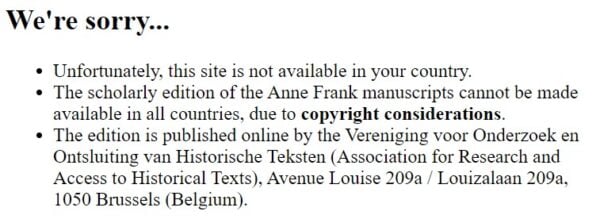
Despite these blocking measures, the Swiss-based Anne Frank Fonds was not pleased. The Fonds essentially argued that if a block isn’t 100% bypass-proof, the content shouldn’t be online at all.
The Dutch lower court dismissed this argument, stating the defendants had taken reasonable measures to prevent access from the Netherlands. The Fonds appealed, without result, and the case is now before the Dutch Supreme Court, which referred several questions to the EU’s top court (CJEU) to decide the fate of VPN neutrality and the sufficiency of geo-blocking.
Court Adviser Backs VPN Neutrality
In an opinion published this month, Advocate General Rantos of the Court of Justice of the European Union (CJEU) sides with common sense, concluding that geo-blocking is a sufficient measure to protect against unauthorized access.
The opinion concludes that digital copyright protections can always be broken or bypassed. That by itself should not automatically mean that the publisher is liable, especially if ‘state-of-the-art’ geo-blocking measures are in place, as the Anne Frank Stichting argued.
“Liability would only arise if the technical measures were found to be deliberately ineffective so that they could be easily circumvented,” the opinion reads.
Equally important, Rantos concludes that a VPN provider isn’t liable for the unlawful actions of users who use their service to bypass geographical restrictions.
“The mere fact that those or similar services may be used for [unlawful] purposes is not sufficient to establish that the service providers themselves communicate the protected work to the public,” the Advocate General writes.
“It would be different if those service providers actively encouraged the unlawful use of their services. In that case, the service providers could be regarded as playing an essential role in making the works in question available.”
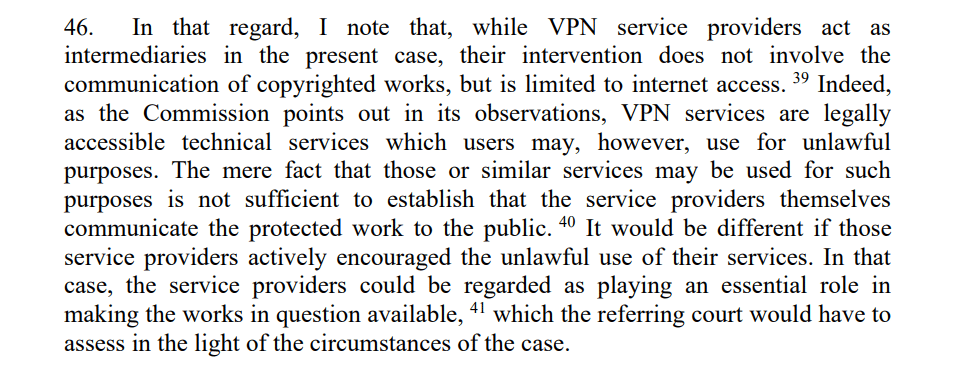
In other words, the opinion concludes that VPNs are neutral services and that they can only be held liable if they actively encourage copyright infringement or other wrongdoing.
What’s Next?
The opinion is not binding for the CJEU, which is expected to issue its final ruling later this year. This final ruling will be key for the digital future of the Anne Frank Diary, as well as all other geo-blocked content on the Internet.
If the court agrees with the opinion of Advocate General Rantos, the status quo will remain. However, if geo-blocking were somehow not to be sufficient, this would impact hundreds of popular sites and services, including all popular video streaming platforms.
Even worse, if VPNs were to be held liable for the actions of users without the providers’ awareness, that would create some significant backlash.
—
A copy of the opinion of Advocate General Athanasios Rantos, delivered on 15 January, is available here (pdf) .
From: TF , for the latest news on copyright battles, piracy and more.