
• chevron_right

      Websites have a new way to spy on visitors: analyzing their SSD activity

      news.movim.eu / ArsTechnica • 27 May 2026

    Over the decades, there has been no shortage of sites using clever techniques to covertly track visitors’ browsing histories , device fingerprints , and log keystrokes and mouse movements in real time. Even Meta and Yandex were recently caught joining in the privacy-invasive free-for-all .

    Now sites have a new way to spy on their visitors: measuring subtle interactions with their solid-state drives. The technique, named FROST (fingerprinting remotely using OPFS-based SSD timing), allows sites to monitor other sites a visitor is viewing and what apps are open on their devices.

    A side channel based on contention

    The technique, laid out in a research paper , exploits a side channel , a form of leak resulting from physical manifestations such as electromagnetic emanations, data caches, or the time required to complete a task. By measuring the manifestations, attackers can decrypt encrypted traffic and infer other confidential data.
    Read full article

    Comments

    • chevron_right

      Mystery GPS jammer in Iran becomes test for NASA satellites’ capabilities

      news.movim.eu / ArsTechnica • 27 May 2026

    NASA satellites designed to observe cyclone wind speeds and collapsing ice sheets have also proven capable of identifying the approximate locations of GPS jammers. That could help monitor high-risk areas for aircraft and ships navigating the growing prevalence of GPS interference worldwide.

    Two different NASA satellite systems showed how they could locate a known but mysterious GPS jammer within several kilometers of its position in Iran, according to an experiment by Sean Gorman , CEO and cofounder of the location-based technology company Zephr.xyz that was detailed in the magazine GPS World . Such jammers use strong signals to overpower the weaker radio signals coming from US-operated GPS satellites and other global navigation satellite systems.

    Such NASA satellites cannot perform “near-real time monitoring” or pinpoint the exact location of GPS jammers, said Clara Chew , principal scientist and lead of the GNSS systems and data team at the California-based satellite manufacturer Muon Space, who was not involved in the study. But Chew told Ars that identifying the approximate locations of GPS jammers “could potentially be helpful for flight planning” or for “indicating high risk areas for maritime shipping.”

    Read full article

    Comments

    • chevron_right

      Mina the Hollower is the best old-school action adventure I've played in a while

      news.movim.eu / ArsTechnica • 27 May 2026 • 1 minute

    Modern Legend of Zelda games like Breath of the Wild are built around Link's ability to run, climb, and jump with the best of them. In old-school, top-down Zelda titles, though, the ability to increase Link's sad starting mobility was a banner event. Finding items like the speed-enhancing Pegasus Boots in Link to the Past or the jump-granting Roc's Feather in Link's Awakening made the methodical exploration in these games feel that much more kinetic and akin to a top-down platform game.

    This kind of kinetic feeling is built into Mina the Hollower from the start. As the titular, mouse-like Hollower, you're armed with the ability to jump up and burrow into soft soil, zipping under obstacles and past enemies with satisfying pep as you do. After a short sojourn underground, you pop out with an extended jump that quickly becomes second nature.

    The sense of energy and verve built in to this simple movement system makes Mina a joy to control. You feel that joy when you burrow away from an enemy attack only to quickly circle back to pop out for a quick counter. You feel it burrowing underneath the scenery through a small hole to uncover a labyrinthine secret corridor. You feel it hopping and bouncing across a series of gaps on inflatable, balloon-like pads.

    Read full article

    Comments

    • chevron_right

      Nvidia bets $150B on Taiwan as Trump's plan to make US an AI hub backfires

      news.movim.eu / ArsTechnica • 27 May 2026

    In a splashy move that signals that Taiwan remains irreplaceable to the AI industry's short-term and long-term goals, Nvidia CEO Jensen Huang announced Wednesday that his chip company will invest $150 billion a year to make sure Taiwan remains at the "epicenter" of the "AI revolution."

    "This is where the chips come, packaging comes, this is where the systems are made, this is where AI supercomputers were created," Huang said. "The number of partners we work with here in Taiwan, incredible."

    As Reuters reported , the substantial investments will be used to create a new Taiwan headquarters for Nvidia, which Huang expects will drive so much AI innovation that the partnership will cement Taiwan as "the world's tech manufacturing hub for a long time." That ambitious project will be operational by 2030, Nvidia anticipates, after breaking ground this year.

    Read full article

    Comments

    • chevron_right

      Roku OS’s home screen now features a large, permanent ad

      news.movim.eu / ArsTechnica • 27 May 2026

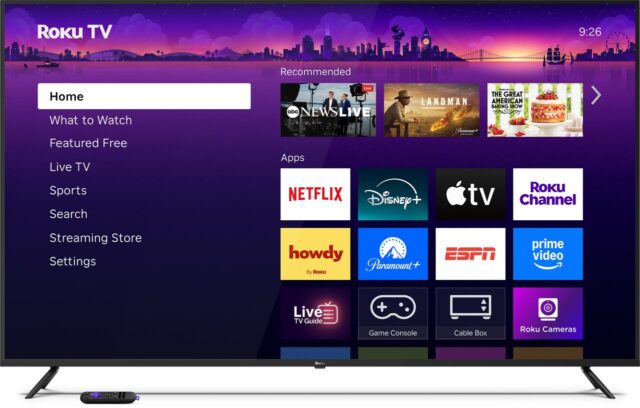
    Roku just unveiled the biggest overhaul to its smart TV operating system (OS) in 10 years. The most noticeable difference is a new ad space that takes up a large chunk of the screen’s right side.

    Before the update, loading up a Roku OS-powered smart TV or streaming device would yield a menu on the left side with sections including “What to Watch,” “Live,” and “Search.” The right side had a row of tiles for “Recommended” content above several rows of tiles representing downloaded apps.

    The old Roku home screen. Credit: Roku

    The right side of the new Roku OS home screen is dedicated to ads. The ad remains visible as you navigate different parts of the Roku menu, taking away space that could be used for displaying apps and content.

    Read full article

    Comments

    • chevron_right

      Valve's Steam Deck is back in stock after months, but you won't like it

      news.movim.eu / ArsTechnica • 27 May 2026 • 1 minute

    Valve's Steam Deck handheld has been largely unavailable to buy since mid-February, a victim of the RAM and storage shortages that have been driving up prices for most consumer tech since the fall of 2025. The good news is that the Deck is back in stock on Valve's site and ready to ship in three to five days; the bad news is that it appears to have returned because somebody wished for it on a monkey's paw .

    The 512GB version of the OLED Steam Deck now sells for a whopping $789, $240 more than its previous $549 price. The 1TB version (which also includes an anti-glare screen coating, a slightly nicer case, and an "exclusive startup movie and keyboard theme") will now run you $949, a $300 increase from its old $649 price. The old $399 base model with 256GB of storage and the older LCD screen has been discontinued, though this had been announced well before these price increases took effect.

    These prices are particularly hard to swallow for a nearly 3-year-old revision of an over-4-year-old handheld PC . If there's a saving grace for Valve, it's that most competing handhelds from the likes of Asus and Lenovo are also pushing or exceeding that $1,000 mark. Of the Deck's major competitors, only the $600 Asus ROG Xbox Ally (and its AMD Ryzen Z2 A processor, which is very similar to the Deck's semi-custom AMD chip) is significantly cheaper than the Steam Deck.

    Read full article

    Comments

    • chevron_right

      Trump admin to block Ebola-exposed Americans from US, move them to Kenya

      news.movim.eu / ArsTechnica • 27 May 2026 • 1 minute

    The Ebola outbreak in the Democratic Republic of the Congo continues to spread wildly, outpacing the international response efforts sprinting to catch up to the deadly Bundibugyo virus strain. The outbreak was first announced May 15 and is already the third largest recorded. The World Health Organization's latest numbers as of May 24 are 1,018 cases (906 suspected, 112 confirmed) with 234 deaths (223 suspected, 11 confirmed). But these are known to be a significant undercount of the true spread and are also likely out of date by now.

    The WHO and other national health agencies are calling for international support and collaboration to bring the outbreak under control. But it appears that the US is instead choosing to try to wall itself off—even to its own citizens and lawful residents.

    On Friday, the Trump administration announced it was escalating its controversial travel ban , now barring even lawful permanent residents (green card holders) from entering the country if they have traveled to the DRC, Uganda, or South Sudan in the 21 days prior. The move is in addition to already barring non-US passport holders with such a travel history. Notably, Uganda has only reported seven cases and one death in the outbreak; there have been no reported cases in South Sudan.

    Read full article

    Comments

    • chevron_right

      "Little red dot" in early Universe is a naked supermassive black hole

      news.movim.eu / ArsTechnica • 27 May 2026 • 1 minute

    The James Webb Space Telescope (JWST) was designed to give us the ability to look at one of the earliest periods in the evolution of the Universe, a time when some of the earliest stars were putting out enough light to ionize the hydrogen that accounted for almost all of the normal matter present at the time. There were lots of ideas about what we might see, but the Universe is full of surprises.

    One of the first surprises was the existence of what picked up the moniker "little red dots," which are exactly what their name suggests. After some initial arguments, it became clear that these were early versions of the supermassive black holes that presently sit at the center of almost every galaxy. Now, gravitational lensing has allowed astronomers to confirm that a little red dot is little more than a supermassive black hole without much in the way of a galaxy around it.

    Making a little red dot bigger

    The little red dot in question is called Abell 2744−QSO1, and gravitational lensing has both magnified it and caused it to appear three times in the vicinity of the galaxy cluster that did the lensing. Based on details in its spectrum, we're looking at the object as it appeared just 700 million years after the Big Bang.

    Read full article

    Comments

    • chevron_right

      US Space Force confirms SpaceX will build sensor-to-shooter targeting network

      news.movim.eu / ArsTechnica • 27 May 2026

    SpaceX has won a lucrative contract to provide the US military with a means of distributing space-based sensing and targeting data, forming the "backbone" of a rearchitected network after separate Pentagon initiatives stalled, officials announced Tuesday.

    Space Systems Command, the Space Force's primary procurement and acquisition center, announced the $2.29 billion firm-fixed-price agreement, confirming long-simmering reports that the Pentagon was likely to tap SpaceX for a new communications network in low-Earth orbit. SpaceX's selection for the Space Data Network (SDN) Backbone contract "accelerates the delivery of a resilient, high-speed communications network in space," Space Systems Command said in a statement.

    The network will be based on technology originally developed for SpaceX's Starlink global Internet constellation. SpaceX already builds and launches specially designed satellites, called Starshield, for military applications. The SDN Backbone network in low-Earth orbit (LEO) will presumably use the Starshield platform.

    Read full article

    Comments