
• chevron_right

      Here's Audi's next Q7 SUV and US-only SQ7, now with an RS V8

      news.movim.eu / ArsTechnica • 9 June 2026 • 1 minute

    Audi provided flights from Washington, DC, to Munich, Germany, and accommodation so Ars could see the Q7, as well as the Q9. We also drove the new RS5. Ars does not accept paid editorial content.

    MUNICH, GERMANY—Audi is having a bit of an SUV renaissance lately. Over the past 18 months, it has brought out a new electric Q6 and replaced the midsize Q5 , and later this summer we'll get to see the Q9 , a full-size leviathan with the Escalade in its sights. But today it's the turn of an all-new version of the Q7, and the North America-only SQ7, both of which go on sale later this year for model year 2027.

    The standard Q7 will come to the US with a twin-turbo 2.9 L V6 that generates 429 hp (320 kW) and 442 lb-ft (600 Nm). Meanwhile, the SQ7 borrows the 591 hp (441 kW), 590 lb-ft (800 Nm) V8 as found under the hood of the RS7 . But there's no plug-in hybrid version slated as far as we know.

    Both models use an eight-speed automatic transmission (ZF's very capable 8HP) and all-wheel drive. Audi says these are the quickest-accelerating Q7 and SQ7s it has made, and it also says they should be much better to drive, too. Standard Q7s will ride on steel springs or can option the adaptive air suspension that's standard on the SQ7—this gets an optional third mode that lowers the car by more than an inch (30 mm).
    Read full article

    Comments

    • chevron_right

      Apple says its AI is still private, even when it's running on Google's servers

      news.movim.eu / ArsTechnica • 9 June 2026 • 1 minute

    CUPERTINO, California—Apple announced earlier this year that its long-delayed Siri upgrade, announced this week as "Siri AI," would use Google's Gemini language models . What the company confirmed at its Worldwide Developers Conference yesterday was that it also ran on Nvidia hardware installed in Google servers. But the company is still making the same privacy promises it did before, when all of its AI models were either running locally on your devices or on Apple-controlled server hardware.

    For years, Apple has touted user privacy as a key benefit of using its platforms. Its cloud services use encryption that's intended to keep other people—including Apple employees—from being able to gain access to it. And the company has long advertised its use of on-device processing for things like scanning images, keeping as much data as possible from leaving your device in the first place.

    But with Apple Intelligence, Apple has run up against the limits of its own hardware. The kinds of language and reasoning models that can run locally on an iPhone or Mac are relatively small, limiting their capabilities and accuracy. Apple's Private Cloud Compute system was a partial solution but relied on Apple's own server hardware; to get the kind of capacity it would need to support Siri AI, Apple would have had to commit to a huge data center buildout that it has so far avoided .

    Read full article

    Comments

    • chevron_right

      First Drive: The 2027 Rivian R2 entirely changes the EV game

      news.movim.eu / ArsTechnica • 9 June 2026

    Rivian provided flights from Los Angeles to Salt Lake City, Utah, and accommodation so Ars could drive the R2. Ars does not accept paid editorial content.

    This month, Rivian begins customer deliveries of the highly anticipated R2 model that aims to bring the startup’s aspirational adventure lifestyle to the mainstream EV market. That has required cutting costs, scaling production, and reaching new customers—a big brief, then, for the diminutive R2.

    To show exactly how a startup transitions to a mass-market automaker, Rivian hosted a picturesque media event in Utah that included both on and off-road driving in the Launch Edition that stickers for just under $60,000 (including destination). We also got plenty of access to the technological development that underpins the brand’s critical electric crossover.

    The R2 almost perfectly matches the dimensions of today's best-selling US cars. This dedicated two-row model, versus the R1’s three-row S or pickup truck T, measures 185.9 inches (4,722 mm) long, or about 1 inch (25.4 mm) longer than a Honda CRV. The R1’s instantly recognizable profile and design language carry through, but unique packaging requirements dictated nifty design solutions.

    Read full article

    Comments

    • chevron_right

      FCC lifts looming deadline for Amazon Leo satellite broadband constellation

      news.movim.eu / ArsTechnica • 9 June 2026

    The Federal Communications Commission has waived a requirement for Amazon to launch half of its satellite broadband constellation by the end of July, a key regulatory reprieve that buys the tech giant time to get more of its spacecraft into orbit.

    Amazon won regulatory approval for the Amazon Leo network in July 2020. The FCC's authorization came with two deadlines. First, Amazon had to launch half of its 3,232 satellites by July 30, 2026, in order to maintain authorization to launch the rest of the network. The regulator gave Amazon a deadline of July 30, 2029, to have all of its first-generation satellites in orbit.

    It has been apparent for some time that Amazon would not meet the FCC's requirement to launch half of its satellites —1,616 spacecraft —by the end of next month. Amazon filed an application in January requesting the FCC extend the deadline to July 2028 or waive it altogether. The commission decided on the latter option, removing any time limit for the 50 percent deployment milestone, but keeping the July 2029 deadline in place for the entire constellation.

    Read full article

    Comments

    • chevron_right

      Tests suggest Russian satellites can jam GPS on a continental scale

      news.movim.eu / ArsTechnica • 8 June 2026

    Russian satellites have been identified as the cause of mysterious, seconds-long bursts of GPS interference across Europe—a rare example of human-made GPS interference coming from space. But uncertainty still hangs over whether such interference is intentional and if it could be more powerfully weaponized as GPS jamming with continental reach in the future.

    The discovery came from an investigation detailed in a June 2 preprint paper by Todd Humphreys and his student Zach Clements at The University of Texas at Austin, along with Argyris Krizise at Stanford University in California. By sifting through public data from ground-based stations with global navigation satellite system (GNSS) receivers, they identified a pattern of high-powered interference lasting less than 10 seconds each time but simultaneously detectable by ground stations across Europe from Norway to Spain to Poland, and even reaching as far west as Greenland and Canada.

    By analyzing the ground station data from January 2019 to April 2026, the researchers found 75 days with at least one widespread GNSS interference event overlapping with the GPS L1 frequency band centered on 1575.42 megahertz. That represents the main band used for signal transmission by the US-made GPS satellite constellation and GNSS constellations from other countries.

    Read full article

    Comments

    • chevron_right

      macOS 27 requires Apple Silicon, as Apple draws down the Intel Mac era

      news.movim.eu / ArsTechnica • 8 June 2026

    As Apple announced last year , this year's macOS release will end support for Intel Macs. The macOS 27 Golden Gate release will require a Mac with an Apple Silicon chip inside, including the original M1 that launched in the MacBook Air, MacBook Pro, and Mac mini back in late 2020.

    Intel Macs running macOS 26 Tahoe can expect security and Safari patches for about two more years after the release of macOS 27 Golden Gate. Macs running macOS 15 Sequoia will receive one more year of updates. Apple Silicon Macs will still be able to run Intel Mac apps via the Rosetta 2 compatibility layer in macOS 27, but future releases will begin to limit the technology (Apple has said it will mainly be used to support older games that still use Intel code).

    This change has been a long time coming, and every new macOS release has left a longer and longer list of Intel Macs behind. But many Mac owners who purchased late-model Intel machines in 2019 and 2020 could still run the latest version of the operating system, and third-party utilities like the OpenCore Legacy Patcher helped more adventurous Mac owners use their unsupported hardware a bit longer.

    Read full article

    Comments

    • chevron_right

      iOS 27 and iPadOS 27 don't drop support for any iPhones—and just a few iPads

      news.movim.eu / ArsTechnica • 8 June 2026 • 1 minute

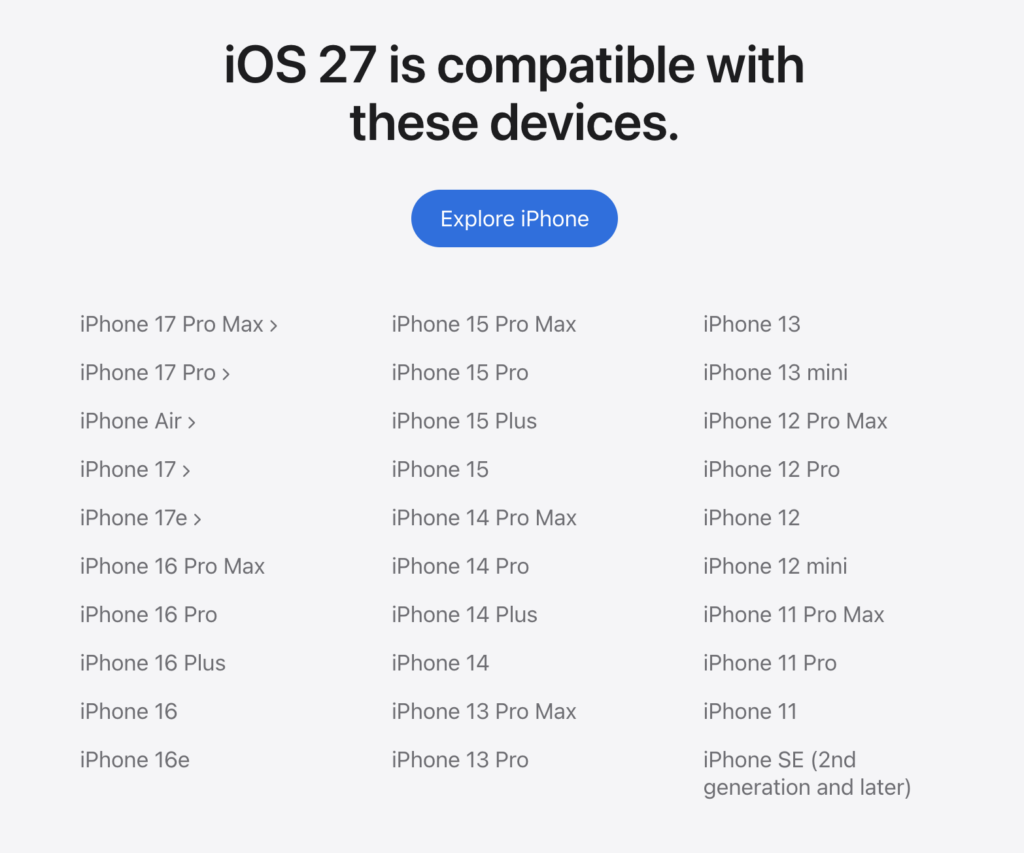
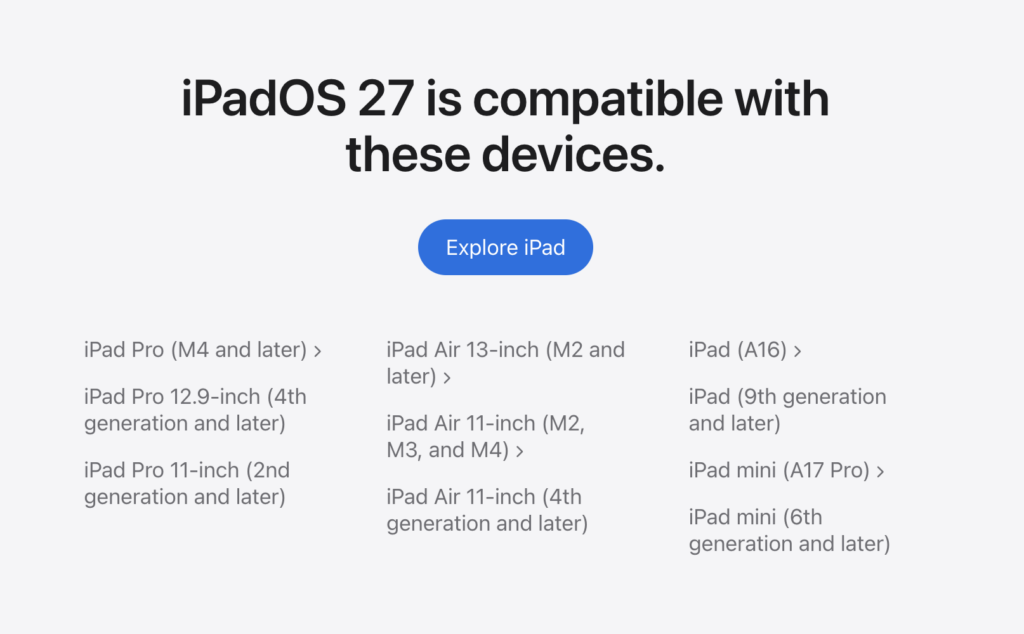
    If you're using older iPhone or iPad hardware and you're hoping to keep running Apple's latest operating systems, this year's releases bring mostly good news. The iOS 27 update will run on all iPhones that can run iOS 26, all the way back to the iPhone 11 and second-generation iPhone SE. The iPadOS 27 update is slightly less generous, dropping support for the 3rd-generation iPad Air, 8th-generation iPad, and 5th-generation iPad mini (all of these devices used an older A12 Bionic chip; supported devices now use an A13 or better).

    Apple says owners of older devices should see performance improvements in iOS 27, thanks in part to an updated CPU scheduler. This scheduler was apparently already included with newer iPhones but has been ported back to older devices with this release.

    Apple's iOS 27 compatibility list. Credit: Apple
    Apple's iPadOS 27 compatibility list. Credit: Apple

    But many of the new features Apple mentioned require support for Apple Intelligence, which remains confined to newer devices with at least 8GB of RAM. Apple Intelligence still requires an iPhone 15 Pro or newer, an iPhone 16 or newer, or an iPhone Air. On the iPad, support requires an iPad Air or iPad Pro with an M1 or newer.

    Read full article

    Comments

    • chevron_right

      Meta alleges NSO violated spyware injunction with new WhatsApp attacks

      news.movim.eu / ArsTechnica • 8 June 2026

    Meta today accused spyware maker NSO Group of violating a court order that barred it from targeting users of WhatsApp.

    "WhatsApp caught and disrupted spear phishing attempts linked to NSO, a spyware firm blacklisted by the US government," WhatsApp owner Meta said in an announcement . Meta said it is asking a court "to hold NSO in contempt for violating a permanent injunction that barred them from ever targeting WhatsApp and its users."

    NSO is an Israeli company that developed the Pegasus spyware. The US government added NSO to the Entity List in 2021, saying it “developed and supplied spyware to foreign governments that used this tool to maliciously target government officials, journalists, businesspeople, activists, academics, and embassy workers.”

    Read full article

    Comments

    • chevron_right

      Artemis II crew flew fast, earned new patch: Astronauts' Mach 39 emblem

      news.movim.eu / ArsTechnica • 8 June 2026

    NASA's Artemis II crew are the fastest people alive, and now they have the patch to prove it.

    Mission Commander Reid Wiseman, pilot Victor Glover, and mission specialists Christina Koch and Jeremy Hansen (the latter with the Canadian Space Agency) spent 10 days in early April flying by the Moon. Their journey took them farther away from Earth than any humans have gone (52,756 miles [406,771 km]) and then, on the way back on board their Orion spacecraft Integrity , they sped up to about 24,664 miles per hour (39,693 k/ph) reentering the atmosphere .

    Only three other people in history have traveled faster. NASA's Apollo 10 astronauts Thomas Stafford, John Young, and Eugene Cernan set the record for the highest speed attained by a crewed vehicle relative to the Earth's surface: 24,791 mph (39,897 kph) on May 26, 1969.

    Read full article

    Comments