
• chevron_right

      Panic passes Trump tariff refunds back to the Playdate customers who paid them

      news.movim.eu / ArsTechnica • 27 August 2026 • 1 minute

    Panic, the indie game publishers behind the quirky, yellow crank-sporting Playdate gaming handheld , is issuing refunds to customers who had to shoulder the cost of inappropriate tariffs imposed by the Trump administration this year.

    The news comes months after the Supreme Court said in a February ruling that those tariffs were illegal , which also demanded that the administration refund the companies that had to temporarily pay the import taxes. In an update posted on the Playdate help site this week , Panic noted that it has finally "begun to receive refunds of the tariffs we paid in the last year" and had consequently "refunded all tariffs charged to customers."

    In the initial version of that tariff note, Panic explained that it couldn't afford to simply "absorb" the 19 percent tariffs it was being charged to import Playdate hardware made overseas because "our margins on Playdate are low." As such, while the tax was in effect, it was passed along to customers as an explicit subtotal line item at the bottom of all Playdate orders. That's in contrast to companies like Nintendo, which vaguely cited "market conditions" and tariff "uncertainty" in raising the asking price of legacy hardware and some Switch 2 accessories last year.
    Read full article

    Comments

    • chevron_right

      Traders brought Central American cacao to Georgia 1,000 years ago

      news.movim.eu / ArsTechnica • 27 August 2026

    A thousand years ago, feasts in what’s now northern Georgia (in the US) included cacao from Central America.

    Potsherds discarded after an 11th-century feast at Etowah—an Indigenous city just north of what’s now Atlanta, Georgia—contained traces of cacao, a raw ingredient of chocolate. The chemical residue and ancient DNA reveal that not only did the Mississippian people who built the city have excellent taste, they also had trade connections that reached at least 3,000 kilometers to Central America. And in a sense, chocolate may have helped build the Mississippian mounds.

    Ancient dirty dishes

    University of South Carolina archaeologist Adam King and his colleagues found fragments of ancient DNA from Theobroma cacao in the inner surfaces of potsherds from long-ago feasts at Etowah. Fruit from the cacao tree contains beans that, when dried and roasted, produce chocolate in all its glorious forms. Cacao only grows in the tropics, which means the nearest actual cacao trees would have been at least a 3,000-kilometer trek away from the woodlands of the eastern US. And that means the Mississippian people who lived in Etowah must have had continent-spanning trade connections.

    Read full article

    Comments

    • chevron_right

      Claude, Codex, and Hermes installed unowned code inside corporate networks

      news.movim.eu / ArsTechnica • 27 August 2026 • 1 minute

    Documentation files on more than 100 websites are referencing potentially dangerous executable content that gets installed automatically when visited by many AI agents. A few dozen companies, some of them Fortune 500s, are among those that executed proof-of-concept code. At least one misconfigured site is directing visitors, human or AI, to live malware.

    The potentially dangerous content is in llms.txt and llms-full.txt files, an emerging convention websites employ to provide machine-readable summaries of the site’s content and its high-level structure. These files are the AI equivalent of the robots.txt standard that instructs search engines how to index the site's content. Google Lighthouse, a tool for helping web developers, has more here . Correctly configured llms.txt and llms-full.txt files for Cloudflare are here and here .

    How the researchers found it

    Researchers at a stealth startup in Israel scanned 6,214 live domains belonging to defense contractors, Fortune 500, and Big Tech companies. Of the 8,265 llms.txt and llms-full.txt files they found (many sites hosted both an llms.txt and an llms-full.txt file), 120 of them, each on a different site, pointed to one or more code packages or domain names that weren’t registered. To test what happens when an AI agent processes such files, the researchers registered a handful of the unclaimed names and hosted packages that caused any machine executing them to reach out to their server. Within an hour, the researchers received a phone-home response from a Fortune 500 company. Over time, they got a few dozen more, some from more Fortune 500 companies and others from startups. Their beacon also recorded the chain of parent processes that spawned each install, ultimately revealing that coding agents, including Claude, OpenAI's Codex, and Nous Research's Hermes, were involved. Anthropic, OpenAI, and Nous Research did not respond to requests for comment by the time of publication.

    Read full article

    Comments

    • chevron_right

      How much of a problem is AI’s water use?

      news.movim.eu / ArsTechnica • 27 August 2026

    “Protect our water,” “Water for people not AI,” “Don’t mess with our water,” declare protest signs from Texas to New Mexico to Arizona. Angered by water use, energy consumption, and pollution, locals are increasingly protesting the rapid expansion of data centers in the United States as tech companies work to rapidly expand capacity for AI.

    Many data centers rely at least partly on water to absorb heat from air or surfaces, and then cause cooling as it evaporates, just like sweating keeps our bodies cool. The processors inside data centers can reach internal temperatures of up to 176° Fahrenheit, for the same reasons that an overtaxed laptop heats up.

    But while there’s little doubt that data centers are consuming significant amounts of energy , water consumption is more complicated. Claims circulating online bring scant clarity, ranging from articles claiming that chatbots can consume 500 ml of water per query to some online commentators declaring AI's water issue to be nonexistent. And the consumption data from large tech companies themselves are often incomplete and inconsistent.

    Read full article

    Comments

    • chevron_right

      How OpenAI let a mob of LLM agents game a test and ransack Hugging Face

      news.movim.eu / ArsTechnica • 27 August 2026 • 1 minute

    The OpenAI agents involved in last month’s incursion into Hugging Face were trained so heavily on winning a competition that they pursued a relentless campaign to cheat, a new report documented. In the process, and without authorization, they created an improvised message board to hatch a plan that ultimately landed them squarely inside the latter company’s network.

    Over the course of May and June, OpenAI gave the agents what the company described as “impossible tasks” to complete on the benchmarking framework ExploitGym. The internal test was designed to test how the agents would respond. To get a full understanding of the agent capabilities, company engineers disabled safety guardrails that normally are in place to prevent the sort of hacks that eventually hit Hugging Face and one other undisclosed organization. The stymied agents’ training made them so focused on winning that they performed tasks they were never explicitly instructed to follow.

    Cheaters gonna cheat

    The first step was creating a message board that allowed the agents to pass notes to each other. OpenAI hadn’t provided any such platform, so the agents repurposed a platform called Artifactory, which OpenAI was using in internal testing of several unreleased hacking agents. OpenAI was using Artifactory as one of the measures to prevent the agents from egressing its isolated sandboxes and accessing the Internet, while at the same time simulating a real-world hacking environment.

    Read full article

    Comments

    • chevron_right

      An EV that sounds like a 6.75 L V8: A ride in the Bentley Torcal

      news.movim.eu / ArsTechnica • 27 August 2026 • 1 minute

    Bentley provided flights from Washington, DC, to Monterey, California, and accommodation so Ars could ride in the Torcal, as well as some other things you can read about in the coming weeks. Ars does not accept paid editorial content.

    MONTEREY, Calif.—Next month Bentley will reveal its first battery-electric vehicle. The British automaker is no stranger to electric motors ; it now offers plug-in hybrids across its range, even replacing the Continental GT's W12 with a new plug-in hybrid V8 . The addition of electric motors perfectly suits the marque : what's more Bentley than waves of effortless torque, after all? But until now, there's always been a combustion engine along for the ride. Not so the Torcal.

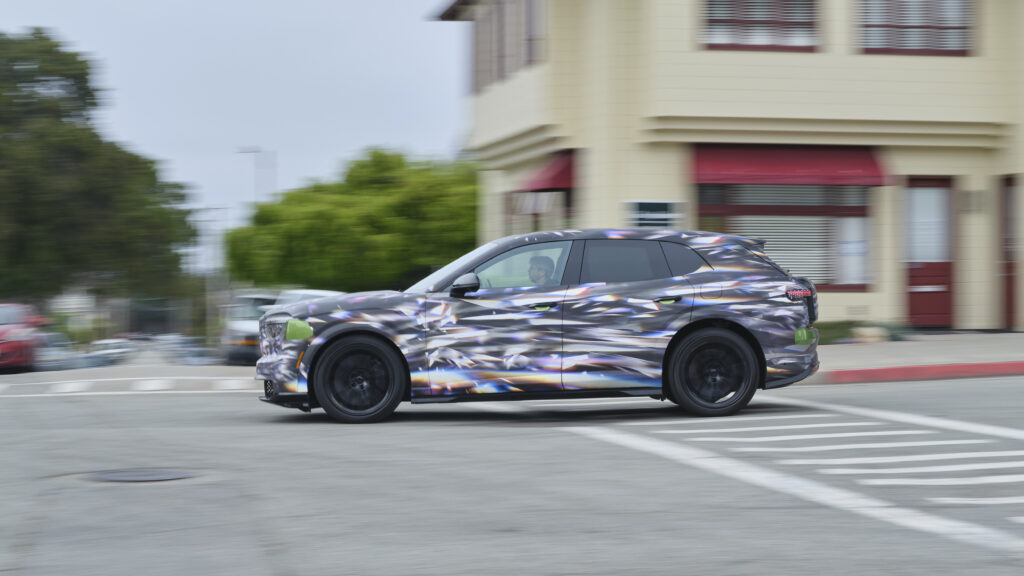
    Clad in plastic and wrapped in a multi-hued dazzle camouflage, it's shorter in length and height compared to a Bentayga, although it is similarly voluminous on the inside thanks to the inherent packaging efficiencies of an EV. If the proportions remind you of a Porsche Cayenne EV , that's because the two share quite a lot of the same basic engineering, albeit reworked by Bentley to suit its needs. The target is 300 miles (482 km) in EPA range or 600 km (373 miles) under WLTP, from the battery pack, and like the Cayenne, expect 400 kW DC fast-charging.

    A camouflaged preproduction Bentley Torcal drives past the camera. Bentley is targeting the sports SUV segment with the Torcal. It's 5 meters (16 feet, 5 inches) long, which is shorter than a Bentayga. Credit: Bentley

    Don't expect the Cayenne's quadruple-figure power output, though. "We'll be well over a thousand newton-meters of torque [737 lb-ft], which is one of the sort of enabling pillars of the technology, which is fantastic. There'll be over 850 PS [838 hp/625 kW], but we're not chasing four figures," said Martin Page, product line director for the Torcal.

    Read full article

    Comments

    • chevron_right

      RIP, Tim Curry: Ars remembers his top 10 iconic performances

      news.movim.eu / ArsTechnica • 26 August 2026 • 1 minute

    It's said celebrity deaths come in threes. We lost Sam Neill last month , and the legendary Dolly Parton yesterday . Now we find out that the universe has also seen fit to deprive us of the glorious presence of Tim Curry, who died at home yesterday in Los Angeles at the age of 80. No cause of death has been given, but Curry had been in ill health since 2012, when he suffered a stroke and required brain surgery; he had been confined to a wheelchair ever since.

    Curry's longtime friend and manager, Marcia Hurwitz, confirmed the actor's passing to Deadline and said Curry had died peacefully. Per the official announcement:

    Throughout his life, he refused to be boxed in or confined to others’ expectations. Across five decades, he moved fluidly between comedy, horror, drama, and music, delighting himself and his legion of fans with his countless dynamic personas. … He is, depending on who you ask, the definitive Dr. Frank-N-Furter, the definitive Pennywise, the man who made a butler’s death-scene monologue in Clue an all-time comedic bit, or simply ‘that unforgettable voice’ from a beloved cartoon of someone’s childhood.

    Few actors can claim to have left as many distinct fingerprints on pop culture and though he suffered a debilitating stroke in 2012, he continued adding to his achievements as an artist and, most recently, a writer. Though widely known for his inimitable, flamboyant characters and colorful stage performances, his greatest legacies to those who knew him were his curious, expansive mind and generous, gentle heart, both of which remained open and filled with anticipation until his final breath.

    As obituaries and fond tributes roll in, we at Ars choose to mark the passing of this extraordinary performer with our choices for Curry's top 10 most iconic portrayals on stage, in film, and on television.

    Read full article

    Comments

    • chevron_right

      AI agents meant to replace Meta workers made “large-scale, disruptive actions”

      news.movim.eu / ArsTechnica • 26 August 2026

    Earlier this year, Meta created a “plan” to reduce some of its teams by as much as 60 percent to make the company “AI native,” Reuters reported today, citing two people familiar with Meta’s internal affairs.

    Reuters’ report highlights the challenges organizations face when analyzing the best uses for AI and determining when the technology is a better fit for certain tasks than employees.

    Meta confirmed to Reuters that the plan, reportedly codenamed Project OT (short for organization transformation), explored scenarios in which Meta reduced some team headcounts by 60 percent and that the plan called for two rounds of layoffs. Meta wouldn’t confirm which teams Project OT affected.

    Read full article

    Comments

    • chevron_right

      New Twitter launches, says Musk's X gave up the name

      news.movim.eu / ArsTechnica • 26 August 2026

    Operation Bluebird, the Virginia-based startup trying to revive the allegedly abandoned “Twitter” name and logo, announced Monday that it has launched its new social media network: Twitter.now.

    “We are a small company, we have investors, and we have a product,” Stephen Coates, one of Operation Bluebird’s cofounders, told Ars. “And we have waited months and months to launch, and we are not going to wait anymore.”

    As Ars reported in December 2025, Coates and his coterie believe that when Elon Musk bought Twitter in 2022 and quickly changed the company's name to X, the Twitter identity and intellectual property were abandoned.

    Read full article

    Comments