
• chevron_right

      Leaked financial docs show OpenAI is losing billions of dollars a year

      news.movim.eu / ArsTechnica • 16 June 2026

    As OpenAI files SEC paperwork ahead of an expected initial public stock offering, newly leaked financial documents show a company with quickly growing revenues that are currently being overwhelmed by even larger expenses.

    The audited financial statements, obtained by independent journalist Ed Zitron , show OpenAI's reported revenue growing from $3.7 billion in 2024 to $13.07 billion in 2025. The Financial Times, which reviewed the same documents , writes that the company's monthly revenues had grown to nearly $2 billion by the end of 2025, suggesting that its ongoing revenue rates continued to grow throughout the year.
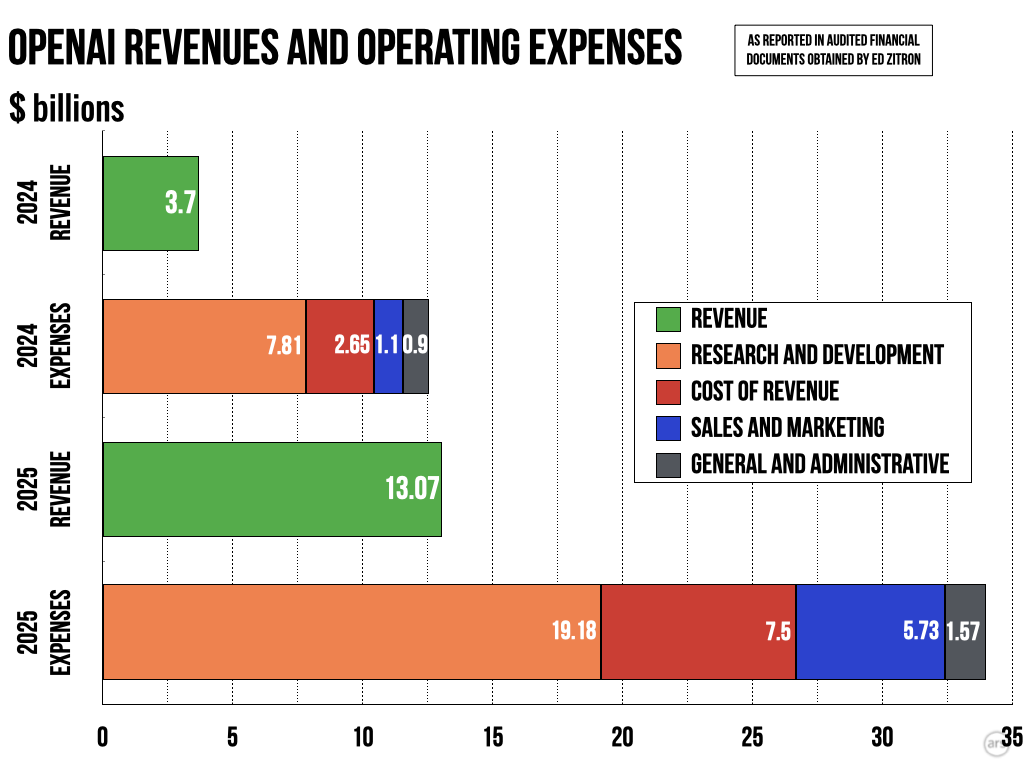
    R&D expenses alone still easily outpace OpenAI's quickly growing revenues. Credit: Ars Technica

    But the company's fast-growing revenues are still dwarfed by its even more significant expenses. OpenAI's total revenues in both of the last two years were outpaced by research and development alone, which grew from a $7.81 billion line item in 2024 to a massive $19.18 billion cost in 2025. Those numbers seem to reflect the significant costs OpenAI incurred in training new models and include $10.59 billion in R&D costs paid to Microsoft alone in 2025.

    Read full article

    Comments

    • chevron_right

      Mobileye is entering the US robotaxi market with standalone service

      news.movim.eu / ArsTechnica • 16 June 2026

    The driving technology company Mobileye plans to launch a robotaxi service in an as-yet-unnamed US city in 2027, it said earlier today. The service will be vertically integrated, using Mobileye's Moovit mobility platform to interact with customers booking rides, coordinate drivers, and so on. The Israeli company, which was bought by Intel in 2017 before going public again in 2022, says it will start with around 100 robotaxis early next year.

    "Mobileye has spent more than two decades building the technologies required for autonomous driving," said Prof. Amnon Shashua, founder and CEO of Mobileye. "Today we are taking the next step: combining those technologies with operational ownership to create a financially and geographically scalable robotaxi business designed from the ground up for global deployment,"

    The company first rose to prominence in the mid-2010s, when Tesla began using Mobileye's advanced driving assistance systems (ADAS) as part of Autopilot. That relationship lasted until 2016, when Mobileye dropped Tesla as a customer after being alarmed that a driver assistance system was being sold to end users as driverless technology. Since then, Mobileye has continued to work with other partners on ADAS and autonomous vehicles.

    Read full article

    Comments

    • chevron_right

      The Ars Technica 2026 Reader Survey: Let your voice be heard!

      news.movim.eu / ArsTechnica • 16 June 2026 • 1 minute

    Greetings, Arsians, and welcome to the great Ars Technica 2026 reader survey ! It has been almost four years since we last ran a big site-wide survey like this, where we ask our readers—you!—what you like about the work we do and what we could perhaps improve on. This kind of check-in is absolutely vital to ensuring we're steering the ship properly, and we take the results very seriously. (The last time we did this, we got several thousand responses, and that's incredibly valuable data for us!)

    You don't have to have been a reader since 1998 to weigh in, either. Whether you're a first-time reader, an old grizzled forum veteran, a front page comment maven, a newbie sysadmin, or a CEO, we want to hear what you have to say, no matter who you are. The only requirement is that you're a human! (Aliens are welcome as well, though we didn't really define any demographic categories for extraterrestrial beings. We'll tackle this issue if it comes up, I suppose.) There are a few text fields. Yes, we will read what you write there!

    To assay, perchance to sing

    Fortunately, this isn't a long survey—just a handful of targeted questions . We're not collecting any personally identifying information, and responses will only be viewed in aggregate. None of the data will be analyzed by anyone except us, and none of it will be sold or otherwise distributed outside of Ars. (We're using SurveyMonkey for our survey platform, the same as we have many times in the past.)

    Read full article

    Comments

    • chevron_right

      Critical Copilot vulnerability allowed hackers to seal 2FA code from users

      news.movim.eu / ArsTechnica • 16 June 2026 • 1 minute

    Last Tuesday, Microsoft patched a vulnerability it rated as max critical in its M365 Copilot AI platform. On Monday, the researchers who discovered the vulnerability and reported it to Microsoft revealed how their proof-of-concept exploit could retrieve 2FA codes and other sensitive data from emails accessible to Copilot.

    Microsoft and other LLM providers have been unable to prevent their products from complying with malicious requests to reveal data. The root cause: AI bots are unable to distinguish between instructions provided by users and those snuck into third-party content the models are summarizing, drafting responses to, or using to perform other actions on behalf of the user. With no way to secure this crucial boundary, Microsoft and its peers are left to erect complicated and ad hoc guardrails designed to rein in the consequences of this incurable gullibility.

    Jumping over guardrails

    One guardrail built into Copilot and most other LLMs prevents them from submitting web forms, sending emails, and taking similar actions that can be used to exfiltrate data from the user. To work around this, LLM hackers turned to markup language, which, among other things, allows users to add formatting elements such as headings, lists, and links to text without the need for HTML tags. Another workaround is to wrap sensitive data inside HTML tags such as <img> and <form>. In either case, a web request showing the data hits the attacker’s web server, where the secret information is captured in logs.

    Read full article

    Comments

    • chevron_right

      Commodore’s newest gadget is a flip phone that blocks social media and browsers

      news.movim.eu / ArsTechnica • 16 June 2026

    The next gadget to bear the storied Commodore branding will be a flip phone.

    The name behind the bestselling desktop PC in history came back about a year ago. Christian “Peri Fractic” Simpson, best known for running the Retro Recipes (now known as Retro Recipes x Commodore ) YouTube channel, acquired the Commodore Corporation and "100 percent of the original and official trademarks that defined the Commodore name since 1983,” per a July 2025 press release. Simpson said the price was “in the low seven figures.” Since the acquisition, the brand released the Commodore 64 Ultimate and the Commodore 64X PC , a mini PC housed in a chassis that resembles the Commodore 64.

    Today, the new Commodore announced a new device in a dated design: a flip phone.

    Read full article

    Comments

    • chevron_right

      Key mission for Europe's commercial space enterprise scrubbed again

      news.movim.eu / ArsTechnica • 15 June 2026

    Isar Aerospace still commands top position among a new generation of European rocket startups, but the company's efforts to launch a critical test flight of its Spectrum rocket continue to encounter roadblocks.

    The latest delay came Monday, when Isar scrubbed a launch attempt after "detecting off nominal behavior in the vehicle's fluid systems," according to a social media post. "The teams are analyzing the new data to isolate the root cause."

    The two-stage, 92-foot-tall (28-meter) Spectrum rocket was awaiting liftoff from Andøya Spaceport in northern Norway. It was the fourth time in five months that Isar Aerospace, headquartered near Munich, Germany, had reached a target launch date for the second test flight of the Spectrum launch vehicle.

    Read full article

    Comments

    • chevron_right

      COVID vaccines still protect against heart problems, large study finds

      news.movim.eu / ArsTechnica • 15 June 2026

    Although most Americans have eschewed seasonal COVID-19 vaccines, the updated shots continue to show significant protection against cardiovascular disease, especially for those over age 75 and those with underlying medical conditions. That's according to a new study that pulled data from more than 1 million patients in a US Department of Veterans Affairs (VA) health system.

    The finding builds on previous data showing that the vaccines significantly lower the risk of COVID-19-associated cardiovascular risks, particularly heart attacks and strokes. But it wasn't a given that the benefit would hold up over time—as the virus evolved, the vaccines were updated, population-level immunity increased from previous infection and vaccination, and risk of severe outcomes fell.

    The new study, published in JAMA Internal Medicine, found that the 2024–2025 COVID-19 vaccine continued to protect against COVID-19-associated "major adverse cardiovascular events" (MACE), which include cardiovascular death, heart attack, stroke, and hospitalization for heart failure.

    Read full article

    Comments

    • chevron_right

      UK to ban social media for kids under 16, may impose overnight curfews

      news.movim.eu / ArsTechnica • 15 June 2026

    The UK government announced today that it will ban social media for all kids under the age of 16 in rules expected to take effect in spring 2027. The ban will apply to platforms including Snapchat, TikTok, YouTube, Instagram, Facebook, and X.

    "We’re going further than any country in the world by banning social media for under-16s and putting wider protections in place to give kids their childhood back," Prime Minister Keir Starmer said in the announcement.

    In addition to the ban on social media, Starmer's government said it will impose "world-leading blocks on harmful functions such as livestreaming and stranger communication with children for under-16s... Restrictions on these functionalities will also be on by default for 16- and 17-year-olds to prevent a cliff-edge at 16." The livestreaming and stranger-contact rules would apply to a range of services, such as online gaming.

    Read full article

    Comments

    • chevron_right

      Chipmaker Nvidia seeks to raise over $25B in first bond deal since 2021

      news.movim.eu / ArsTechnica • 15 June 2026

    Chipmaker Nvidia is planning to sell $25 billion of investment-grade debt in the US on Monday, its first bond sale in five years, in a test of investor appetite for further exposure to the AI sector.

    In a marquee seven-part bond offering, the company will issue a wide range of maturities from two years to 30 years, according to a term sheet seen by the FT.

    The issuance was upsized from $20 billion after receiving more than $85 billion in orders by early afternoon in New York, according to people familiar with the deal.

    Read full article

    Comments