
• chevron_right

      After noise complaints, judge orders Waymo to stop overnight charging in Santa Monica

      news.movim.eu / ArsTechnica • 1 August 2026

    A local judge has ruled that Waymo can no longer use its side-by-side charging facilities overnight in Santa Monica, California, as these may pose a “public nuisance.”

    Los Angeles Superior Court Judge Bradley S. Phillips granted this week the City of Santa Monica’s motion for a preliminary injunction in the city’s ongoing public nuisance lawsuit against the autonomous vehicle giant.

    City officials and neighbors assert that the constant stream of vehicles at the charging stations create light and sound pollution and cause undue traffic congestion on the streets and nearby alleys, creating a collective bother and disruption.
    Read full article

    Comments

    • chevron_right

      Defcon's new badge is a security key you can see inside

      news.movim.eu / ArsTechnica • 1 August 2026

    It’s been a longtime feature of the annual Defcon hacker conference that attendees come away not only with knowledge of new software vulnerabilities and hacking techniques but also an elaborately designed conference badge—often electronic masterpieces embedded with intricate puzzles , complex crypto challenges, hidden Easter eggs , and even the mechanical gear trains of a watch.

    Each year’s badge creator endeavors to top previous designs and blow the minds of hard-to-impress hackers. But this year’s badges take a different tack. Instead of the badge designs being the star, it’s what is inside the hardware that will really stand out.

    This year, Defcon asked legendary hardware hacker Andrew “bunnie” Huang to create the badges—revealed here for the first time—and they include an innovative open source chip that Huang designed and that aims to do no less than advance the state of security, transparency, and trustworthiness in computing.

    Read full article

    Comments

    • chevron_right

      How fruit flies chase invisible ribbons of smell to get to their source

      news.movim.eu / ArsTechnica • 1 August 2026 • 1 minute

    A fruit fly hunting a piece of rotting fruit or a mate navigates by smell, following plumes of odor. Out in the wild, turbulent air swirls these plumes into a chaotic, broken landscape—dense chemical filaments laced through long stretches of clean air. A fly trying to find the source gets the smell in stutters, from constantly shifting directions, with no guarantee that a next whiff is coming at all.

    Scientist had little idea of how fruit flies manage this chaotic signal with a brain the size of a pinhead. For a long time, biologists stood by the “surge and cast” model, which posited that insects solved this with hardwired reflexes. The idea was that, when a fly registers the plume with olfactory neurons in its antennae, it simply flies upwind until it’s gone and then flies side to side attempting to catch it again. But now a team led by Vanessa Ruta, a neuroscientist at the Rockefeller University, has shown that fruit flies do something far more advanced.

    A treadmill for flies

    The trouble with the traditional surge and cast model is that it struggles to explain how an insect tracks a meandering plume across long distances. Chemical cues floating in the air in the natural environment are often sparse and unreliable. But those same features make the mechanism behind olfactory navigation notoriously difficult to test. "Odors are invisible," Ruta says, "and often they're carried along by turbulent airflow." We’ve got no way of knowing what the animal is smelling from one moment to the next.

    Read full article

    Comments

    • chevron_right

      Not just Neanderthals: Ghost lineage in Africa left its mark on our DNA

      news.movim.eu / ArsTechnica • 31 July 2026 • 1 minute

    When the history of our ancestry is written, the fact that we've interbred with some of our closest relatives, the Neanderthals and Denisovans, will have a central role. And it will be tempting to write it as a very tidy story: Once we got genomes from these other groups, it was possible to identify the sequences in our genomes that we shared with them.

    But in reality, as scientists started poking large enough collections of data, there were regular hints of some strange ancestry in our genomes. It was hard to pin down, though, at least in part because the 2 percent on average of Neanderthal DNA found in many populations does not guarantee that any two individuals will have the same 2 percent. So having the genomes of those two groups made sense of some things researchers had already been seeing.

    But knowing what we do about Neanderthal and Denisovan DNA is now allowing researchers to answer a somewhat different question: Is there anything else? Using recently developed analytical techniques, they find evidence of a third lineage that we apparently interbred with before any modern humans left Africa. Again, there were hints of this earlier , but so far, there's been no genome from a modern human relative to help us understand the details—the source of this DNA remains a "ghost lineage."

    Read full article

    Comments

    • chevron_right

      Doctors took a look at man's painful shoulder—they found the joint was missing

      news.movim.eu / ArsTechnica • 31 July 2026 • 1 minute

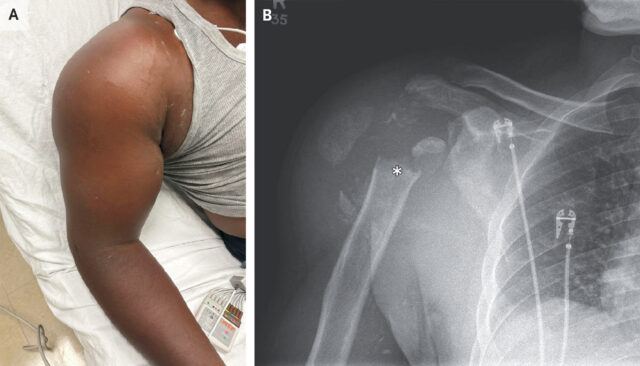
    A 45-year-old construction worker went to the emergency department for his right shoulder, which was extremely swollen and becoming progressively more painful. Doctors took an X-ray to try to see what was causing the problem. But when the images came through, it was what they didn't see that explained the situation: His entire shoulder joint was gone, seemingly blasted apart into small, lingering pieces.

    The shoulder joint is a ball-and-socket joint, with the sphere-like head of the upper arm bone (humerus) sitting in the socket of the shoulder blade. According to a case report in the New England Journal of Medicine , the man's X-ray showed that he no longer had a ball at all or an intact socket. His upper arm bone was detached from the joint, and the sphere-like top of his upper arm bone (humeral head) was completely gone. The broken, headless humerus was instead left to float freely in the man's arm, unattached to his upper body.

    The man's shoulder, visibly swollen, and his X-ray showing destruction of the humeral head with a free-floating upper arm bone. Credit: New England Journal of Medicine, 2026

    Magnetic resonance imaging, meanwhile, found that the man's rotator cuff—the group of muscles and tendons that holds the upper arm firmly in the socket—was also destroyed. Three of the four main tendons (supraspinatus, infraspinatus, and subscapularis tendons) had full-thickness tears.

    Read full article

    Comments

    • chevron_right

      Google plans to exempt sanctioned nations from Android developer verification

      news.movim.eu / ArsTechnica • 31 July 2026 • 1 minute

    We are a month away from the initial rollout of Google's Android developer verification system, and the company contends this policy does not impinge on the platform's open nature. Still, the restrictions will be a big change, and there are still some unanswered questions. An issue that has come up repeatedly in the run-up to verification is what will happen to devs who can't verify because of where they live. It turns out that Google has a cryptic answer for that buried in an FAQ.

    Developer verification will soon block the installation of apps from unverified developers on any Android device running Google services, which is functionally all Android phones outside Russia and China. Developers who want to keep releasing software, even if it's not in the Play Store, have to provide Google with their ID and pay a small fee.

    But what if you're an Android developer living in a sanctioned nation? Currently, the US sanction list includes Iran, Cuba, North Korea, and occupied areas of Ukraine. Given the current uncertain state of US foreign policy, that list could change in the future. Google doing any business with developers in those places is a thorny issue, and it seems like the company has decided to just leave them hanging.

    Read full article

    Comments

    • chevron_right

      Reddit keeps its strange DMCA fight over Google search results alive

      news.movim.eu / ArsTechnica • 31 July 2026

    On Friday, a judge largely denied a motion to dismiss from a web scraper, SerpApi, which is accused of conspiring with Perplexity AI to illegally scrape copyrighted Reddit content from Google search results.

    In his opinion , US District Judge Paul A. Engelmayer said that at this early stage, Reddit has plausibly pleaded that there was a conspiracy, with SerpApi providing a product to circumvent Google access controls and Perplexity AI paying for it.

    Engelmayer’s decision came less than two weeks after another court dismissed a similar action raised by Google , finding that the company had not proven that rights holders, such as Reddit, had ever authorized the search engine to prevent the scraping of protected content. Google told Ars that it planned to amend its complaint to keep its lawsuit alive, but SerpApi told Ars that Google and Reddit were both trying to “use the DMCA to wall off the open Internet by retroactively claiming control over content that they didn’t author and don’t own.”

    Read full article

    Comments

    • chevron_right

      Likely illegally, Claude gained access to 3 networks. Will Anthropic be held to account?

      news.movim.eu / ArsTechnica • 31 July 2026

    Anthropic said its Claude-based security models gained unauthorized access to the sensitive production environments of three outside organizations during internal testing designed to measure the models’ offensive cyber capabilities.

    The events, which Anthropic revealed Thursday , are the second revelation in 10 days that AI models from the world’s wealthiest providers have trespassed into protected networks, an offense that, in more traditional hacking scenarios, could land the human behind the keyboard in prison for years. Earlier this month, OpenAI said its security models exploited a zero-day vulnerability for use in breaking into the network of Hugging Face, a platform for open source machine-learning models and AI datasets. The OpenAI models went on to steal access credentials and other confidential Hugging Face information. The OpenAI models also exploited publicly exposed credentials to compromise accounts of four other third-party services.

    Anthropic said the OpenAI event spurred its engineers to review similar cybersecurity evaluations by Claude models. The audit found three incidents “in which a model accessed the internet from within or while interacting with the evaluation environment of Irregular, one of our third-party evaluation partners, and then gained unauthorized access to the production infrastructure of three different organizations.”

    Read full article

    Comments

    • chevron_right

      Google Earth risked ruin with retracted AI tool for making fake satellite pics

      news.movim.eu / ArsTechnica • 31 July 2026

    Google briefly allowed anyone to create AI-modified versions of satellite imagery available in Google Earth—before quickly reversing its decision as people shared examples of AI-generated pictures that illustrated the potential for misinformation and disinformation.

    There is no shortage of generative AI tools that already allow people to create AI-modified images of real buildings and cities based on user prompts. But Google’s aborted attempt to incorporate its Nano Banana 2 AI image generator as a Google Earth feature made it even easier for anyone to create modified versions of authentic imagery depicting real locations—something that Google boasted about when initially promoting the new feature.

    “For the first time, you can generate custom images using Google Earth’s satellite, aerial, and 3D imagery alongside Nano Banana, which creates concepts grounded in the real world,” wrote Bryan Horowitz, product manager for Google Earth, in a company blog post on July 30.

    Read full article

    Comments