• chevron_right

      Dino 0.2 Release

      pubsub.movim.eu / Dino • 12 November 2020 • 3 minutes

    Dino is a secure and open-source messaging application. It uses the XMPP (Jabber) protocol for decentralized communication. We aim to provide an intuitive, clean and modern user interface.

    The 0.2 release adds message correction, improves the file upload functionality and provides more information about message encryption. Besides other smaller changes it also fixes a number of bugs.

    Message correction

    message_correction.png

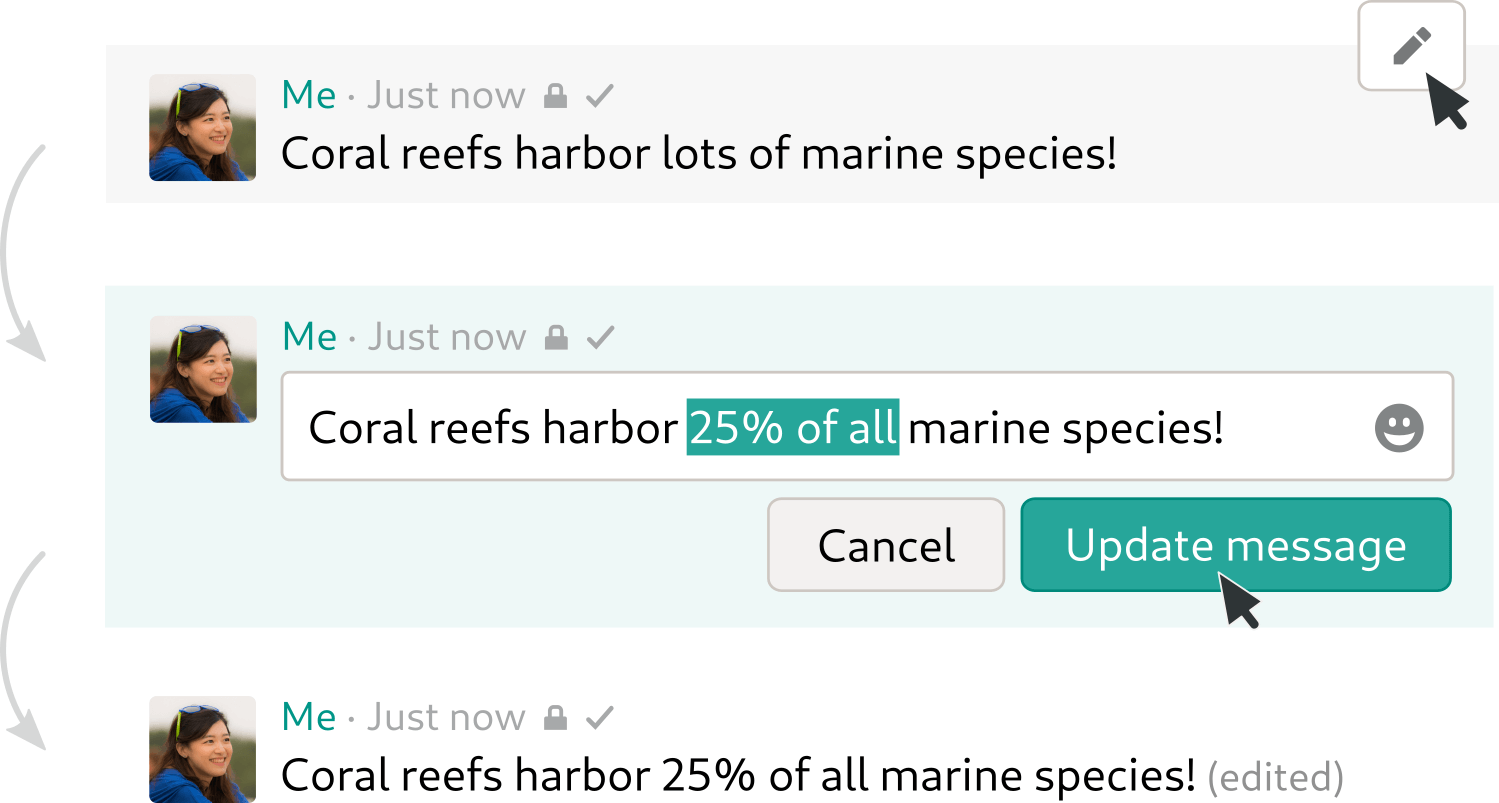
    It is now possible to correct the last message you sent. You can access the function by hovering the message that you want to correct and then click the edit button that appears. If you’re a fan of shortcuts, you can also press the UP key. Last message correction has been the most frequently requested feature addition so far. We are happy about how it turned out and hope you are, too!

    File sharing

    file_upload2.png

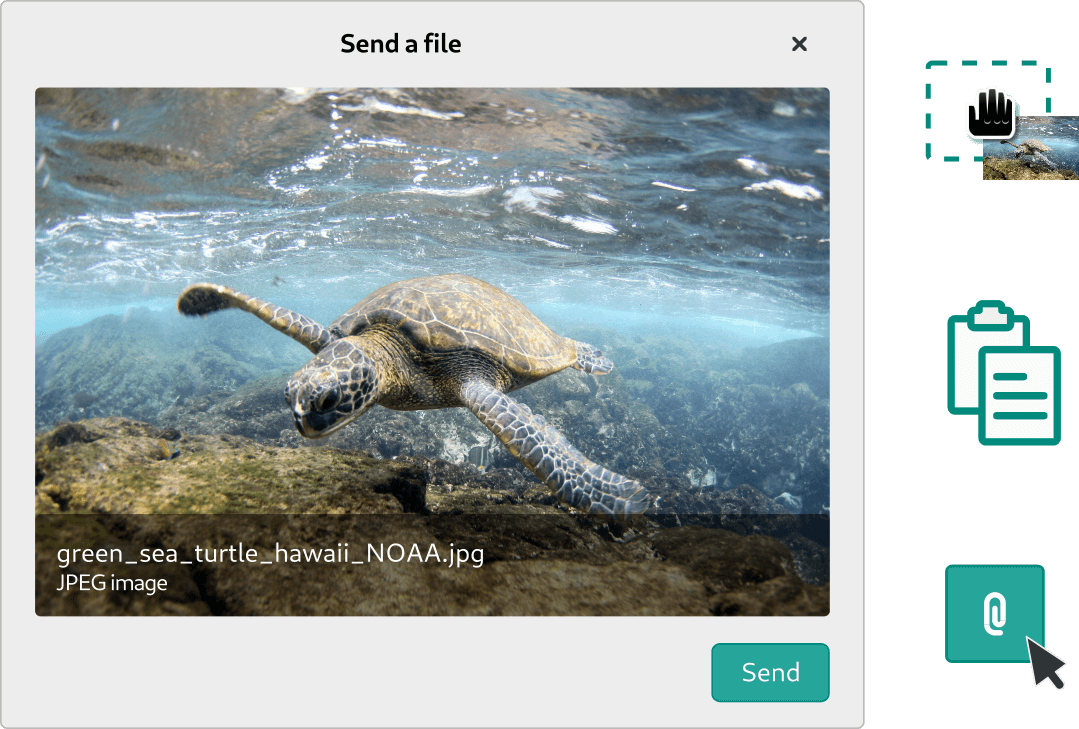
    You can now send files via drag and drop! Furthermore, you can now send Images by pasting them from your clipboard. As before, there is also still the option to press the “Send a File”-button.

    Especially with those new ways of sending a file it is important to know that you are sending the right file to the right person. That’s why Dino now presents a confirmation dialog with a file preview and some file details.

    Encryption

    encryption2.png

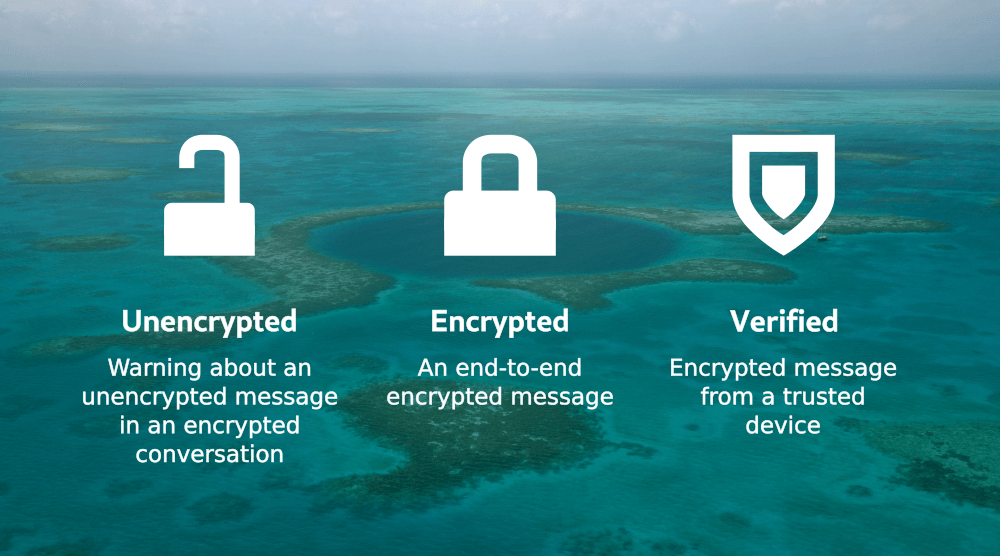
    It has already been possible to accept, verify or reject OMEMO keys. Now you can see the relevant information alongside each message: A small lock or seal symbol above a message indicates whether the message was encrypted by an accepted or a verified device, respectively. A red, open lock warns you in case your contact sends unencrypted messages in an encrypted conversation.

    Unread, pending and more…

    unread_count.svg

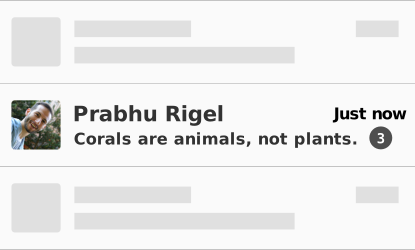
    Dino now displays the number of unread messages in the conversation list. The color of the circle tells you whether the new messages triggered a notification (e.g. direct messages, mentions in channels).

    Furthermore, Dino lets you know in case your message has not been sent yet by displaying “pending…” alongside the message.

    In moderated channels, Dino will inform you if you don’t have the permission to write messages and offer the possibility to request that permission from a moderator.

    Coral Reefs

    Coral reefs are diverse and important ecosystems. Climate change and local human influences endanger coral reefs around the world. We named this Dino release “Mexican Caribbean Coral Reefs” to help spread the word about what needs to be done to preserve these unique ecosystems.

    While coral reefs only occupy 0.1% of the ocean area, they are home to 25% of all marine species. Those reefs are made up of the calcium carbonate skeletons of corals. Corals grow very slowly and thus reefs require thousands of years to form. Many tropical corals live in symbiosis with tiny algae, which provide the corals with nutrients in exchange for shelter.

    Climate change harms corals in two ways: First, it raises the ocean temperatures. Corals lose their algae in high water temperatures, which is called “bleaching”. Without the algae the corals starve. Secondly, the ocean absorbs parts of the increasing carbon dioxide amounts from the atmosphere. In water, CO₂ reacts to carbonic acid, which dissolves coral skeletons.

    Many coral reefs are located in the shallow water near coasts and are thus highly affected by local human activities: Sediments and nutrients are washed into the ocean and deprive the corals of light; Overfishing can negatively affect the whole ecosystem; Destructive fishing using poisons or explosives harms the corals.

    For example, the coral cover in the Mexican Caribbean Coral Reefs decreased by 60% between 1980 and 2016. This was caused by mass bleaching events due to increased water temperature, hurricane impacts, and an increased amount of sediment due to deforestation [ 1 ].

    Various programs aim to protect individual coral reefs from local dangers. However, the ecosystem coral reef can only be preserved by also eliminating the global threat: Climate change. According to multiple studies, coral reefs only have a chance of survival if the global temperature increase is limited to 1.5°C [ 2 , 3 ]. Your actions have an impact.

    • chevron_right

      Setting out for calls and conferences

      pubsub.movim.eu / Dino • 11 August 2020

    Video calls have become a widely used means of communication in personal and in business settings. Especially during the last months, people increasingly used video calls to keep in touch. Unfortunately, many turn to US-based, centralized and closed-source solutions that come with privacy and security issues.

    Screen showing dinosaurs in a video conference

    We are now starting to implement decentralized calls and conferences in Dino. As with the rest of the UI, we aim for a nice and simple user experience. The call features are planed to be implemented and published step-by-step over the next 12 months. Support for encrypted two-party calls that are compatible with Conversations should be ready by the end of this year or early next year. For conference calls, we are also looking into compatibility with the popular video-conferencing solution Jitsi Meet, that is also based on the XMPP protocol.

    This work is made possible through contributions from the NGI0 PET Fund. The fund is managed by NLnet and dedicated to Privacy and Trust Enhancing technologies. It was established with financial support from the European Commission’s Next Generation Internet programme.

    Logos of NGI0 PET, NLnet and European Commission
    • chevron_right

      Dino 0.1 Release

      pubsub.movim.eu / Dino • 29 January 2020 • 3 minutes

    We are thrilled to announce the first release of Dino: Version 0.1. This marks an important milestone of the development process that started three years ago and already combined work of 30 contributors, including 4 summer of code students and multiple development sprints.

    Dino is a secure and open-source application for decentralized messaging. It uses the XMPP (“Jabber”) protocol and is interoperable with other XMPP clients and servers. We aim to provide an intuitive, clean and modern user interface.

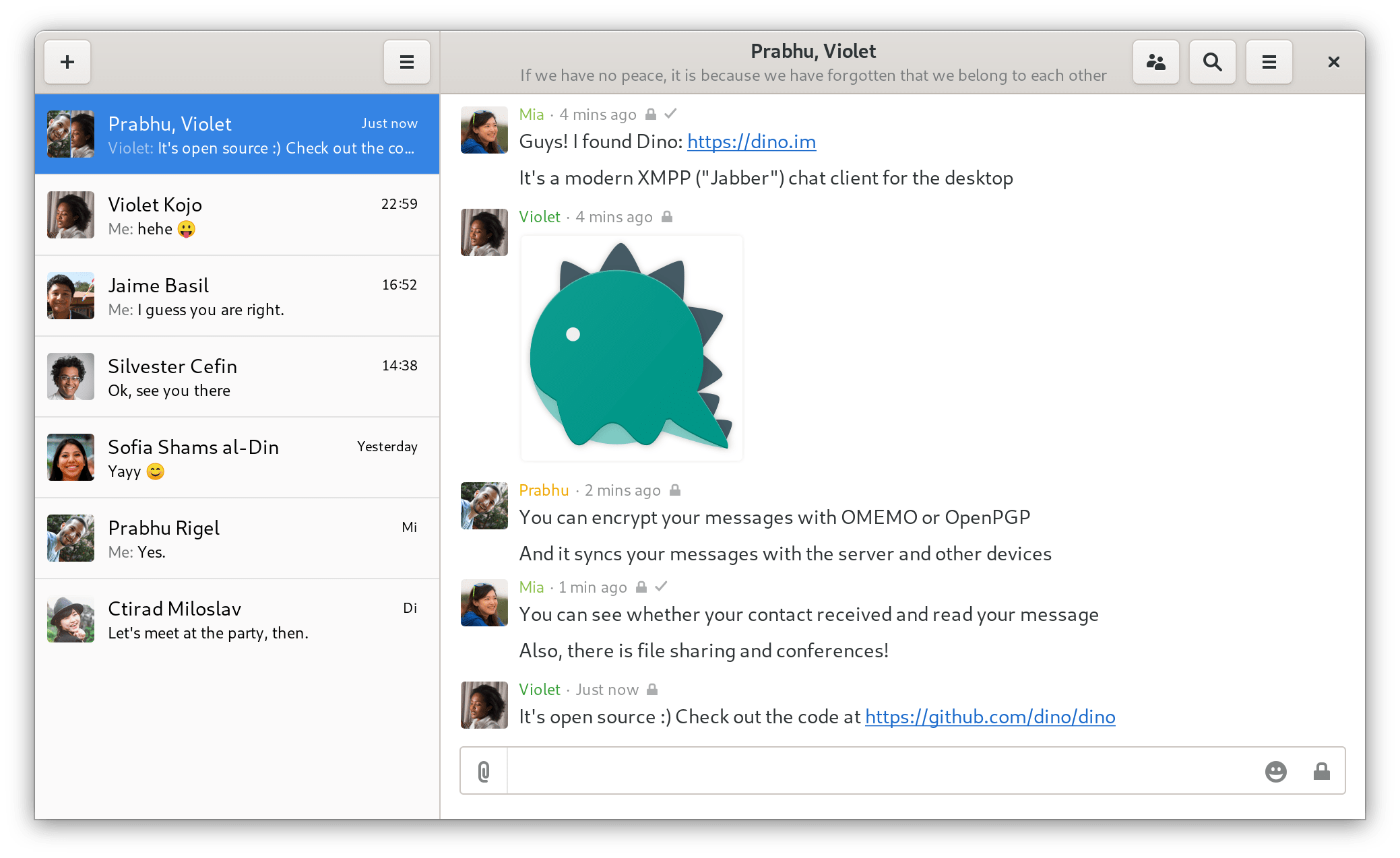
    Dino's Main Window

    Motivation: Why Dino?

    Chat applications like WhatsApp and Facebook Messenger are easy to use and thus were adopted by billions of people. However, they are closed-source and the companies behind them are frequently criticized for misuse of private data. Multiple messaging apps grew around the idea of providing a privacy-friendly alternative, for example Signal and Wire. While they provide encryption and release source-code, their users still have to rely on a centralized service and trust a single company.

    XMPP is an open protocol for federated communication. There are lots of public servers that communicate with each other and anyone can host their own server. This makes it a great basis to write a privacy-friendly and decentralized messenger on. A number of clients already exist for the XMPP protocol, however Dino sets a different focus. Existing clients target tech-savvy power users. The XMPP ecosystem lacks a client that is enjoyable to use while providing the features people expect from a modern chat application. Dino fills that gap by aiming to be secure and privacy-friendly while at the same time providing a great user experience.

    Features

    At first glance, Dino’s user interface is similar to what you might be used to from other popular messengers. On the left side your opened conversations are listed, ordered such that the latest messages are always on top. You can open new conversations or join channels with the ‘+’ menu.

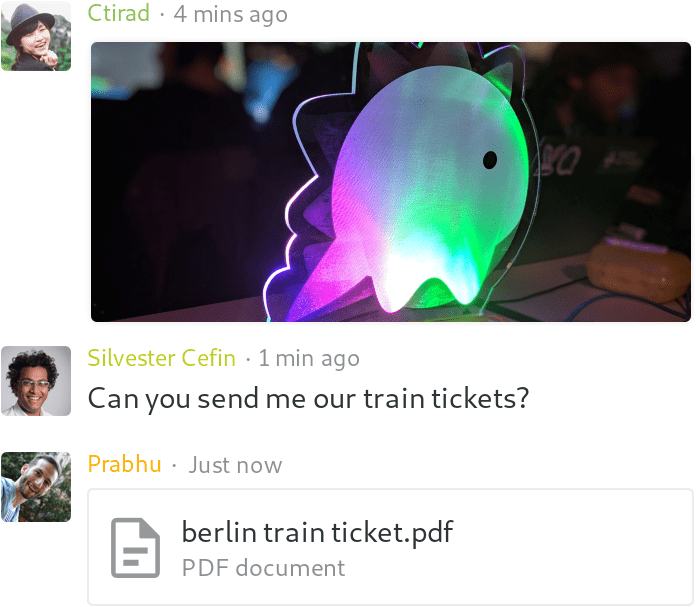
    Conversation with inline images and a file in Dino

    Messaging and more

    You can send messages to individuals as well as to private group chats and public channels. Dino can be used together with other clients simultaneously, allowing you continue the same conversation on your mobile phone as well as on your desktop. Messages you sent and received while Dino was offline are synchronized on start up.

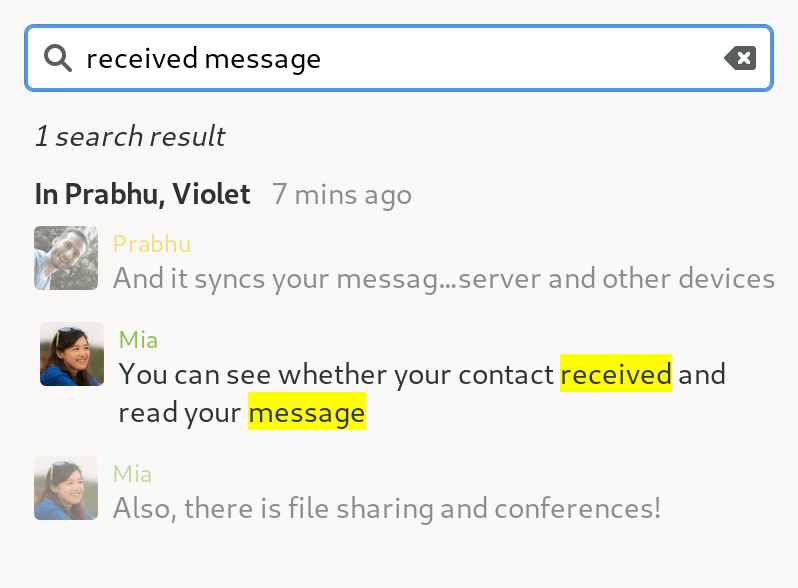
    Dino's message search with highlighted results

    Message search

    Dino supports sharing images and other files. It can transfer files via your server or directly to your contact, peer-to-peer and without size limitations.

    An advanced message search allows you to search and filter your message history - globally or within one conversation. After looking through the results, you can jump to a message to read more of the context.

    You can use multiple accounts in the same interface, allowing you for example to conveniently separate your work and private identities.

    Security and Privacy

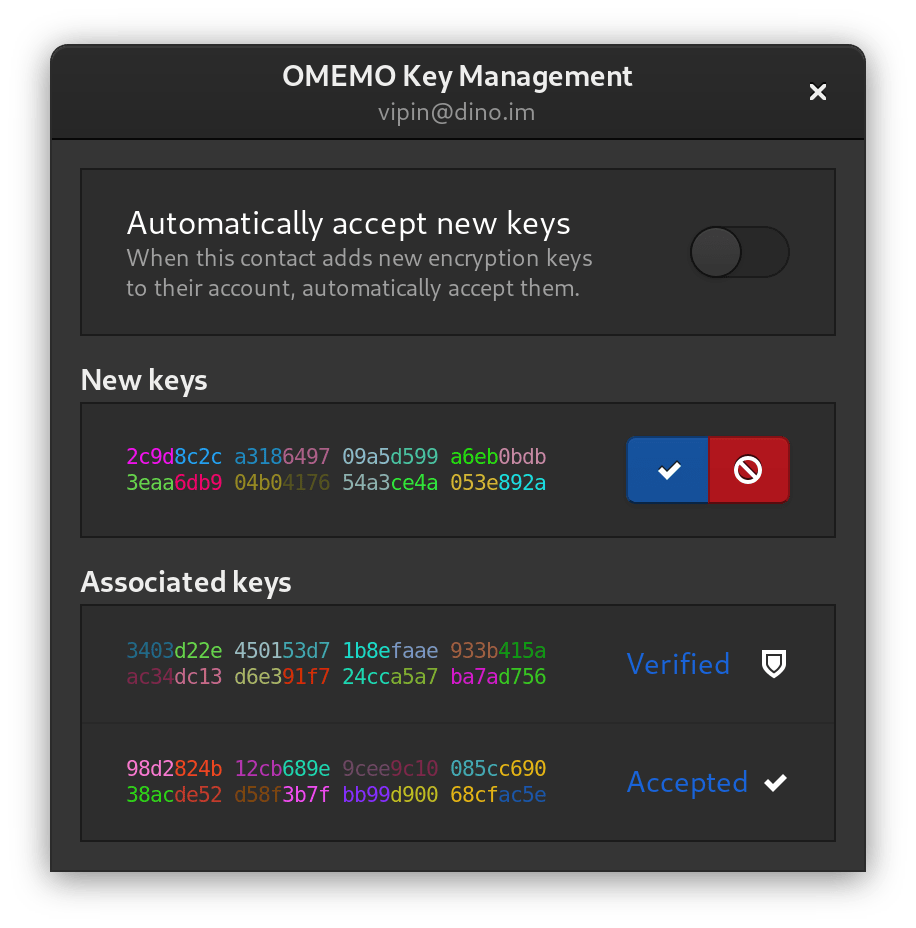
    Dino's OMEMO Key Management Dialog

    Security has been a focus for Dino development since the beginning. That’s why we support two end-to-end-encryption methods out of the box: The well-known encryption standard OpenPGP allows you to extend your Web-of-Trust from e-Mail to XMPP. The OMEMO double-ratchet encryption provides you with a modern encryption scheme with individual device trust that is widely used in the XMPP network.

    We take your privacy seriously in every detail. For example you can keep Dino from informing the sender when you read a message, so they won’t see a double-tick on their messages. Dino allows you to configure all of its privacy features per contact: You can keep your best friends up-to-date while not sharing anything with strangers.

    Fast and well integrated

    Dino does not include a full browser stack with its large resource usage and potential of security issues. Instead it is a native desktop application meaning it is small and has a light footprint. Dino integrates nicely with the rest of your desktop applications and services.

    Get Started

    Once you created an XMPP account, you can contact people across the globally connected XMPP network. XMPP addresses are of the form user@example.com . You can sign in with an existing account or create a new one!